
ChatGPT for Teens Changes the AI Literacy Conversation: What Parents, Educators and Youth Organizations Need to Understand Now
OpenAI’s new teen experience brings stronger safeguards, learning-focused features and parental controls to younger users. But safer technology alone cannot teach verification, privacy, critical thinking or responsible use. The rollout raises a larger question for families, educators and youth-serving organizations: Who is preparing young people to use AI well?
Founder & CEO, SoftScale AI | CPD-Certified AI Consultant | AI Literacy & Workforce Readiness Strategist

Main Topics: ChatGPT for Teens · Youth AI Literacy · Teen AI Safety · Responsible AI · AI in Education · Parental Controls · Critical Thinking · AI Misinformation · Youth-Serving Organizations
Quick Answer: What Is ChatGPT for Teens?
ChatGPT for Teens is OpenAI’s age-appropriate ChatGPT experience for eligible teen users. OpenAI began rolling it out globally on August 18, 2026, across both Free and paid personal ChatGPT plans.
The teen experience includes stronger age-appropriate safeguards, learning-focused tools, healthy-use features and optional parental controls. Availability is still expanding, so an eligible teen may not yet see every feature in every region.
That is good news.
But it does not mean the youth AI-literacy challenge has been solved.
A safer product can provide guardrails.
It cannot automatically teach a young person how to question information, recognize when an AI answer may be wrong, protect personal information, preserve independent thinking or decide when AI simply should not be used.
That is where AI literacy begins.
The larger takeaway is simple:
A safer AI product is not the same thing as an AI-literate young person.

Why Does ChatGPT for Teens Matter?
Artificial intelligence has already entered young people’s lives.
We are no longer talking about what childhood, school or adolescence might look like someday.
It is happening now.
Young people are using AI to research, brainstorm, summarize, study, write, create, explore careers and ask questions.
Some are using it thoughtfully.
Some are allowing it to do work they should still be doing themselves.
Some understand that AI can make mistakes.
Others may not yet recognize how convincing an incorrect answer can sound.
And many of the adults responsible for helping young people navigate these tools are still learning about AI themselves.
That is why OpenAI’s introduction of ChatGPT for Teens deserves attention beyond the technology industry.
OpenAI describes the teen experience as being designed to support learning, critical thinking and deeper understanding while providing stronger age-appropriate safeguards.
That is an encouraging development.
But where do we go from here?
We do not need every parent, teacher or youth-program leader to become an AI expert.
We do need enough understanding around young people that they are not left to figure all of this out on their own.
That is a very different goal.
What Is ChatGPT for Teens and How Is It Different?
ChatGPT for Teens is not a completely separate chatbot.
It is the broader ChatGPT experience with additional safeguards, features and settings designed around teenage users.
OpenAI says an eligible account can automatically move into the teen experience when account-provided age information, verified age or its age-prediction system indicates that the user is under 18.
The experience brings together features intended to support learning rather than simply answer generation.
These include Study Mode, responsible-homework reminders, quizzes where available, learning visualizations, Study Hours and additional age-appropriate protections.
That learning approach is worth paying attention to.
Consider the difference between:
“Give me the answer.”
and:
“I understand the first two steps, but I get confused after that. Help me understand what I am missing without giving me the final answer.”
Both students are using AI.
But the second student is still doing something essential:
thinking.
That distinction matters.
The goal should not be teaching young people that AI is an answer machine.
A much healthier lesson is:
AI can help you work through a problem without doing all of the thinking for you.
Is ChatGPT for Teens Free?
There is no separate premium subscription families have to purchase just to receive the teen experience.
OpenAI says ChatGPT for Teens is rolling out to eligible teen accounts on both Free and paid personal ChatGPT plans.
That accessibility matters.
Responsible AI education should not depend entirely on whether a family can afford another monthly technology subscription.
There is also an important distinction between a teen account and a parent’s paid account.
Parents and teens can choose to link their separate ChatGPT accounts through parental controls. Linking the accounts allows the parent or guardian to manage selected settings, schedules and certain safety features.
It does not automatically give the teen the same paid subscription tier as the parent.
And it does not give the parent access to the teen’s conversations.
Is ChatGPT for Teens Available Everywhere Yet?
The rollout is underway, but we should be precise about what “available” means.
OpenAI says ChatGPT for Teens began rolling out globally on August 18 and will continue expanding availability over the coming weeks.
It also notes that features may vary by region.
So here in Ohio—and anywhere else in the United States—the responsible message is:
ChatGPT for Teens is rolling out now, but every eligible teen account may not yet have every teen-specific feature.
Why does that distinction matter?
Because technology changes quickly.
Organizations should be careful about creating an entire youth AI program around one feature, one interface or one platform.
The stronger approach is to teach skills that remain useful even when the technology changes.
Verification.
Privacy.
Questioning.
Critical thinking.
Judgment.
Those skills travel.
How Many Teens Are Already Using AI?
ChatGPT for Teens did not create teen AI use.
It is responding to something that was already happening.
A February 2026 Pew Research Center report, based on a nationally representative survey of 1,458 U.S. teens ages 13–17 and their parents, found that 64% of teens reported using AI chatbots.
More than half said they had used chatbots to search for information, and 54% had used them for help with schoolwork.
About three in ten were using AI chatbots daily.
There was another finding I think parents should pay attention to.
While 64% of teens reported using AI chatbots, only about half of parents said their teen used them.
That tells us we may be asking the wrong question.
Instead of:
“Will young people eventually start using AI?”
We should be asking:
“How are they already using it?”
And then:
“Who is teaching them how to use it responsibly?”
Why Is Youth AI Literacy Becoming Urgent?
Common Sense Media’s August 2026 research makes the education gap especially clear.
In a nationally representative survey of more than 1,000 U.S. teens, 70% said they use AI for schoolwork.
Among teens using AI, 63% said they had obtained an answer to schoolwork from AI in some form—whether they used the answer directly, rewrote it to sound more like themselves or combined it with what they already knew.
At the same time, 66% said AI helped them understand their schoolwork.
That is important.
This is not a simple story of:
AI is good for students.
Or:
AI is bad for students.
Both are too easy.
The same technology can help a student understand a difficult concept in one moment and allow that student to avoid meaningful thinking in another.
The difference may come down to how the young person has learned to use it.
The Bigger Gap May Be Education, Not Access
Here is one number that should get our attention:
Only 27% of teens surveyed by Common Sense Media said a teacher had ever talked with them about how to use AI safely.
Seventy-three percent said that conversation had not happened.
Think about that for a moment.
Young people have access to increasingly powerful AI systems.
They are already using them.
But many have not received basic guidance about how those systems work, how they can fail or how to use them responsibly.

And simply blocking access may not close that gap.
Among teens who used AI for schoolwork, 44% said an AI tool had been blocked on a school network or device.
Of those teens, 59% said they simply switched to a personal device afterward.
There may absolutely be situations where schools or organizations should restrict an AI tool.
But restriction and education solve different problems.
Telling a student:
“You cannot use this here.”
does not teach them:
Why can AI be wrong?
How do I verify an answer?
What information should I never enter?
When is AI assistance appropriate?
When am I allowing it to do too much of my thinking?
That is why I believe education has to be part of the solution.
What Is the Difference Between AI Safety and AI Literacy?
This is one of the most important distinctions in the entire conversation.
AI safety and AI literacy are related. They are not the same thing.
Technology companies can build safeguards.
Parents can establish Quiet Hours.
Platforms can restrict sensitive content.
An AI system can redirect a student toward Study Mode.
Those things matter.
But none of them automatically give a young person judgment.

Imagine a teenager researching a community issue.
The AI gives them a polished response.
It includes statistics.
It names organizations.
It sounds confident.
Everything looks credible.
But one statistic is outdated.
Another is incorrect.
A source does not exist.
An important perspective is missing.
Would the young person know?
That is where literacy becomes essential.
The American Psychological Association says teen AI literacy should go well beyond simply knowing how to operate an AI tool. Young people need to understand limitations, misinformation, privacy concerns, bias and how to critically evaluate AI-generated information.
In other words, they need to learn to ask:
Where did this information come from?
Can I verify it?
Is the source real?
Is the information current?
What might be missing?
Could the AI be making an assumption?
Is AI even the right place to get this answer?
Those are AI-literacy skills.
But they are also something bigger.
They are critical-thinking skills.
Can ChatGPT for Teens Still Give Incorrect Information?
Yes.
Stronger safeguards do not mean every answer will be correct.
This is important for young people—and adults—to understand.
AI-generated information can sound polished, detailed and confident even when parts of it are wrong.
So one of the habits I would want every young person to learn is simple:
Ask → Examine → Verify → Decide

Ask the question.
Examine the answer instead of accepting it automatically.
Verify important information using reliable sources.
Then decide whether and how the AI response should be used.
Prompting gets a lot of attention in AI education.
Prompting is useful.
But a young person who can write a wonderful prompt and cannot recognize an unreliable answer is not yet AI-literate.
Verification has to be part of the skill set.
How Can AI Affect Teen Critical Thinking?
Young people themselves are already noticing the tradeoff.
Among teens using AI in Common Sense Media’s study, 38% said AI caused them to generate fewer of their own ideas, and 39% said they sometimes felt they were missing out on learning when they used AI to complete assignments.
That does not mean AI automatically weakens critical thinking.
It means how we use AI matters.
Consider these two writing prompts:
“Write my essay about climate change.”
versus:
“I have three possible arguments for my essay. Ask me questions that will help me determine which argument is strongest. Do not write the essay for me.”
Both students are using AI.
But only one has deliberately kept their own reasoning at the center.
Or compare:
“Give me the answer.”
with:
“Quiz me on this chapter and do not give me the answer until I make an attempt.”
This is the kind of difference young people need to see and practice.
We want AI to help them become better thinkers—not become a substitute for thinking.
Can AI Be a Good Learning Tool for Teens?
Absolutely.
And I think this is where balance matters.
We should talk honestly about the risks without making young people afraid of a technology that can also be incredibly useful.
Used thoughtfully, AI can help a teen:
- understand a difficult concept,
- create practice questions,
- brainstorm ideas,
- organize thoughts,
- compare viewpoints,
- practice vocabulary,
- explore careers,
- prepare for an interview,
- receive another explanation,
- practice writing,
- or work through a problem step by step.
The APA similarly notes that AI can support brainstorming, organization and personalized feedback when it supplements rather than replaces a young person’s own thinking.
So the goal is not:
“Keep teens away from AI.”
And it is not:
“Give teens AI and let them figure it out.”
There is a much more useful space between those two extremes.
Teach them how to use it well.
What Should Teens Understand About AI Bias?
Accuracy is only one part of AI literacy.
Young people also need to understand that an AI-generated answer is not automatically neutral simply because a computer produced it.
AI systems learn from information created by people and can reflect biases, gaps and assumptions contained in that information or in how systems are designed.
The APA specifically identifies algorithmic bias as an important part of adolescent AI literacy.
We do not need to make this overly complicated.
Young people can understand that AI:
- does not know everything,
- can reflect imperfect information,
- may leave out important perspectives,
- can produce biased or incomplete answers,
- and should not automatically be treated as an objective authority.
The goal is not to teach teens to distrust everything AI says.
It is to help them become comfortable asking:
“What might I be missing?”
What Should Teens Understand About Privacy?
A conversational AI system can feel surprisingly informal.
You ask a question.
It responds.
You keep talking.
That ease can make it simple to forget that some information should not be entered into an AI system at all.
Young people need age-appropriate guidance around what should remain private.
That may include passwords, sensitive identifying information, confidential school or family information, private information about another person, financial information or sensitive photographs.
OpenAI has added additional protections and settings for teen accounts, and parents linked through parental controls can manage selected settings.
But there is still one internal question I want young people to develop:
“Should I be sharing this with an AI tool?”
That is a habit they can carry from one platform to another.
What Do Parents Need to Know About Teen AI Use?
Parents do not need to become AI engineers.
I want to emphasize that because this conversation can become overwhelming very quickly.
The tools are changing.
The terminology changes.
New features seem to appear constantly.
You do not have to understand every model or every technical detail before you can begin helping a young person develop better habits.
Start with the basics.
Ask questions.
Protect privacy.
Verify important information.
Keep independent thinking in the process.
And make sure your teen understands that AI is a tool—not the final authority.
One of the best places to begin may be with a very simple question:
“Show me how you use AI.”
Not:
“Are you cheating?”
Not:
“What are you doing wrong?”
Begin with curiosity.
Ask:
What do you use it for?
What do you like about it?
Has it ever given you something that turned out to be wrong?
How do you decide what to trust?
What would you never share with it?
How do you know when you should stop using it and do the work yourself?
The APA similarly recommends that parents approach teen AI use with curiosity and help young people question outputs, consider privacy and make thoughtful choices about when AI is appropriate.
You do not need all the answers to begin having better conversations.
How Do ChatGPT Parental Controls Work?
OpenAI allows a parent or guardian and a teen to link their separate ChatGPT accounts.
Once linked, a parent can manage selected settings, establish schedules such as Quiet Hours and Study Hours, and receive safety notifications in limited situations.
There is an important privacy distinction:
Linking the accounts does not allow a parent or guardian to read the teen’s conversations, chat history or real-time activity.
OpenAI also says safety notifications are not real-time monitoring and do not include the teen’s conversation transcript.
That balance is worth noting.
Technology controls can help establish boundaries.
But they do not replace conversation, trust or guidance.
Why Do Adults Who Work With Young People Need AI Literacy Too?
Parents are only one part of the environment surrounding young people.
Teens also interact with educators, librarians, mentors, coaches, counselors, volunteers, after-school staff, youth-development professionals and community leaders.
If these adults are expected to guide responsible AI use, they need preparation too.
A youth-program leader should not have to learn what an AI hallucination is for the first time while trying to determine whether a young person’s research is accurate.
An educator should not have to guess whether a student is using AI as a learning aid or allowing it to replace their work.
A volunteer should not have to wonder what information is safe for a young person to share.
This is why I believe strong youth AI initiatives may need two connected learning tracks.
Youth AI Literacy
Young people learn how to:
- understand AI,
- ask better questions,
- verify information,
- protect privacy,
- recognize bias,
- preserve their own thinking,
- use AI responsibly,
- and know when another source or trusted person is needed.
Adult AI Readiness
The adults who guide them learn how to:
- understand generative AI,
- recognize common limitations,
- guide verification,
- discuss misinformation,
- address privacy,
- recognize overreliance,
- establish age-appropriate boundaries,
- support responsible AI use,
- and reinforce organizational expectations.
Adults and youth do not need identical training.
They do need a shared language.
And organizations do not need to solve everything at once.
Start with what the people you serve actually need.
Why Youth AI Literacy Has to Be Bigger Than ChatGPT
One mistake I do not want us to make is turning youth AI literacy into:
“How to use ChatGPT.”
ChatGPT for Teens is the reason this conversation is especially timely.
But AI literacy is the larger subject.
Platforms will change.
Features will change.
Models will change.
Policies will change.
Young people will encounter AI systems we have not even seen yet.
So what should remain?
Can they recognize AI-generated information?
Can they question it?
Can they verify it?
Can they identify private information?
Can they recognize bias or missing perspectives?
Can they preserve their own voice?
Can they recognize when AI is doing too much of the work?
And can they decide not to use AI when another approach is better?
Those are transferable skills.
UNESCO’s AI Competency Framework for Students reflects that broader view, organizing student AI competency across a human-centered mindset, ethics, AI techniques and applications, and AI system design.
UNICEF’s updated Guidance on AI and Children similarly emphasizes safety, privacy, fairness, transparency, children’s development and preparing young people for an increasingly AI-enabled world.
That is much bigger than learning one platform.
It is about preparing young people to participate responsibly in a changing world.
Can Children Under 13 Use ChatGPT?
This is especially important for schools and community organizations serving several age groups.
OpenAI says ChatGPT is not intended for children under 13.
Young people ages 13–18 must have parental or guardian consent to use ChatGPT.
And when ChatGPT is used in an educational setting involving children under 13, OpenAI says the actual interaction with ChatGPT must be conducted by an adult.
But that does not mean younger children cannot learn AI literacy.
They absolutely can.
A younger learner can begin with questions such as:
What is AI?
Where do I already encounter it?
Can a computer be wrong?
Why should I protect private information?
How can I check whether something is true?
How is AI different from a person?
An adult could demonstrate an AI-generated answer and then ask:
“What do you think it got right?”
“What should we check?”
“Where could we verify this?”
“Would you trust this answer without checking?”
That is AI literacy too.
And for younger children, it may be the better place to begin.
What Should Age-Appropriate AI Literacy Look Like?
A 10-year-old and a 17-year-old should not receive the same AI instruction.
Their developmental needs are different.
Their school responsibilities are different.
Their independence is different.
And their proximity to college and the workforce is different.

Younger Learners
The focus can be on:
- recognizing AI,
- understanding that AI is a tool and not a person,
- knowing that AI can make mistakes,
- basic privacy,
- asking questions,
- comparing information,
- and adult-guided exploration.
Early and Middle Teens
Learning can expand into:
- responsible prompting,
- hallucinations,
- research,
- fact-checking,
- privacy,
- bias,
- school expectations,
- academic integrity,
- healthy-use habits,
- and maintaining independent thinking.
Older Teens
Learning can grow into:
- deeper source evaluation,
- research workflows,
- AI-assisted writing and revision,
- responsible disclosure,
- career exploration,
- workplace AI,
- ethical decision-making,
- data privacy,
- bias,
- responsible creation,
- and understanding where human skills remain essential.
The goal is not to turn every young person into an AI expert.
The goal is to help them become informed, confident and responsible AI users.
Where Should Youth-Serving Organizations Begin?
This is where the conversation can start to feel overwhelming.
It does not need to.
Organizations do not need a massive AI initiative on day one.
You can begin by understanding what is already happening.
1. Ask Young People How They Are Already Using AI
Do not assume.
Ask.
What tools are they using?
What do they use them for?
What do they believe AI is good at?
How do they decide whether an answer is true?
What do they believe is safe to share?
A simple pre-assessment or survey can reveal much more than guessing.
2. Assess the Adults Too
Do staff and volunteers understand generative AI?
Can they recognize hallucinations?
Are they comfortable discussing privacy?
Can they demonstrate productive versus inappropriate AI use?
If adults are expected to guide young people, they need support too.
3. Establish Age-Appropriate Boundaries
Different age groups may require different tools, levels of supervision and types of activities.
One youth AI policy should not automatically be treated as appropriate for every child.
4. Teach Verification Early
Before advanced prompting, teach young people how to check what AI gives them.
Use the habit:
Ask → Examine → Verify → Decide
5. Make Privacy Concrete
Do not simply say:
“Protect your privacy.”
Show examples.
Talk through situations.
Let young people practice deciding what is safe to share and what should stay outside an AI system.
6. Teach AI as a Thinking Partner
Show the difference between:
“Do this for me.”
and:
“Help me think through this.”
That one distinction can change how a young person relates to AI.
7. Use Real Projects
Let young people investigate a community issue, compare information, test an AI answer, explore a project idea or find errors in AI-generated research.
Then ask:
What did AI contribute?
What did you contribute?
What did you have to verify?
What did the AI misunderstand?
What required human judgment?
8. Measure Judgment, Not Just Tool Use
Do not measure AI literacy only by asking:
“Can this young person use ChatGPT?”
Ask:
Can they recognize an unreliable claim?
Can they protect sensitive information?
Can they compare sources?
Can they improve a weak question?
Can they explain when AI use would be inappropriate?
Can they tell you which parts of the work are theirs?
Can they recognize when another person or source is needed?
Those are much stronger measures of readiness.
What Does This Mean for Schools and Community Organizations?
Youth AI literacy does not have to live inside a computer-science classroom.
Young people learn throughout their communities.
A school may focus on research, curriculum and academic integrity.
A library may help young people evaluate information and sources.
An after-school organization may use project-based learning.
A youth-development program may focus on privacy, responsible use, creativity and critical thinking.
A career program for older teens may connect AI literacy with employment and workforce readiness.
A community organization may help parents understand what their children are already using.
Different organizations can play different roles.
No single institution has to carry the entire responsibility.
But the responsibility cannot belong to no one.
I explored this broader community role in Libraries May Become a Vital Front Door to Community AI Literacy. Read the SoftScale AI article
And the adult and leadership side connects directly to AI Readiness Is a Shared Leadership Responsibility. Read the SoftScale AI article
Pamela’s Perspective
When I first wrote about ChatGPT for Teens in August, I saw it as another signal that AI literacy is moving closer to becoming a basic readiness skill.
I believe that even more strongly now.
But the deeper issue is not simply whether teenagers have access to a safer version of ChatGPT.
The deeper issue is whether the people and organizations around them are prepared for what that access means.
We have spent a lot of time asking:
Should young people use AI?
I think the more useful questions are becoming:
How are they already using it?
What do they believe about it?
What habits are they developing?
Who is teaching them to question it?
Who is showing them how to recognize when an answer needs to be verified?
Who is helping them understand where AI belongs—and where it does not?
What stands out to me in the research is that young people themselves already see both sides.
Many say AI helps them understand their schoolwork.
Others say it sometimes causes them to generate fewer of their own ideas or miss out on learning.
That is the tension we have to help them navigate.
I do not believe preparing young people for an AI-enabled future means encouraging them to use AI for everything.
It means preparing them to make better decisions.
Sometimes the right choice will be:
Use AI.
Sometimes:
Use AI—but verify it.
Sometimes:
Use AI to help you think—but do the work yourself.
And sometimes:
Do not use AI for this at all.
Knowing the difference is what readiness looks like.
And I want parents, educators and youth leaders to know something else:
You do not have to understand everything about artificial intelligence before you can begin helping young people develop better habits.
Start with the basics.
Ask questions.
Protect privacy.
Verify important information.
Keep human thinking involved.
And stay curious enough to keep learning alongside them.
The technology will keep changing.
Those principles will still matter.
That is why youth AI literacy has to be about more than prompting.
It has to include judgment.
And the adults guiding young people need that literacy too.
A Question for Youth-Serving Leaders
If the young people your organization serves are already using artificial intelligence, can you clearly answer this question?
Who is teaching them how to question it, verify it, protect themselves and use it without allowing the technology to replace their thinking?
If the answer is unclear, that does not mean your organization is behind.
It may simply mean you have found the right place to begin.
Frequently Asked Questions About ChatGPT for Teens and Youth AI Literacy
Is ChatGPT for Teens available now?
Yes, but the rollout is still expanding.
OpenAI began rolling out ChatGPT for Teens globally on August 18, 2026. Individual teen-specific features may not yet be available on every eligible account and may vary by region.
Is ChatGPT for Teens free?
The teen experience is rolling out on eligible Free and paid personal ChatGPT plans. There is no separate paid ChatGPT for Teens subscription.
What ages is ChatGPT for Teens designed for?
The teen experience is designed for eligible teen users. OpenAI requires users to be at least 13 years old, or the minimum age required in their country, and users under 18 must have permission from a parent or legal guardian.
Can children under 13 use ChatGPT?
ChatGPT is not intended for independent use by children under 13. In educational contexts involving children under 13, OpenAI says the actual interaction with ChatGPT must be conducted by an adult.
Can parents read their teen’s ChatGPT conversations?
No. OpenAI says parental controls do not provide access to a teen’s conversations, chat history or real-time activity.
What can parents control?
Depending on availability, linked parents can manage selected settings, Study Hours, Quiet Hours, certain features and other protections. OpenAI may also send limited safety notifications in certain serious situations.
Does ChatGPT for Teens prevent misinformation?
No AI system can guarantee that every generated answer will be correct. Teens still need to verify important claims, evaluate sources and recognize that confident language does not automatically make information factual.
Is using ChatGPT for schoolwork cheating?
Not automatically.
It depends on the assignment, the school or teacher’s expectations and how the technology is being used.
Asking AI to explain a difficult concept is different from asking AI to produce work a student is expected to complete independently.
Young people need guidance about that difference.
Should youth AI literacy focus mainly on prompting?
No.
Prompting is useful, but youth AI literacy should also include verification, privacy, critical thinking, bias awareness, responsible use, academic integrity and knowing when AI is not the right tool.
Why should youth-serving organizations care about AI literacy?
Because young people are already using AI inside and outside school.
Trusted youth-serving organizations have an opportunity to reinforce critical thinking, responsible digital habits, creativity, privacy awareness and future readiness alongside families and educators.
Sources and Further Reading
- OpenAI — Introducing ChatGPT for Teens: Built for Learning, Backed by Protections
Read the OpenAI announcement - OpenAI Help Center — ChatGPT for Teens
Read the OpenAI guidance - OpenAI Help Center — Managing Parental Controls in ChatGPT
Read about parental controls - OpenAI Help Center — Is ChatGPT Safe for All Ages?
Read OpenAI’s age guidance - Pew Research Center — How Teens Use and View AI
Read the Pew Research Center report - Common Sense Media — Teens in the AI Era: Schoolwork and Skills That Matter
Read the Common Sense Media research - American Psychological Association — AI Literacy: Why Every Teen Needs to Learn This Essential Skill
Read the APA guidance - American Psychological Association — Artificial Intelligence and Adolescent Well-Being
Read the APA health advisory - UNESCO — AI Competency Framework for Students
Read the UNESCO framework - UNICEF — Guidance on AI and Children
Read the UNICEF guidance
Related SoftScale AI Insights
- AI Literacy Is Becoming a Basic Readiness Skill: 5 Developments Leaders Should Watch
Read the article - Libraries May Become a Vital Front Door to Community AI Literacy
Read the article - AI Readiness Is a Shared Leadership Responsibility
Read the article - AI Is Getting Smarter. But Are We Getting Ready?
Read the article
Share this article
Preparing Young People for an AI-Enabled Future
Artificial intelligence will keep changing.
The young people growing up alongside it will need more than access.
They will need to know how to question.
How to verify.
How to protect themselves.
How to create.
How to make informed decisions.
How to recognize when AI can help.
And how to recognize when their own judgment needs to lead.
AI literacy is quickly becoming a life skill.
And we do not have to wait until we understand every future AI tool to begin preparing young people now.
We can start with the skills that will still matter when today’s technology has changed:
Curiosity.
Critical thinking.
Verification.
Privacy.
Responsible decision-making.
Human judgment.
If your school, youth-serving organization, library, nonprofit or community program is exploring practical, age-appropriate AI literacy for the young people and adults you serve, SoftScale AI can help you identify a thoughtful starting point.
SoftScale AI helps organizations become AI-ready—without leaving people behind.
This article reflects publicly available research and OpenAI product information available as of September 2, 2026. AI features, product availability, policies and age-related settings may change as the technology continues to develop.
Stay AI-Ready
Practical AI insights for work, education, community and business—plus This Week in AI with Pamela Gosa, delivered to your inbox.
Turning these ideas into practice.
AI literacy workshops, leadership briefings, speaking, and workforce-readiness programs for organizations, schools, and communities.
Explore Training & Speaking
Prefer to talk it through? Book a discovery call.
Related insights
 This Week in AI with Pamela Gosa
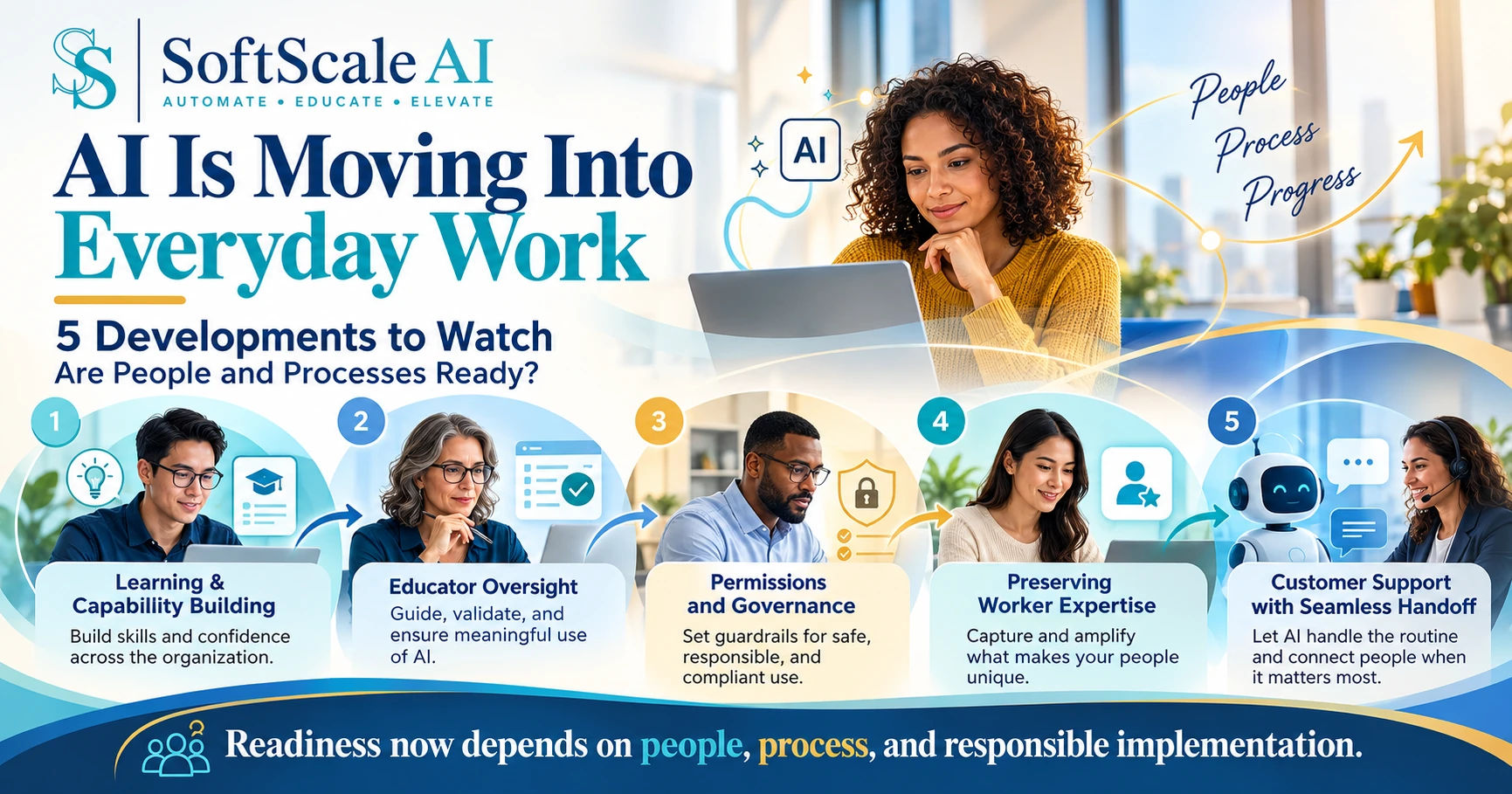
AI Is Moving Into Everyday Work. Are People and Processes Ready? 5 Developments to Watch
This week: a $70 million AI-skills initiative, new educator training, AI agents in banking, a manufacturing knowledge assistant and an AI customer-service voice agent. Plus: Ohio AI Watch.
 This Week in AI with Pamela Gosa
AI Is Getting More Capable. Are People and Organizations Ready? 5 Developments Worth Watching
Five AI developments this week are changing how schools prepare students, how employers prepare workers, how increasingly capable AI systems are governed, and how nonprofits build AI capacity—plus a new Ohio AI Watch development unfolding in Greater Cincinnati.
 This Week in AI with Pamela Gosa
AI Readiness Is Now a Leadership Challenge: 5 Developments That Explain Why
Five major AI developments show why leaders must strengthen workforce skills, responsible AI oversight and business processes. Plus an Ohio education spotlight.