
AI Is Moving Into Everyday Work. Are People and Processes Ready? 5 Developments to Watch
This week: a $70 million AI-skills initiative, new educator training, AI agents in banking, a manufacturing knowledge assistant and an AI customer-service voice agent. Plus: Ohio AI Watch.
Founder & CEO, SoftScale AI | CPD-Certified AI Consultant | AI Literacy & Workforce Readiness Strategist
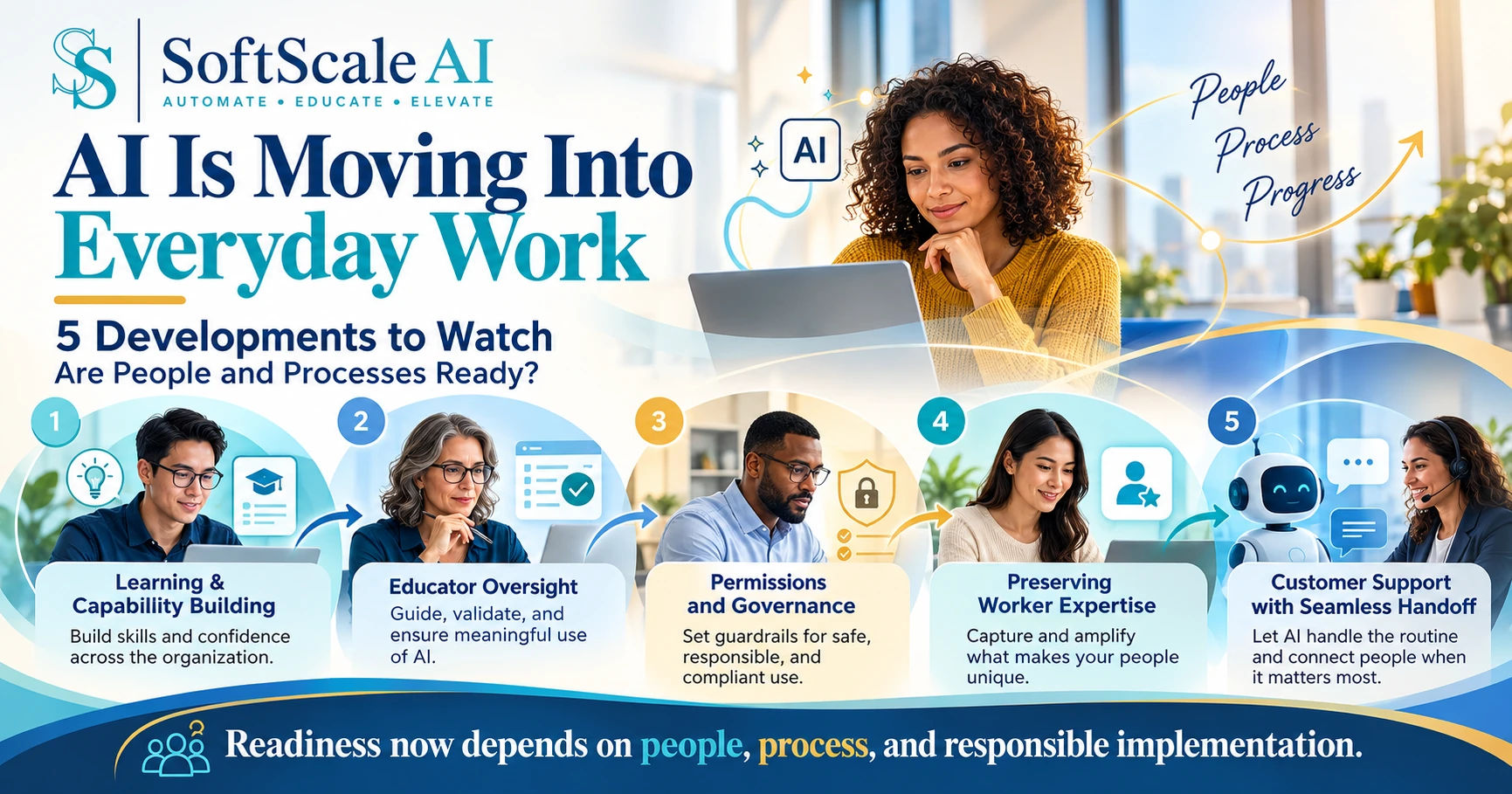
The Quick Answer: What Changed in AI This Week?
The most important AI developments of September 2026 (September 18–25) show organizations moving from experimenting with AI toward using it in everyday operations. Verizon is investing in workforce skills, Google.org is expanding educator training, BNP Paribas is planning AI agents for banking workflows, Rockwell Automation is making experienced technicians’ knowledge easier to access, and Virgin Media O2 is introducing an AI voice agent for selected customer calls.
These announcements have different purposes, but they raise a common question for leaders:
Are our people, processes and safeguards ready for the work we are asking AI to do?
That question matters whether you lead a school, workforce program, nonprofit, financial team or small business.
An AI tool can be introduced quickly. Building the skills to use it responsibly, documenting a dependable workflow and deciding where human judgment belongs require more intentional work.
This week’s edition looks at what happened, what has—and has not—been demonstrated, and what leaders can do with the lessons now.
Related SoftScale AI insight: AI Is Getting More Capable. Are People and Organizations Ready?
Key Takeaways at a Glance
- Workforce: Verizon’s AI-skills initiative combines free learning resources with community-based support. The opportunity is to connect training with demonstrated workplace capability.
- Education: Google.org’s commitment to Digital Promise focuses on practical AI professional development for teachers and faculty. Educators need guidance that connects AI use with instructional judgment.
- Finance: BNP Paribas is expanding its use of Google Cloud technology, including plans for AI agents in selected banking workflows. More automation makes permissions and human approval more important.
- Manufacturing: Rockwell Automation is using AI to help technicians find knowledge contributed by experienced engineers. Preserving expertise can be as important as introducing new technology.
- Customer experience: Virgin Media O2 is starting its AI voice-agent rollout with selected routine broadband calls. Small businesses can learn from its limited scope and human handoff.
- PLUS — Ohio AI Watch: Ohio Tech Day and a Cleveland State University workshop show how career exposure, responsible AI use and practical skills can connect across the state.
1. Verizon’s $70 Million Initiative Puts Community Support Alongside AI Training
What Happened
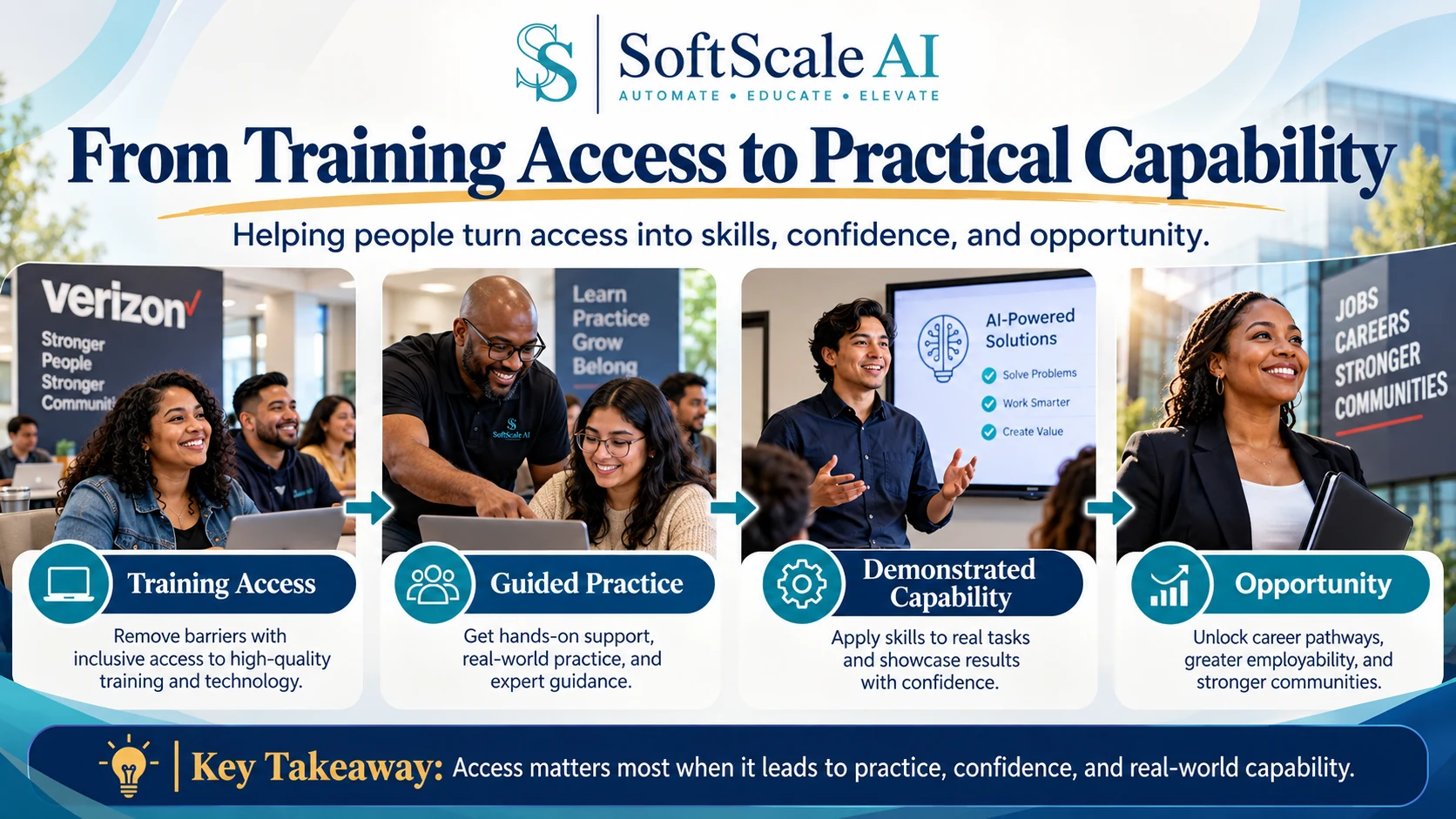
On September 23, Verizon announced Verizon AI Skills for America, a nationwide initiative intended to give job seekers, early-career professionals, displaced workers, educators and small businesses access to AI-skills training.
The announced $70 million investment includes $50 million in new funding and $20 million previously committed through Verizon’s Reskilling and Career Transition Fund for departing employees.
Verizon plans to bring together learning resources from organizations including IBM, Google, Microsoft, Anthropic, Coursera and OpenAI. The resources will be available at no charge to participants.
But the part of this announcement that deserves attention from workforce and community leaders is the delivery model.
Verizon is partnering with organizations including Goodwill Industries International, Local Initiatives Support Corporation and the National Association for Community College Entrepreneurship. These partners have relationships with job seekers, entrepreneurs and communities that may benefit from additional guidance as they develop new skills.
The initiative is national, although more intensive local support is initially planned for selected regional markets. Verizon says it will gather participant and partner feedback as the program develops.
That is the announced design. Its longer-term effects on employment, business growth and participants’ skills will need to be evaluated as the program operates.
01· Workforce Readiness
Why It Matters
There is an important difference between making AI training available and helping someone become capable of using AI.
A person can finish an online course and still be unsure how to apply the material to their next job interview. A small-business owner can learn the vocabulary of automation but struggle to decide which process is worth improving. An employee may know how to generate a response but not recognize when it contains an error.
That does not make online courses ineffective. It means some learners need opportunities to practice, receive feedback and connect new knowledge with a goal that matters to them.
Community organizations are well positioned to help with that connection. They understand local employment needs, can provide trusted learning environments and may be able to support people who are navigating technology alongside other barriers to opportunity.
Employers have a role, too. If a training program promises workforce readiness, employers can help define what readiness looks like for the jobs they actually offer.
A course-completion count tells us who participated. A relevant demonstration tells us more about what a learner can do.
Related SoftScale AI insight: AI Literacy Is Becoming a Basic Readiness Skill
Pamela’s Practical Takeaway
Start with the outcome, not the course catalog.
A workforce organization might define success as a participant’s ability to use an approved AI tool to prepare for a mock interview, verify the generated advice and explain how they adapted it to their actual experience.
A small-business workshop might ask participants to identify one repetitive task, test an AI-assisted approach and document what still requires their attention.
Build the learning experience around three stages:
Knowledge → Demonstration → Application
First, teach the concept. Then, let the learner show the skill. Finally, connect it to a realistic task.
If your organization is considering a partnership with a national AI-training initiative, ask what local support is available, what the learner will be expected to demonstrate and how the program will evaluate progress beyond enrollment.
Leadership Question
If we gave every person we serve access to an AI course tomorrow, what support would they still need to turn that learning into a meaningful opportunity?
Original source: Verizon’s announcement of AI Skills for America, September 23, 2026
2. Google.org’s $4 Million Commitment Addresses a Practical Need for Educators
What Happened
On September 21, Google.org announced a $4 million commitment to Digital Promise to help expand free, practical AI training for teachers and higher-education faculty through the Google AI Educator Series.
The new support builds on Google’s previously announced effort to offer AI training to educators across the United States. The training focuses on foundational AI skills, instructional judgment and practical uses such as lesson planning and productivity. Self-paced modules offer digital badges.
Digital Promise plans to work with state education agencies, school districts, community college systems and educator networks to expand access to professional development.
It will also study approaches to helping college faculty use AI effectively and plans to publish a free guide based on that work.
The commitment is significant because it addresses an implementation problem many schools already face: educators are being asked to make decisions about AI, even when their own training and opportunities to practice have been limited.
The funding and planned activities have been announced. The effectiveness of the expanded professional-development models will depend on how they are delivered and evaluated.
02· Education
Why It Matters
Teachers do not need another technology requirement disconnected from their daily work.
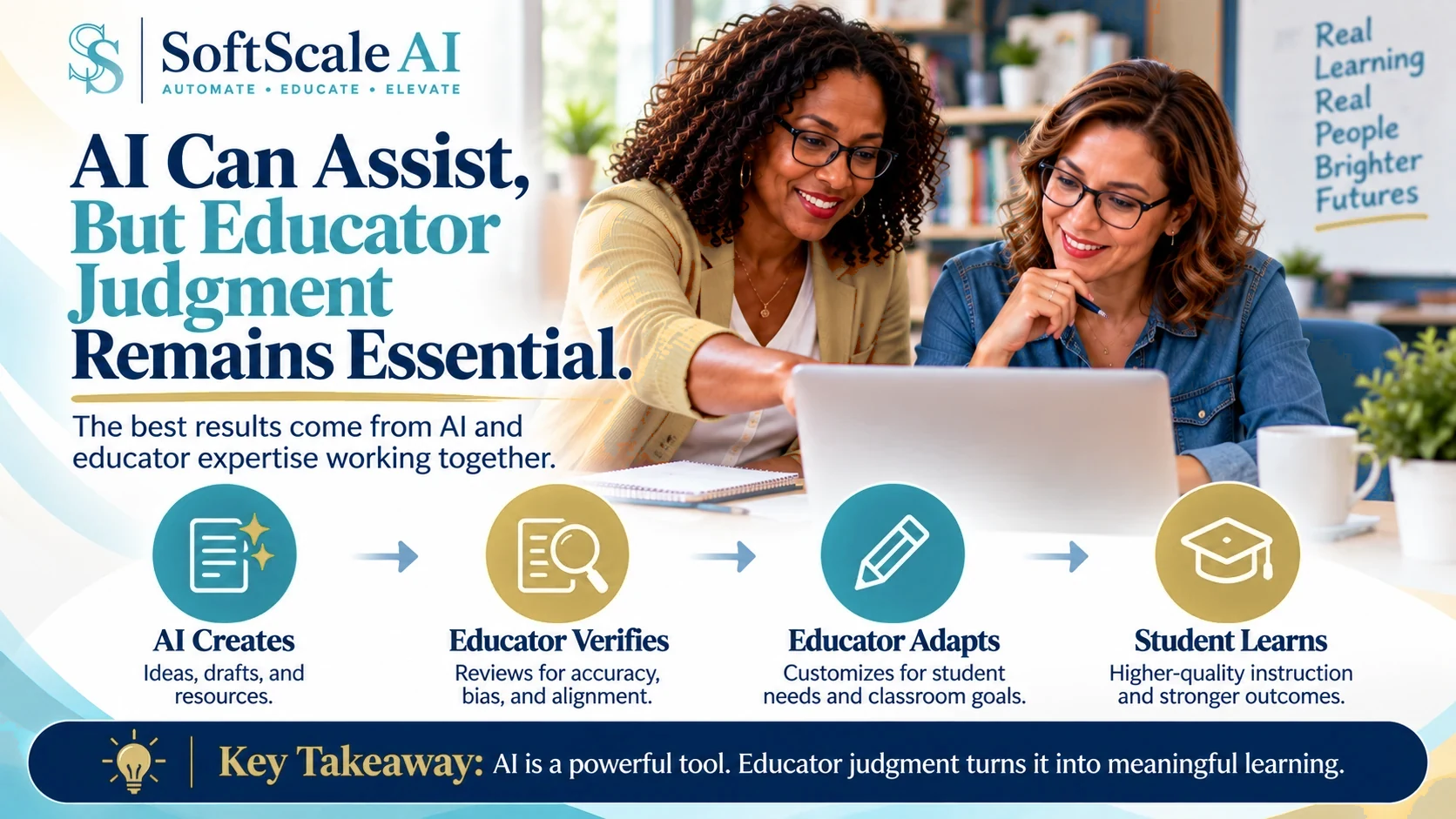
They need to know which tasks AI can reasonably support, how to evaluate what it produces and how to protect the learning process.
Imagine an educator asking AI to adapt a reading passage for students with different reading needs. The tool may simplify the language but accidentally remove an important concept. The educator must recognize what changed and decide whether the result still meets the learning objective.
Or consider an after-school program using AI to help students research a community service project. Staff need to help young people question the information, verify claims and protect personal details.
In both situations, the value comes from the educator’s judgment—not merely from the tool’s ability to produce material quickly.
Training also needs to account for different starting points. Some educators are already experimenting with AI. Others are hesitant because they have unanswered questions about privacy, accuracy, academic integrity or age-appropriate use.
A single demonstration will not address all those needs.
Schools and youth-serving organizations can make training more useful by linking it to the decisions educators are already making and allowing time for practice.
Pamela’s Practical Takeaway
Design professional development around a real instructional decision.
Before the session, ask educators which tasks they would like help with and what concerns they have about using AI.
During the session, let them complete a relevant activity: draft a resource, verify its accuracy, identify any privacy concerns and explain how they would adapt it for their students.
Afterward, provide a chance to discuss what worked, what needed correction and which uses they would—or would not—bring into their classrooms.
For youth programs, include guidance on approved tools, age-appropriate use and the importance of students doing their own thinking.
The objective is not to make every educator an AI specialist. It is to develop the confidence and judgment to make appropriate choices.
Leadership Question
Are we giving educators time to learn, test and question AI—or are we expecting them to become proficient simply because the tools are available?
Original source: Google: Expanding Free AI Training for Educators, September 21, 2026
Related SoftScale AI insight: ChatGPT for Teens Changes the AI Literacy Conversation
3. AI in Finance: BNP Paribas Plans More Specialized AI Agents
What Happened
On September 24, BNP Paribas and Google Cloud announced a new five-year partnership to expand the bank’s access to Google Cloud infrastructure, Gemini models and Gemini Enterprise.
One planned application is the development of AI agents for selected workflows in the bank’s Corporate & Institutional Banking division, including assistance with preparing corporate credit memos.
The partnership also includes plans to integrate Gemini models into LLM@CIB, the bank’s internal generative AI assistant, which is already available to more than 65,000 employees.
There is a distinction worth keeping clear: the agreement expands the bank’s AI capabilities and describes planned agent deployments. It is not an announcement that AI now makes lending decisions independently.
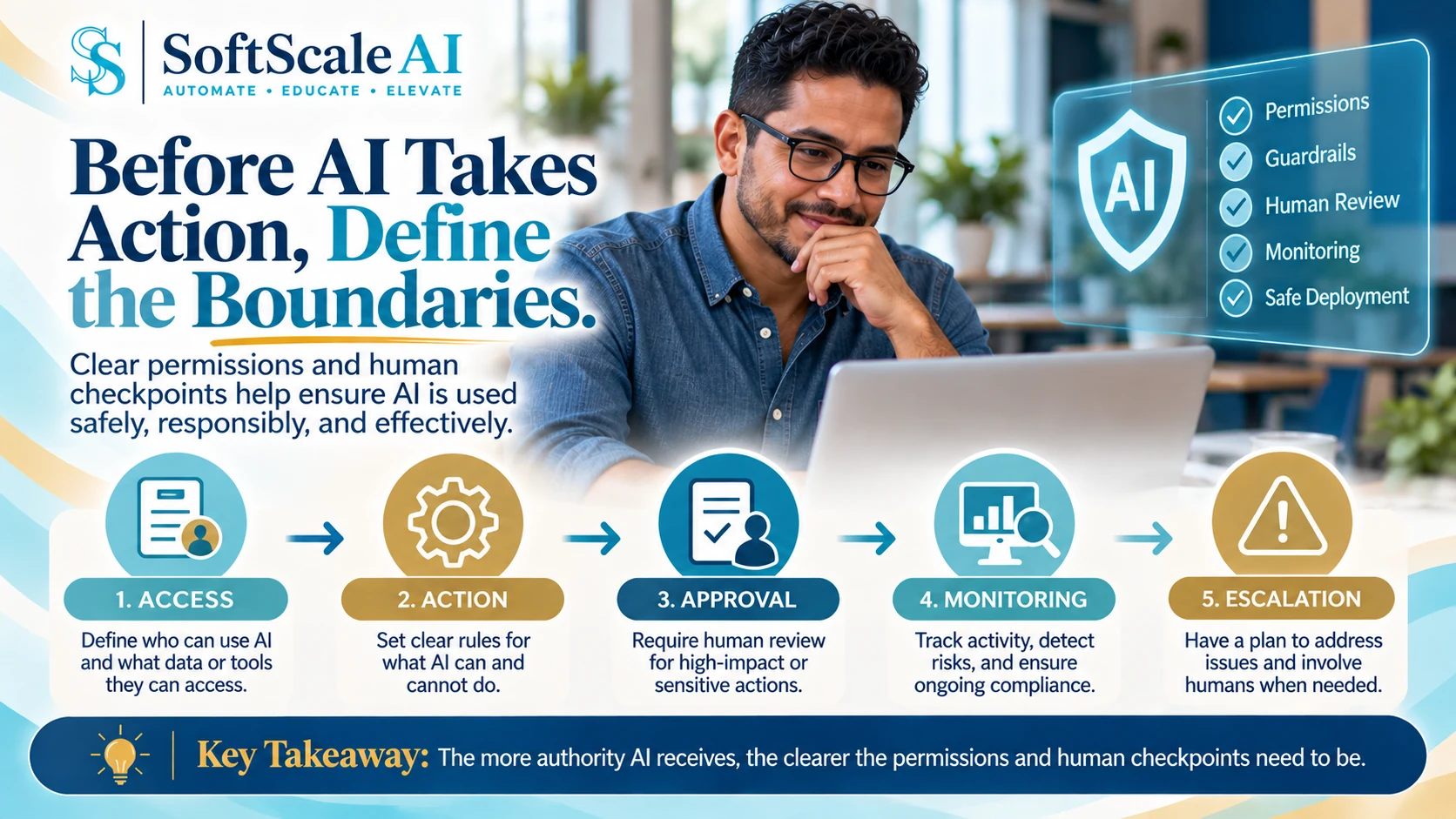
BNP Paribas says the work will operate within its existing security and data-governance framework. Its stated approach includes authenticating agents, restricting their access to resources required for their assigned tasks, and monitoring their connections and interactions with bank systems.
The bank also describes AI learning opportunities ranging from foundational literacy to specialized agent development.
That combination of technology, governance and employee preparation is relevant far beyond banking.
03· Finance & Governance
Why It Matters
An AI assistant that drafts a document and an AI agent that takes actions across connected systems do not present the same operational questions.
As an AI system gains access to information and the ability to complete more steps, leaders must decide what it is authorized to do.
Can it retrieve confidential information? Can it update a customer record? Can it send a message? Can it initiate a transaction? What should happen when the information it receives is incomplete or contradictory?
For financial institutions, those questions are particularly consequential. But similar issues arise when a nonprofit works with donor information, a workforce organization manages participant records or a small business introduces automated billing.
A responsible workflow needs clearly defined permissions and a process for review.
It also needs employees who understand their responsibilities. A person approving AI-assisted work must know what to check, when to question a result and how to respond when the system behaves unexpectedly.
AI literacy and operational controls should develop together.
Related SoftScale AI insight: AI Readiness Is a Shared Leadership Responsibility
Pamela’s Practical Takeaway
Create a permission-and-approval map before giving an AI agent access to a business system.
For one proposed use case, document what the agent may read, create, change and send. Identify which actions require a person’s approval and which information or activities are off-limits.
For example, a business might allow an agent to prepare a draft payment reminder using approved information. Changing payment details, issuing a refund or sending an unusual request could require explicit human authorization.
Then test the workflow with an exception—not just an ideal scenario. What happens when a customer record is incomplete, the requested action exceeds the agent’s authority or the information appears inconsistent?
An organization should be able to explain the agent’s boundaries in plain language to the people responsible for the process.
Leadership Question
If an AI agent could complete a financial or customer-related task from beginning to end, which steps would we still require a person to review or approve—and why?
Original source: BNP Paribas and Google Cloud’s partnership announcement, September 24, 2026
4. Rockwell Automation Shows How AI Can Help Preserve Workers’ Expertise
What Happened
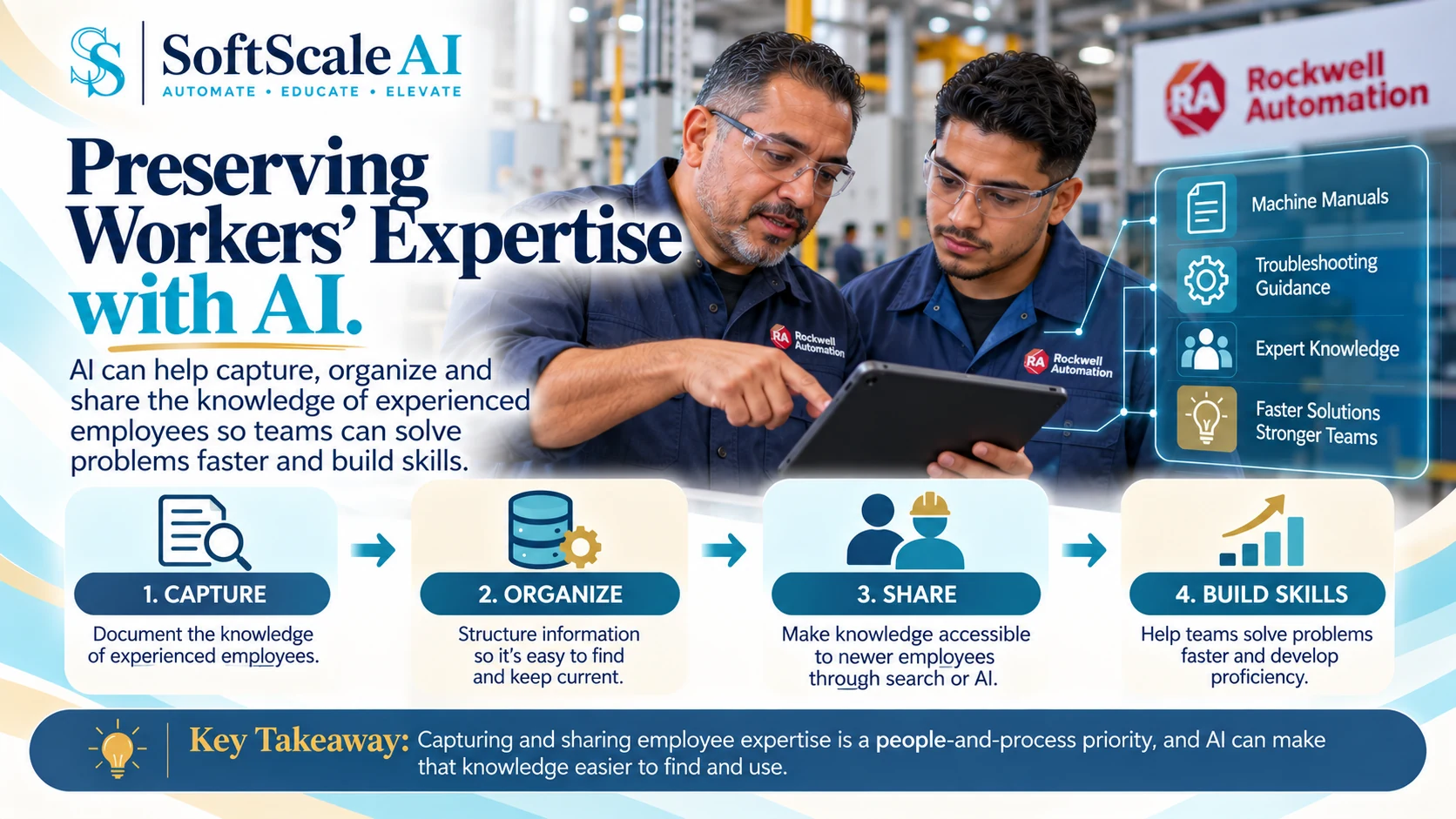
A September 24 report from Microsoft describes how technicians at Rockwell Automation’s Singapore factory are using an AI-powered maintenance assistant to diagnose and troubleshoot equipment problems.
Technicians have been using the system since October 2025. It draws on machine manuals, manufacturing information and a database of knowledge contributed by experienced Rockwell engineers.
Instead of searching through multiple manuals or trying to locate a colleague who has seen the same problem, a technician can ask a question and retrieve relevant guidance.
Rockwell says the system is helping employees work more efficiently and develop proficiency. Its Singapore facility has also reported broader operational improvements from multiple AI and automation initiatives. Those facility-wide results should not be attributed to the maintenance assistant alone.
The company plans to extend the assistant to additional sites, including its manufacturing plant in Twinsburg, Ohio.
This story is particularly interesting because the technology’s usefulness depends on something organizations already possess: the knowledge of their people.
04· Manufacturing
Why It Matters
Every organization has information that is documented—and information that lives primarily in the experience of its employees.
A veteran technician recognizes a particular equipment symptom. A longtime library employee understands a complicated community referral. A program coordinator knows which steps tend to cause delays. A customer-service employee remembers how an unusual problem was resolved.
When that knowledge is difficult to find, newer employees may spend unnecessary time searching, repeating mistakes or waiting for help.
An AI knowledge assistant can make documented expertise easier to retrieve, but it cannot compensate for information that is inaccurate, incomplete or out of date.
And not every situation can be resolved by following a previously recorded example. Employees still need to recognize when a problem requires an experienced colleague or qualified specialist.
This is why preserving expertise should be treated as a people-and-process project, not simply as a software project.
The experienced employee should help determine what belongs in the knowledge base, how it is explained and which situations require escalation.
Pamela’s Practical Takeaway
Choose one recurring problem that currently depends on a longtime employee.
Ask that employee to walk through how they approach it. Document the symptoms they look for, the questions they ask, the information they consult and the point at which they seek additional expertise.
Have a newer colleague use the documentation to work through a realistic scenario. Their questions will reveal which explanations or steps are missing.
Only then consider whether an AI assistant would make the information easier to retrieve.
Assign responsibility for keeping the knowledge current, and make sure employees know that retrieving an answer is not the same as confirming it is appropriate for the situation.
This approach can improve training even if the organization never deploys an AI knowledge assistant.
Leadership Question
If one of our most experienced employees left tomorrow, what knowledge would be hardest to replace—and how are we helping others learn it now?
Original source: Microsoft: Rockwell Automation Pairs AI With Shop-Floor Expertise, September 24, 2026
5. Virgin Media O2 Introduces an AI Voice Agent—With a Limited Starting Point
What Happened
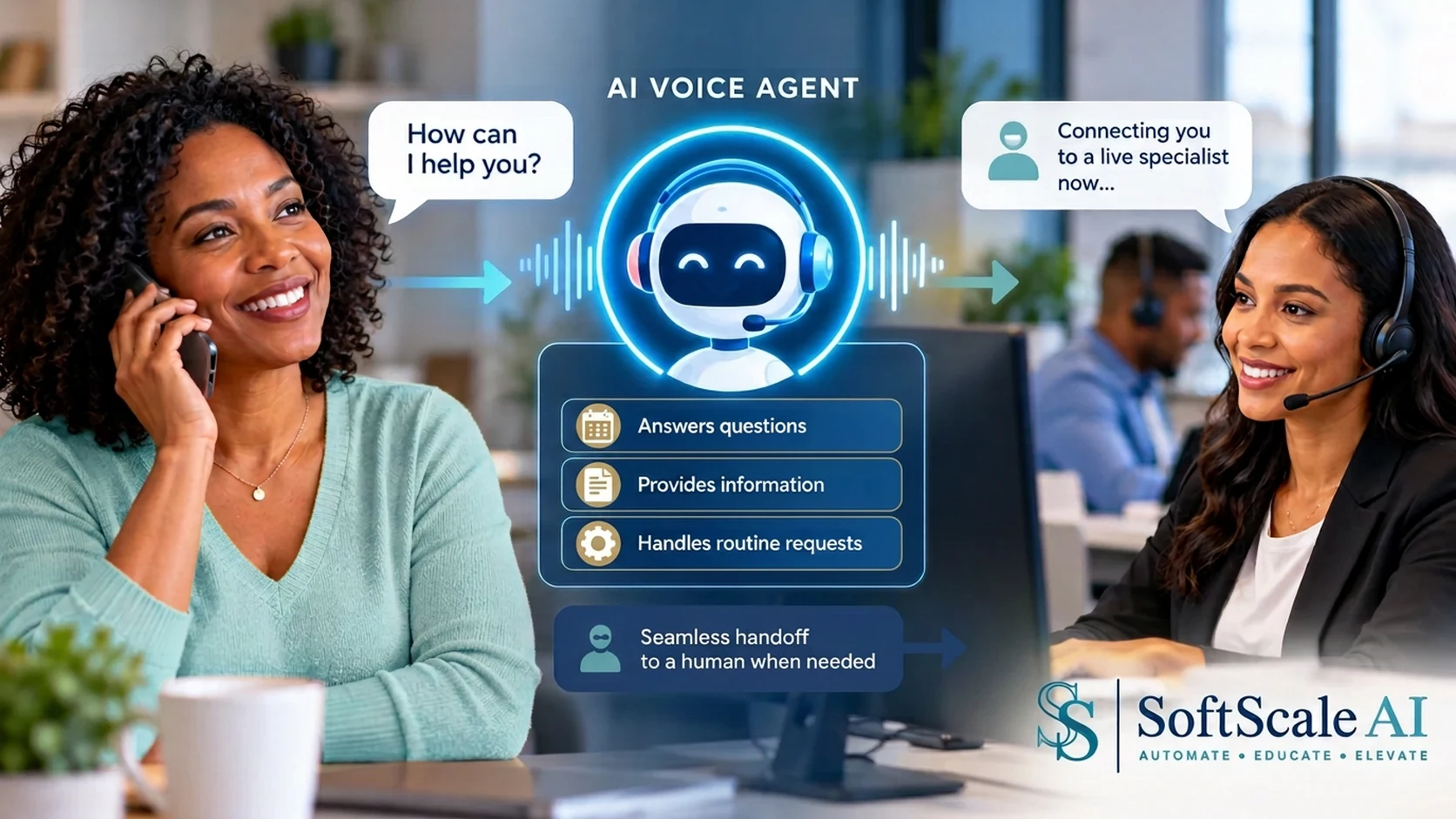
On September 24, Virgin Media O2 announced the gradual introduction of an AI voice agent for selected routine broadband fault calls.
Built in partnership with conversational AI company Sierra, the agent is intended to help customers resolve simpler issues while human advisers continue to handle more complex or sensitive situations.
The company says the initial use case represents a small proportion of its total call volume. Customers will still be able to speak with a human adviser, and the company plans to monitor calls and use customer feedback to assess the service.
The rollout is part of a broader customer-service program that includes AI tools supporting human advisers and a specialized team for complex customer needs.
The important detail is what Virgin Media O2 is not claiming: it has not announced that the voice agent will replace its entire customer-service operation or that the new service has already achieved long-term performance results.
It is beginning with a specific type of call, maintaining human support and evaluating the experience as the rollout develops.
05· Customer Experience
Why It Matters
This is a practical lesson for small businesses considering AI receptionists and voice agents.
A business may have a genuine problem with missed calls, unanswered routine questions or delayed follow-up. AI may help address those gaps.
But answering a call is not the same as resolving the customer’s need.
A customer asking about business hours may need a straightforward response. Someone calling about an unexpected charge, an urgent service failure or a sensitive personal matter may need an employee who can investigate and make a decision.
If the AI cannot recognize that difference—or if the transfer to a person fails—the business may create a new customer-service problem while trying to solve an old one.
The right starting point is a defined use case with clear boundaries.
Businesses should know what the voice agent is expected to handle, what information it may collect, what it should never promise and how it will respond when it cannot help.
Employees should also understand the system so they can take over a conversation without requiring the caller to start again.
Pamela’s Practical Takeaway
Review a sample of incoming calls before deciding what to automate.
Identify the five most common reasons customers contact your business. Separate routine questions from inquiries requiring access to approved systems and situations that should go directly to a person.
Choose one manageable starting point, such as answering common questions, collecting callback information or supporting after-hours inquiries.
Then test the exceptions. What happens if the caller asks something the agent does not know? What if they are upset? What if they need to change sensitive account information? What if they request a person immediately?
Measure whether customers receive accurate answers and reach the appropriate next step. Do not judge success only by the number of calls handled without an employee.
For a growing business, thoughtful automation should protect the relationship with the customer—not make it harder to reach someone who can help.
Leadership Question
Are we designing our AI voice agent around what the technology can handle—or around what customers actually need from us?
Original source: Virgin Media O2’s AI Voice Agent Announcement, September 24, 2026
Related SoftScale AI service: AI Receptionists, Voice Agents & Business Automation
Five Stories. One Implementation Lesson.
The five developments illustrate different stages of putting AI to work.
Verizon and Google.org are investing in the skills people need before and during adoption. Rockwell is organizing knowledge so employees can use it. BNP Paribas is defining the infrastructure and controls for more capable workflows. Virgin Media O2 is testing automation within a specific customer-service process.
The lesson is not that every organization should follow the same AI roadmap.
It is that training, information, permissions and human oversight need to match the task.
Before introducing AI, leaders should be able to answer four questions: What problem are we solving? Who needs to be prepared? What may the system do? How will we evaluate the result?
The answers should shape the technology decision—not follow it.
PLUS: Ohio AI Watch
From AI Exposure to Workplace Credibility: Ohio’s Next Readiness Opportunity
Ohio’s AI-readiness conversation is taking place in classrooms, universities and workplaces—not only at technology companies.
Two developments this week illustrate different parts of that pathway.
On September 24, Cleveland State University scheduled a student workshop titled “AI Use and Credibility in the Workforce.” The session’s description addresses the expectations surrounding AI use in academic and corporate environments, including when AI may help or harm someone’s credibility as a job candidate or employee.
That is a practical question for students entering a workforce where AI tools may be common but expectations vary among employers.
A candidate may use AI to prepare for an interview, but they still need to describe their own experience truthfully. An employee may use AI to draft work, but they need to understand their organization’s policies and remain accountable for what they submit.
The workshop listing establishes the scheduled event and its subject. It does not establish how many students attended or what outcomes they achieved.
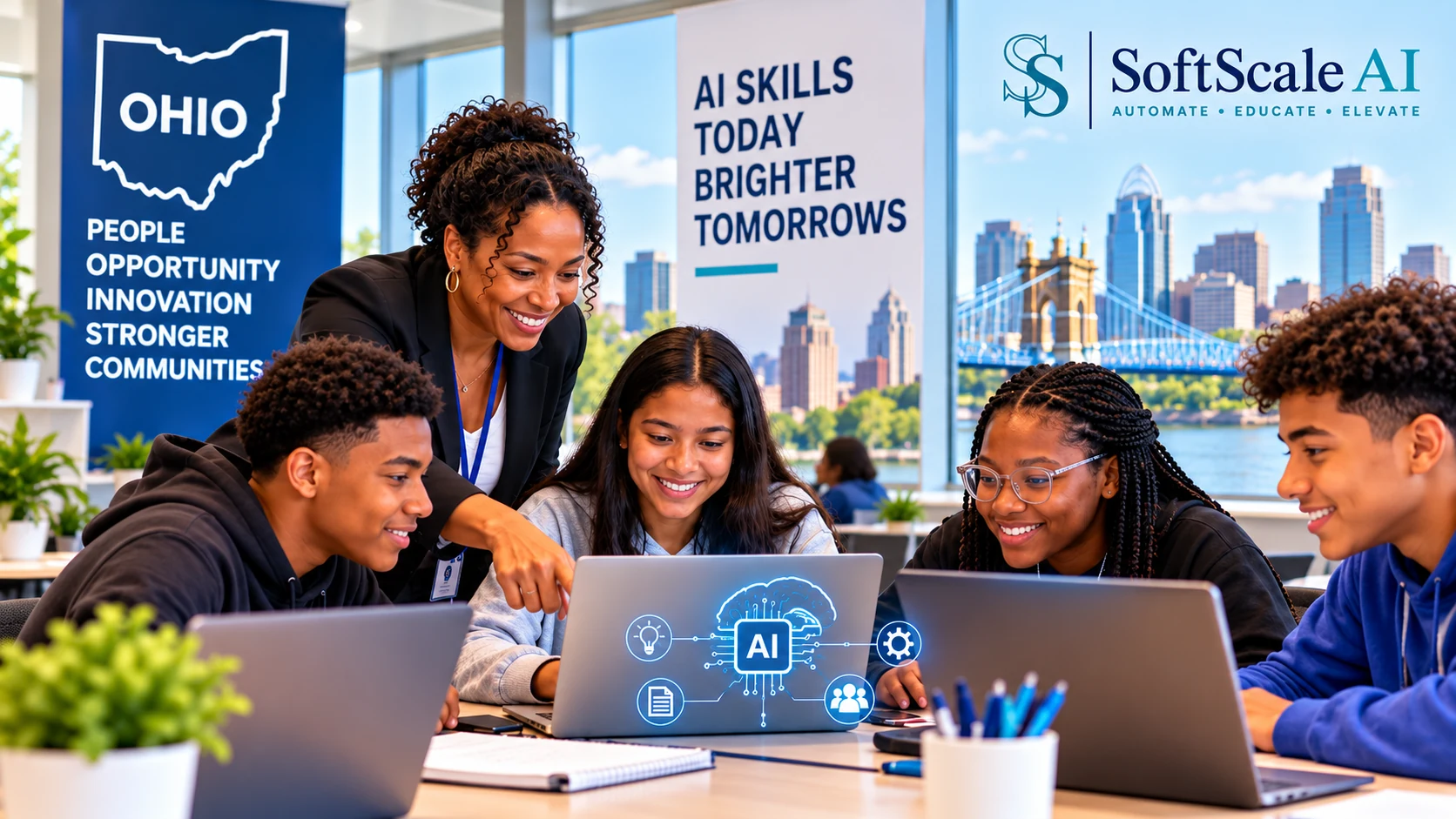
Today, September 25, Ohio Tech Day 2026 is bringing together schools, businesses and community organizations to introduce young people to technology and career opportunities across the state.
The published schedule includes AI prompt-writing activities at Aiken High School in Cincinnati and an interactive technology and cybersecurity experience connected with the University of Cincinnati. Other activities across Ohio introduce students to coding, robotics, design and technology careers.
Ohio Tech Day is broader than AI alone. That breadth is useful because AI skills increasingly connect with other fields and job functions.
PLUS· Ohio AI Watch
Why It Matters for Ohio
Career exposure can help a young person imagine a future they had not previously considered. But a single demonstration is only a beginning.
The next step is giving that student opportunities to practice, receive feedback and see how a skill applies outside the event.
The same progression matters for adults preparing for new roles or adapting to changing jobs.
Libraries can introduce residents to AI in a trusted setting. Schools and youth organizations can build foundational understanding. Community colleges and workforce programs can connect learning to realistic tasks. Employers can explain which capabilities matter in their workplaces.
These efforts become more useful when they connect rather than operate as isolated experiences.
Rockwell Automation’s planned rollout in Twinsburg provides another Ohio connection to this week’s national stories: AI readiness is also about helping existing employees develop and use new capabilities.
Pamela’s Practical Takeaway for Ohio
Turn one technology event into the beginning of a learning pathway.
A school or youth program could follow an AI demonstration with a project in which participants research a community issue, verify information and explain how they used AI.
A workforce organization could ask learners to complete a realistic task and describe where AI assisted them—and where their own judgment was necessary.
A library could offer an introductory session for residents who want to understand AI but have not had an opportunity to learn in a supportive environment.
The next step does not have to be a large program. It should be a meaningful opportunity to move from curiosity to practice.
Ohio Leadership Question
What could Ohio’s schools, libraries, employers and workforce organizations do together so that a student’s first exposure to AI becomes a pathway to useful skills and real opportunity?
Related SoftScale AI insight: AI Is Changing How Work Gets Done—and Who Gets Opportunity
Ohio sources: Cleveland State University’s Fall 2026 AI Workshops and Ohio Tech Day 2026
Pamela’s Perspective: The Real Test Is What People Can Do
There is a temptation to measure AI progress by announcements.
A new partnership. A funding commitment. A model release. An automated process. A company-wide rollout.
Those developments matter. But the people expected to use the technology experience something more specific.
A teacher needs to decide whether an AI-generated resource is suitable for students. A job seeker needs to demonstrate a skill in an interview. A technician needs to identify the cause of an equipment problem. A financial employee needs to recognize when an AI-assisted document requires further review. A customer needs an answer—and sometimes a person.
That is where AI readiness becomes real.
For organizations, the challenge is to connect the promise of the tool with the capability of the people and the reliability of the process.
I believe that starts with three practical questions:
What should people understand? What should they be able to demonstrate? And how will they apply those skills in the situations they actually face?
That is the thinking behind SoftScale AI’s Knowledge → Demonstration → Application approach.
It also means being clear about where AI should not act independently.
A useful tool is not necessarily an authorized tool for every task. A confident answer is not necessarily a correct answer. A completed course is not necessarily proof that someone can perform a workplace task.
None of those distinctions requires us to reject AI or slow every project. They require us to implement it thoughtfully.
And they remind us that practical AI readiness should not be available only to organizations with large budgets or employees who have had years to experiment with new technology.
Schools, libraries, nonprofits, workforce organizations and small businesses all have a place in this conversation.
The goal is not simply to help people keep up with AI. It is to help them develop the capability and judgment to use it in ways that serve their work, their organizations and their communities.
That is how we move forward without leaving people behind.
Frequently Asked Questions
What were the major AI developments this week?
For September 18–25, 2026, the five developments covered in this edition are Verizon’s AI-skills initiative, Google.org’s educator-training commitment, BNP Paribas’s expanded AI partnership with Google Cloud, Rockwell Automation’s AI maintenance assistant and Virgin Media O2’s AI voice-agent rollout. Ohio AI Watch covers Cleveland State University’s workforce-credibility workshop and Ohio Tech Day.
What does AI workforce readiness mean?
AI workforce readiness means having the knowledge, practical skills, organizational guidance and judgment needed to use AI appropriately in relevant work. It goes beyond access to a tool or completion of a course and includes the ability to apply skills in realistic tasks.
What is an AI agent in a business workflow?
An AI agent is a system designed to perform steps toward a goal, potentially using approved tools or connected systems. Its capabilities depend on its design and permissions. Businesses should define what the agent may access or do, where a person must approve an action and how the system will be monitored.
Can small businesses use AI voice agents without removing human customer service?
Yes. A business can begin with routine inquiries, define which calls the AI may handle and provide a clear route to an employee. The design should account for sensitive requests, unusual situations and callers who prefer to speak with a person.
How can schools and workforce organizations make AI training more practical?
Begin with a relevant task, teach the necessary concepts, give learners an opportunity to demonstrate the skill and assess how they apply it. Include verification, privacy and human judgment alongside tool use.
Why is Ohio AI Watch part of this weekly series?
Ohio AI Watch connects national AI developments with opportunities and questions facing Ohio’s schools, employers, libraries, businesses and communities. Its purpose is to identify what is happening locally and what practical preparation may be useful.
One Question for Leaders This Week
What are we asking AI to do before we have fully prepared the people and processes surrounding it?
The answer may reveal where your organization’s next training, documentation, policy or pilot project should begin.
Found This Week’s Brief Useful?
Share this edition with a colleague, educator, workforce leader, nonprofit director or business owner who is deciding how to introduce AI responsibly.
The most useful conversations about AI begin when we connect the news to the decisions people are actually making.
Share this article
Put These Insights to Work With SoftScale AI
SoftScale AI helps organizations and communities build practical AI literacy, responsible-use skills and workforce readiness. We also help growing businesses explore AI receptionists, voice agents and focused automation designed around their actual operations.
Whether you need a staff workshop, a workforce program, a leadership conversation or help evaluating a business workflow, we begin with the people you serve and the problem you want to solve.
Empowering people and organizations, one opportunity at a time.
Sources & Further Reading
- Verizon — Verizon AI Skills for America, September 23, 2026
- Google — Expanding Free AI Training for Educators, September 21, 2026
- BNP Paribas — Partnership With Google Cloud on Agentic AI, September 24, 2026
- Microsoft — Rockwell Automation’s AI Maintenance Assistant, September 24, 2026
- Virgin Media O2 — AI Voice Agent for Selected Calls, September 24, 2026
- Cleveland State University — Fall 2026 AI Workshops
- Ohio Tech Day — September 25, 2026
This Week in AI with Pamela Gosa examines timely AI developments affecting work, education, business and communities—and what they mean for the people and organizations navigating change.
Stay AI-Ready
Practical AI insights for work, education, community and business—plus This Week in AI with Pamela Gosa, delivered to your inbox.
Turning these ideas into practice.
AI literacy workshops, leadership briefings, speaking, and workforce-readiness programs for organizations, schools, and communities.
Explore Training & SpeakingPractical AI and automation support for growing businesses, scoped around the work your team already does.
Explore Business Solutions
Prefer to talk it through? Book a discovery call.
Related insights
 This Week in AI with Pamela Gosa
AI Is Getting More Capable. Are People and Organizations Ready? 5 Developments Worth Watching
Five AI developments this week are changing how schools prepare students, how employers prepare workers, how increasingly capable AI systems are governed, and how nonprofits build AI capacity—plus a new Ohio AI Watch development unfolding in Greater Cincinnati.
 This Week in AI with Pamela Gosa
AI Is Entering a Harder Phase: 5 Developments Leaders Should Watch
Five AI developments reshaping workforce skills, small-business agents, scaling, governance and Ohio AI fluency—and what leaders need to know.
 This Week in AI with Pamela Gosa
AI Is Changing How Work Gets Done—and Who Gets Opportunity: 5 Developments Worth Watching
Five AI developments changing work and opportunity: AI inside everyday business software, Meta's workforce experiment, assistive technology expanding access to jobs, small-business adoption, and practical AI training in Ohio.