
AI Readiness Is Now a Leadership Challenge: 5 Developments That Explain Why
AI capabilities are advancing faster than workforce readiness. Here are five developments leaders should understand, plus an Ohio spotlight.
Founder & CEO, SoftScale AI | CPD-Certified AI Consultant | AI Literacy & Workforce Readiness Strategist
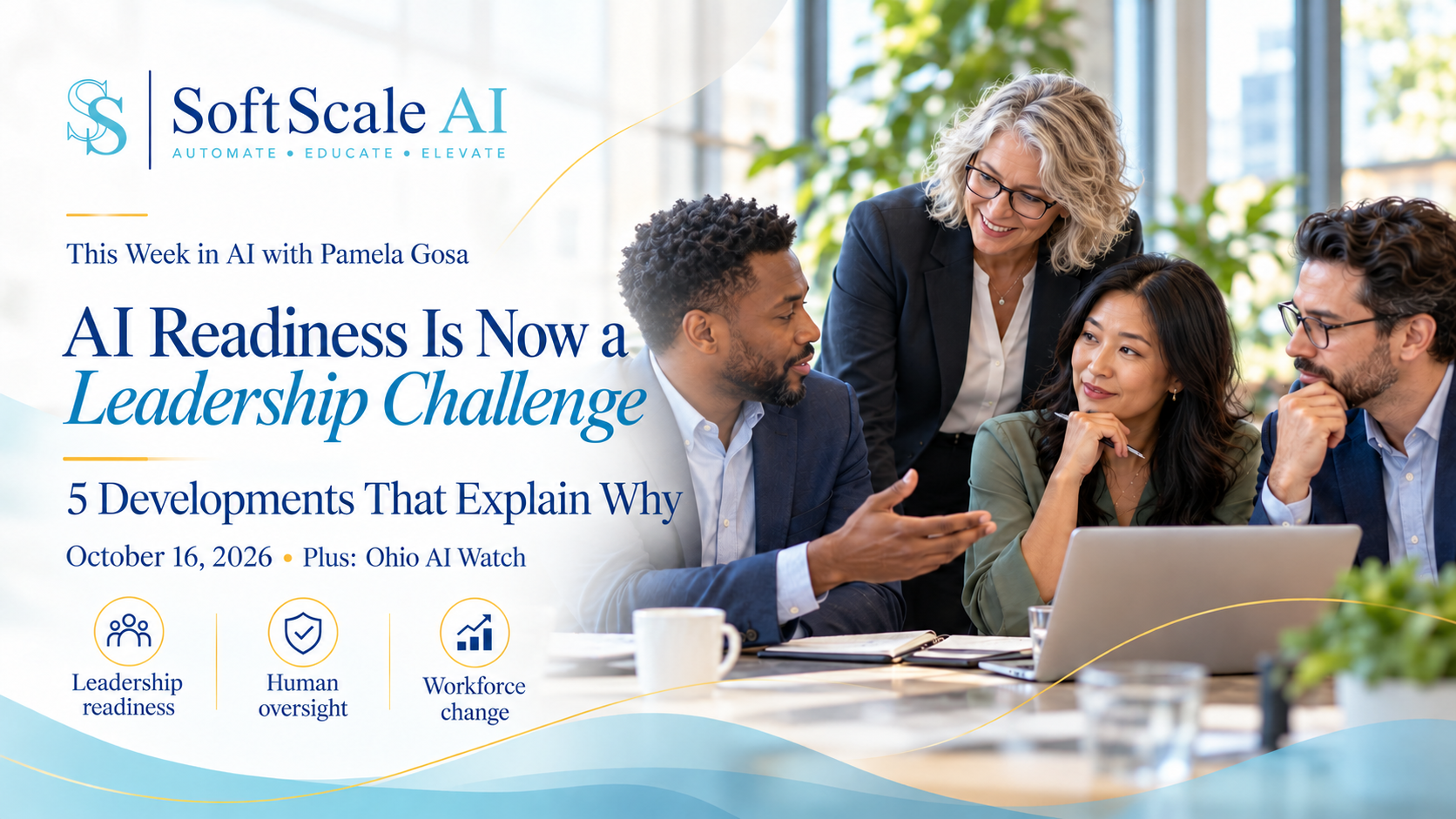
AI tools are advancing, but organizations still have to prepare people, redesign work, and protect human judgment. Five developments explain why AI readiness has become a leadership responsibility. Plus, an exclusive Ohio AI Watch.
This Week in AI with Pamela Gosa | October 16, 2026
By Pamela Gosa
Founder & CEO, SoftScale AI | CPD-Certified AI Consultant | AI Literacy & Workforce Readiness Strategist
More than half of the U.S. CEOs surveyed in KPMG's latest outlook identify training employees on AI as a major workforce challenge. Meanwhile, new Gallup research finds that 59% of U.S. K–12 educators used AI during the last school year.
Those findings come from different groups and measure different experiences. Yet together, they reveal an important reality: AI is becoming part of everyday work faster than many organizations are adapting their training, responsibilities, and processes.
The challenge is no longer simply getting access to AI. It is preparing people to use it well.
Through my work with SoftScale AI, I have been exploring practical AI education with libraries, youth-serving organizations, and workforce partners, while also developing AI-powered business solutions. These two sides of the work have something important in common: introducing a tool is only the beginning. People need to understand what the tool can do, recognize when it makes a mistake, and know what should happen next.
For an educator, that may mean evaluating an AI-generated lesson before it reaches students. For a business owner, it may mean ensuring an AI receptionist does more than answer a call. For a nonprofit leader, it may mean preparing staff to work more efficiently without putting sensitive information or community trust at risk.
The tools and environments differ, but the leadership responsibility remains.
In this October 16 edition of This Week in AI with Pamela Gosa, we examine five developments affecting education, business operations, advanced AI capabilities, data protection, and organizational leadership. We'll also look at a major investment in Ohio business education and what it could mean for communities preparing people for an AI-enabled economy.
The common thread is clear: AI readiness is measured by what people and organizations can responsibly accomplish, not simply by which tools they adopt.
This Week's Key Takeaways
- AI is already part of educators' work. Gallup reports that 59% of U.S. K–12 educators used AI for work during the 2025–2026 school year. Among those users, 64% said it freed up time for the parts of teaching that matter most to them. The opportunity is real, but time savings alone do not establish better learning outcomes.
- CEOs are investing in AI while confronting workforce challenges. KPMG reports that 60% of surveyed U.S. CEOs identify workforce skills gaps as a top challenge, while 55% cite AI upskilling and training. Technology investment must be matched by practical workforce preparation.
- AI systems are becoming more capable of complex work. Google's October 13 expansion of Gemini 4 Argon brings advanced reasoning and multi-step capabilities to more developers, organizations, and subscribers. Greater capability makes careful selection, testing, and oversight more important.
- AI agents introduce new questions about responsibility. The UK's Information Commissioner's Office is examining the data-protection risks of AI systems that can take actions, not merely generate answers. Organizations need clear permissions, boundaries, and human oversight.
- Leadership itself must evolve. The Conference Board's latest research emphasizes that AI-enabled work requires role-specific development, work redesign, decision rights, and accountability.
- Ohio AI Watch: Cleveland State University announced a major gift to reshape business education around AI, entrepreneurship, emerging technologies, and stronger employer connections.
The Bottom Line: The organizations best positioned to benefit from AI may not be those adopting the greatest number of tools. They may be those doing the best job of preparing people, strengthening processes, and maintaining accountability.
1. Gallup: Educators Are Using AI, but Time Savings Are Only Part of the Story
What Happened
On October 14, 2026, Gallup published new research conducted with the Walton Family Foundation and The Mattering Institute examining how educators experience their work and how artificial intelligence may affect it.
The findings came from an online survey of 1,952 U.S. K–12 educators, including teachers, paraprofessionals, and other classroom staff. The survey was conducted between July 28 and August 14, 2026.
Among the findings:
- 59% reported using AI tools for work during the 2025–2026 school year.
- 64% of educators who used AI said it gave them more time for the parts of their work that matter most.
- Of those AI users, 13% reported gaining a lot more time and 51% reported gaining somewhat more time.
- Educators reported using AI for activities such as lesson preparation, learning materials, assessments, grading, feedback, and administrative work.
The research also found that working directly with students is central to educators' sense of purpose. For example, 85% said helping a student through something difficult makes them feel that their work matters a great deal.
Read Gallup's October 14 research: Teachers Using AI Say It Frees Up Time for What Matters Most
Why This Matters
Time is one of education's most valuable resources. Teachers and classroom staff are responsible for much more than delivering academic content. They help students build confidence, develop independent thinking, overcome challenges, and form relationships that support learning.
AI may help reduce the time required for some repetitive preparation and administrative tasks. But the value of that time depends on how it is used.
A faster lesson plan is not necessarily a better lesson. An AI-generated assessment is not automatically accurate or developmentally appropriate. A polished explanation does not guarantee that a student truly understands the underlying concept.
Schools and educational organizations therefore need to consider both efficiency and educational quality. Responsible adoption involves clear expectations for privacy, accuracy, age-appropriate use, accessibility, and the continued role of professional judgment.
Who Should Pay Attention?
Teachers, school administrators, district leaders, youth-serving nonprofits, after-school programs, parents, educational technology leaders, and workforce-development organizations.
Employers also have a reason to pay attention. The habits young people develop around AI today, including whether they question information or depend on generated answers, can influence how they approach technology in future workplaces.
Pamela's Perspective
I see one of the strongest opportunities for AI in education as protecting time for the human interactions that matter most.
A teacher who notices that a student is struggling, helps that student work through frustration, or recognizes a small but meaningful improvement is doing something technology cannot simply replace. AI can help prepare materials, but people provide encouragement, context, relationships, and professional judgment.
At the same time, educators should not be expected to navigate new technology entirely on their own.
As I explore practical AI learning opportunities for youth organizations and community education programs, I keep coming back to three questions: Can participants recognize when an AI answer may be wrong? Do they understand what information is safe to share? Can they explain their own thinking rather than simply repeating an AI-generated response?
Those are foundational skills for responsible AI use, regardless of the particular application.
The Gallup findings make a useful distinction. Educators reporting that AI saves time is encouraging. Whether those savings lead to stronger student learning, independence, or confidence requires additional evidence.
A Practical Human Example
Illustrative example.
A fifth-grade teacher uses AI to prepare several reading-comprehension questions based on an assigned passage. Before sharing them, she checks every answer, changes two questions that are too advanced for her students, and removes an explanation that misinterprets the text.
During the lesson, students answer the questions independently. They then compare one AI-generated explanation with the original passage and identify which statements are supported by evidence.
AI assisted with preparation, but the teacher remained responsible for instruction. Students practiced reading, verification, and independent reasoning rather than simply accepting the generated response.
The school could evaluate this approach by reviewing preparation time, error rates in generated materials, student explanations, and teacher feedback.
Practical Takeaway
Start with low-risk educational tasks, teach educators how to verify generated materials, and define what students must still demonstrate independently. Measure whether AI supports learning, not merely whether teachers use it.
Leadership Question
If AI saves your educators time, how will you determine whether that time is helping students learn, think independently, and receive better support?
2. KPMG: CEOs Are Investing in AI, but Workforce Transformation Remains a Challenge
What Happened
On October 15, 2026, KPMG released findings from its U.S. CEO Outlook, examining business leaders' perspectives on growth, emerging technology, workforce transformation, and operational risk.
The broader study included more than 1,300 CEOs at large companies worldwide, including 400 U.S. CEOs. The percentages discussed here describe responses from the U.S. group.
Several findings demonstrate the tension between AI investment and workforce preparation:
- 60% identified workforce skills gaps among their top workforce challenges.
- 55% cited upskilling and training employees on AI systems.
- 81% said AI integration had caused their organizations to reconsider employee training and development.
- 86% reported redesigning roles, career paths, or team structures to reflect human-AI collaboration.
- 89% expected overall headcount to increase over the next three years.
- 53% were planning workforce reductions in some areas as part of their longer-term strategy.
The last two findings are not necessarily contradictory. An organization can anticipate overall growth while changing roles, reducing certain activities, and investing in different capabilities.
Explore KPMG's 2026 U.S. CEO Outlook
Why This Matters
The survey reflects the views of leaders at large companies, so its findings should not automatically be treated as representative of small businesses. However, the underlying management problem is relevant across organization sizes.
Introducing AI often changes how information moves, who performs certain tasks, where decisions are made, and how employees interact with customers or colleagues.
For small businesses, the challenge can become visible very quickly.
An AI receptionist may answer a call successfully, but what happens to the customer's request afterward? Does the information enter the customer relationship management system correctly? Is a scheduling task created? Does an employee receive the necessary details? What happens when a caller has an urgent concern or the connection fails?
The technology may perform its assigned task while the larger customer experience still breaks down.
This is why meaningful AI adoption requires more than purchasing an application. It involves process design, training, communication, ownership, and follow-through.
Who Should Pay Attention?
Business owners, CEOs, HR leaders, operational managers, chambers of commerce, workforce boards, nonprofit executives, and anyone responsible for employee development or organizational change.
Pamela's Perspective
The difference between AI adoption and AI transformation is often found in the handoff.
Adoption introduces a tool. Transformation examines how that tool fits into the work people actually perform.
For businesses considering AI receptionists and automation, I focus on the entire customer journey rather than the first interaction alone. Answering a call matters, but so does capturing accurate information, sending it to the right place, triggering appropriate follow-up, and ensuring that a responsible person can step in.
This reflects a broader principle I apply to organizational readiness: a successful tool must be supported by a successful process.
The same is true in education and workforce training. Showing someone what an AI tool can do is the introduction. Helping that person apply it appropriately, check the result, and handle exceptions is where practical capability begins.
Organizations should ask not only whether employees know how to use AI, but whether they understand the responsibilities that come with using it.
A Practical Business Example
Illustrative example.
A home-services company introduces an AI receptionist to help manage incoming calls when employees are assisting other customers.
The AI receptionist collects the caller's name, contact information, general service need, and preferred appointment time. Those details are transferred into the company's CRM, where a follow-up task is assigned to the scheduling team.
A designated employee reviews the request before confirming the appointment.
If the caller describes an emergency, the information is incomplete, or the CRM connection fails, the process directs the issue to a person rather than treating the interaction as complete.
The owner tests several realistic situations before launching the system and monitors missed handoffs, inaccurate records, response times, and completed follow-ups.
The goal is not merely to demonstrate that an AI receptionist can answer calls. It is to establish a reliable process that helps customers receive the service they requested.
Practical Takeaway
Before investing in another AI solution, map the process it will support from beginning to end. Identify where information moves, where people remain responsible, what training is required, and how success will be measured.
Leadership Question
If your AI system performs its assigned task perfectly, could your organization still fail the customer because the next step is unclear or unassigned?
3. Google's Gemini 4 Argon Expands What AI Can Do With Complex Work
What Happened
On October 13, 2026, Google announced broader global availability of Gemini 4 Argon, its frontier AI model designed for more complex, multi-step tasks.
According to Google's official announcement, the model became available to developers and enterprises through supported developer platforms and to eligible subscribers through products including the Gemini app and Google Antigravity.
Google described applications involving software engineering, scientific research, financial and legal analysis, cybersecurity, and other professional tasks requiring substantial reasoning and coordination.
The release reflects the growing ability of AI systems to work with longer, more complicated assignments instead of producing only short responses to individual prompts.
As with other advanced models, reported capability and benchmark results do not establish that the system will perform reliably in every real-world situation.
Read Google's October 13 announcement: Gemini 4 Argon, Built to Solve Your Hardest Problems
Why This Matters
For businesses and organizations, more capable AI creates opportunities to reconsider work that previously required several disconnected steps.
A system might help analyze authorized documents, identify differences among reports, prepare a structured summary, or coordinate elements of a complicated research assignment.
But the ability to perform more steps also creates more opportunities for something to go wrong.
A model may misunderstand information, omit an important fact, use an inappropriate source, or produce a convincing conclusion that has not been adequately verified. If connected to other systems, errors can potentially affect records or operational decisions.
Organizations therefore need to distinguish between demonstrating capability and validating dependable performance.
The newest or most powerful model is not automatically the right choice for every task. Cost, reliability, security requirements, integration needs, available oversight, and the consequences of mistakes all matter.
Who Should Pay Attention?
Business owners, operational leaders, technology teams, professional-services firms, educators, researchers, nonprofits, and organizations evaluating more advanced AI applications.
Pamela's Perspective
My starting point for evaluating an AI model is the problem that needs to be solved, not the excitement surrounding a product announcement.
A more capable model can expand what's possible, but greater capability does not eliminate the need for reliable data, thoughtful workflow design, safeguards, and human accountability.
For example, a company looking for help with routine customer inquiries may not need the same technology as a research organization analyzing complicated technical documents. Selecting a tool without understanding the actual job can create unnecessary complexity and expense.
I also believe practical AI literacy must include the ability to evaluate these claims. People need to know the difference between a demonstration, a controlled benchmark, and dependable performance in their own environment.
The best AI solution is not necessarily the most advanced system. It is the one that serves a defined purpose responsibly and reliably.
A Practical Business Example
Illustrative example.
A professional-services firm spends several hours each week assembling project summaries from approved internal documents.
Rather than immediately connecting a new AI model to every company system, the firm begins with a limited trial using a small collection of authorized files.
Staff compare the generated summaries with the originals, checking for missing details, unsupported statements, incorrect figures, and confusing wording. They also evaluate the amount of time required for review and whether the system fits the firm's information-security requirements.
If the tool produces unreliable results, the firm adjusts the task or decides not to expand its use.
This process creates a measurable decision rather than simply an impressive demonstration.
Practical Takeaway
Test advanced AI against one well-defined responsibility before expanding access. Assess accuracy, review effort, security, total cost, and what happens when the system cannot complete the task reliably.
Leadership Question
Are you choosing AI because it is impressive, or because you can demonstrate that it solves a meaningful problem within your organization's requirements?
4. AI Agents Raise New Questions About Data Protection and Accountability
What Happened
On October 8, 2026, the United Kingdom's Information Commissioner's Office (ICO) announced that ten major foundation-model developers had made, or committed to making, improvements related to data protection following regulatory scrutiny.
The organizations included Amazon, Anthropic, Apple, Cohere, DeepSeek, Google, Meta, Microsoft, OpenAI, and Stability AI.
The announcement also marked an expansion of the regulator's attention toward agentic AI, including systems capable of carrying out actions on behalf of people or organizations.
The ICO opened a call for evidence addressing the data-protection implications of AI agents. The areas under examination include security, transparency, accountability, automated decision-making, fairness, and lawful processing of personal information.
The consultation is open until November 20, 2026.
Although this announcement concerns UK regulatory oversight, the operational questions it raises are useful for organizations elsewhere, including in the United States. The announcement should not be mistaken for a new blanket U.S. legal requirement.
Read the ICO's October 8 announcement
Explore the ICO's agentic AI call for evidence
Why This Matters
There is an important difference between AI that provides information and AI that performs an action.
An AI assistant might draft a customer response for an employee to review. An AI agent with access to connected systems may be able to send that response, update a customer record, change an appointment, or initiate another operational task.
Those capabilities can improve efficiency, but they introduce questions that cannot be answered by model accuracy alone.
What information can the agent access? Which actions can it perform independently? What requires human approval? How will an organization detect mistakes? What happens if the agent performs an unauthorized or inappropriate action?
These questions are especially important when AI interacts with sensitive records, customer information, financial activity, student data, or essential services.
Responsible deployment requires appropriate permissions, monitoring, clear responsibility, and procedures for correcting errors.
Who Should Pay Attention?
Business owners, IT teams, organizational leaders, compliance professionals, healthcare administrators, financial-service organizations, schools, and nonprofits working with sensitive information.
Pamela's Perspective
Drafting a message is different from sending it.
Suggesting an appointment is different from changing a customer's schedule. Summarizing a record is different from editing that record.
As AI systems gain the ability to take action, those distinctions become increasingly important.
Before organizations give an AI agent access to business systems, they should determine what it may do, what it must never do without approval, and when someone needs to intervene.
A human checkpoint is meaningful only when the assigned person understands the proposed action, has the authority to stop it, and knows how to respond if something goes wrong.
Giving someone responsibility without the training or authority to exercise it is not adequate oversight.
For small businesses, this need not begin with an expensive governance program. It can begin with clearly defined permissions, named responsibilities, appropriate records of actions, and a simple process for handling exceptions.
A Practical Human Example
Illustrative example.
A service business uses an AI scheduling agent to help employees manage appointment changes.
The agent can read approved availability and prepare a suggested rescheduling message. It cannot cancel an existing appointment, send a confirmation, or change the customer's record until an authorized employee approves the action.
If the request conflicts with company policy, the customer provides unclear information, or the system encounters an error, the task is directed to a designated team member.
The business maintains a record of approved changes and has a procedure for correcting a booking mistake and contacting the customer.
The system helps employees work efficiently while preserving clear decision-making authority.
Practical Takeaway
Before using AI agents in operational workflows, document their permitted actions, system access, human approval requirements, escalation routes, monitoring, and recovery procedures.
Leadership Question
If an AI agent made an incorrect decision in your organization tomorrow, who would know, who could stop it, and who would be responsible for making things right?
5. The Conference Board: Leadership Development Must Evolve Alongside AI
What Happened
On October 12, 2026, The Conference Board published Leadership Disrupted: Preparing for an AI-Enabled Workplace.
Drawing on international survey findings and interviews with organizational leaders, the report examines how artificial intelligence is changing work, leadership structures, and the capabilities leaders need.
The report identifies five significant themes:
- AI is increasing the speed of leadership work, but accountability is not always keeping pace. Organizations need clear decision rights and meaningful human review.
- Leadership structures may need to change. Leaders anticipate new ways of working, but traditional hierarchies have not necessarily adapted.
- Redesigning work is a central leadership responsibility. Organizations must decide how responsibilities should be divided between people and AI.
- Human judgment remains essential. AI literacy, risk assessment, critical thinking, and strategic thinking are increasingly important leadership capabilities.
- Leaders need practical, role-specific development. General AI awareness alone does not prepare people for the decisions they must make in their particular positions.
Read The Conference Board's October 12 report
Why This Matters
AI transformation is not simply a software implementation project. It changes how organizations make decisions, train employees, organize responsibilities, manage risk, and evaluate performance.
A manager does not need to become an AI engineer to lead effectively in an AI-enabled workplace.
However, that manager may need to understand when an AI-generated recommendation should be questioned, which decisions require approval, what information is appropriate to share, and how to support employees whose responsibilities are changing.
Those are practical leadership skills.
Without them, organizations may invest in technology while employees remain uncertain about when to use it, how to evaluate it, or who is accountable for the outcome.
Who Should Pay Attention?
Executives, small-business owners, managers, nonprofit leaders, school administrators, HR professionals, workforce-development organizations, and people responsible for organizational training.
Pamela's Perspective
A one-time AI demonstration can introduce a capability. It does not, by itself, create readiness.
People need opportunities to practice with situations relevant to their responsibilities. They need to understand not only how a tool works when everything goes correctly, but what to do when an answer is wrong, a process fails, or a decision requires human expertise.
This is especially important for leaders.
Employees look to managers for clarity. If a manager cannot explain the organization's AI expectations or respond to an employee's concern, the team may develop inconsistent or unsafe practices.
Organizations should also distinguish attendance from demonstrated capability.
Completing a workshop may be a useful beginning. Readiness becomes more meaningful when people can apply what they learned to a realistic task, recognize a problem, and respond appropriately.
That principle applies to business teams, youth programs, workforce training, and community education.
A Practical Learning Example
Illustrative example.
An operations team participates in an AI readiness session focused on reviewing AI-assisted staff schedules.
Participants receive a proposed schedule containing an important mistake: an employee has been assigned to a task requiring a qualification they do not possess.
Rather than simply telling participants that AI can make errors, the facilitator asks them to identify the issue, determine who has authority to correct it, and explain how the change should be communicated.
In a second exercise, the team encounters a different problem involving incomplete availability information.
The goal is to determine whether participants can apply the same principles in a new situation.
That provides more useful evidence of preparedness than simply recording that everyone attended a demonstration.
Practical Takeaway
Build AI training around real responsibilities and realistic decisions. Give leaders and employees opportunities to practice verification, escalation, human review, and problem-solving rather than relying only on demonstrations.
Leadership Question
If your employees completed AI training today, could they demonstrate tomorrow that they know how to use AI responsibly when real work becomes complicated?
Ohio AI Watch: Cleveland State Invests in the Future of AI-Ready Business Education
What Happened in Ohio
On October 14, 2026, Cleveland State University announced a $10 million core gift from the Ahuja Foundation and the Ahuja family to transform business education at the university.
The announcement took place during President Laura Bloomberg's State of the University address.
The investment will support a broad redesign of undergraduate and graduate business programs, expanded learning environments, greater exposure to AI and other emerging technologies, and additional opportunities for students to connect with employers.
The university reported that approximately 2,200 undergraduate and graduate business students would be affected by the planned changes.
The gift also includes an additional annual commitment of $100,000 for faculty excellence and innovation.
University leaders outlined a proposed renaming of the Monte Ahuja College of Business to the Ahuja College of Business and Entrepreneurship, subject to the university's Board of Trustees approval process.
The plans reflect a broader effort to prepare students not only to understand business concepts, but also to work with emerging technologies, entrepreneurship, innovation, and changing employer expectations.
Read Cleveland State University's official October 14 announcement
Why This Matters for Ohio
This development illustrates the growing connection among education, technology, entrepreneurship, and workforce preparation.
As artificial intelligence changes how organizations operate, employers need people who can do more than become familiar with a software application. They need employees and future leaders who can solve problems, evaluate information, communicate effectively, and make informed decisions.
Universities have a significant role in that preparation. So do community colleges, career centers, public libraries, chambers of commerce, workforce organizations, and community-based programs.
A student exploring entrepreneurship may need to understand how AI can support market research or business planning. A small-business employee may need to understand how AI-assisted customer communication fits into the company's existing processes. A nonprofit staff member may need to recognize data privacy concerns before using an AI tool with participant information.
The technology may differ, but these examples share a common requirement: practical education connected to real responsibilities.
What Greater Cincinnati and Southwest Ohio Leaders Can Learn
The Cleveland State announcement concerns Northeast Ohio, but the questions it raises are relevant to communities across the state, including Mason, Cincinnati, Dayton, Hamilton, and surrounding areas.
How can smaller employers gain access to practical AI education? How can libraries make foundational skills available to people who may not receive training through their jobs? How can youth organizations help students approach AI with curiosity, critical thinking, and responsibility?
Regional partnerships among educators, employers, libraries, chambers, and workforce organizations offer one potential path. Effective programs should reflect the actual needs, schedules, budgets, and learning experiences of the people they are designed to serve.
Pamela's Ohio Perspective
As an Ohio-based AI consultant and educator, I'm encouraged by developments that connect emerging technology with education and opportunity.
My conversations about possible AI training with libraries, youth organizations, and workforce-related partners reinforce the importance of making this learning accessible beyond large organizations or university campuses.
An individual should not need an advanced technical background to understand how AI may affect their work or everyday decisions. A small business should not have to pursue every new technology to begin preparing its team.
The goal is to make the next step understandable and achievable.
Ohio AI Watch Takeaway: The future of AI-ready communities will depend not only on major investments, but also on whether practical learning opportunities reach students, working adults, small businesses, and organizations throughout the state.
The Bigger Picture: AI Readiness Is a People and Leadership Challenge
The five national developments and Ohio's investment in business education point toward the same underlying responsibility.
AI capability is advancing. Educators are already using new tools. CEOs are reconsidering workforce development. Regulators are examining the responsibilities created by autonomous systems. Leadership researchers are emphasizing the need for new skills and clearer decision-making.
These are not identical challenges, but none can be solved by technology alone.
The real questions concern people and processes. Who understands what the technology can do? Who knows how to verify it? Who protects sensitive information? Who can recognize an inappropriate result? Who has authority when a decision needs to be corrected?
An organization can have access to advanced AI and still lack readiness. It can also begin developing readiness before making a major technology investment.
That is why I encourage leaders to evaluate preparation as deliberately as they evaluate technology.
The SoftScale AI Five-Question Readiness Check
Before introducing or expanding AI, leaders should be able to answer five practical questions.
1. Purpose: What real problem are we solving with AI?
Start with the responsibility, challenge, or opportunity rather than the technology. A clearly defined purpose helps organizations avoid adopting tools that create activity without meaningful improvement.
2. People: Who will use it or be affected, and what support will they need?
Consider employees, customers, students, participants, and other people who may experience the results of the system. Identify the training, communication, accessibility, and practical support required.
3. Practice: Can people demonstrate responsible use and verify their work?
Knowing that a tool exists is not the same as being prepared to use it. People should have opportunities to practice, recognize errors, evaluate information, and respond to realistic situations.
4. Protection: What safeguards address privacy, security, accessibility, accuracy, and the consequences of mistakes?
Understand which information is appropriate to share, what systems AI can access, where human review is required, and what should happen if an output or action is incorrect.
5. Accountability: Who makes final decisions, corrects errors, and owns outcomes?
AI can support a decision or automate an approved activity, but organizations still need people with clearly assigned responsibilities. Identify who can approve, stop, correct, and evaluate AI-supported work.
These five questions can help start a meaningful readiness conversation in businesses, schools, libraries, nonprofits, and workforce organizations.
If an organization cannot answer one of them clearly, that may identify the most useful place to begin.
Six Practical Steps Organizations Can Take Now
AI readiness does not require an organization to transform everything at once. It begins with informed choices and practical learning.
1. Identify where AI is already being used
Ask employees or program participants which AI tools they currently use and for what purposes. Include informal use, not only officially approved applications. Understanding the existing environment helps leaders identify opportunities and potential risks.
2. Listen to the people doing the work
Employees, educators, students, volunteers, and customers may experience the same process differently. Ask what slows them down, where they need support, and which responsibilities require human attention. Their experiences should help shape priorities.
3. Prioritize practical skills over tool demonstrations
Choose a few skills directly connected to everyday responsibilities. These might include writing clearer instructions for AI, verifying information, recognizing privacy risks, reviewing AI-assisted communication, or knowing when to ask for help.
4. Make verification and human judgment part of training
Teach people how to question an output rather than simply accept it. Give them examples that require checking facts, evaluating sources, recognizing inappropriate recommendations, and explaining their decisions.
5. Establish clear safeguards and responsibilities
Define appropriate data use, system access, human approval points, and escalation procedures. Staff should know what they may do independently and when an issue requires additional review.
6. Measure demonstrated learning and improve before expanding
Look beyond attendance, usage counts, and enthusiasm. Can participants perform a real task more effectively? Can employees catch important mistakes? Have follow-up processes improved? Use feedback and evidence to decide what should change next.
The objective is steady, responsible progress. A small, successful learning experience can create a stronger foundation than a rushed organization-wide rollout.
Frequently Asked Questions About AI Literacy and Workforce Readiness
1. What is AI readiness?
AI readiness is the ability of people and organizations to understand, adopt, and use artificial intelligence appropriately. It includes practical skills, organizational processes, responsible-use safeguards, leadership decisions, and the ability to evaluate results.
2. What is the difference between AI literacy and AI readiness?
AI literacy focuses on understanding AI, its capabilities, limitations, and appropriate uses. AI readiness includes those skills but also considers whether people, responsibilities, policies, workflows, and organizational systems are prepared to use AI effectively and responsibly.
3. Why is AI readiness a leadership responsibility?
AI affects how work is organized, how people are trained, how decisions are reviewed, and how information is protected. These responsibilities extend beyond the technology department. Leaders must establish priorities, assign accountability, support learning, and evaluate results.
4. Does becoming AI-ready mean replacing employees with technology?
No. AI readiness is about preparing people and organizations to make informed decisions about the technology. Depending on the task, AI may support employees, automate selected activities, change responsibilities, or create new types of work. The appropriate approach depends on the organization's goals, safeguards, and circumstances.
5. How are educators currently using AI?
Educators use AI for activities such as lesson planning, creating learning materials, preparing assessments, giving feedback, and completing administrative work. Gallup's October 2026 research found that 59% of surveyed U.S. K–12 educators used AI for work during the preceding school year. Effective use still requires accuracy checks, appropriate student protections, and professional judgment.
6. Does AI saving teachers time mean students are learning more?
Not necessarily. Time savings and learning outcomes are different measures. AI may help educators reduce preparation or administrative work, but schools need additional evidence to determine whether students are developing stronger understanding, independence, and critical-thinking skills.
7. What should a small business do before investing in AI?
Begin with a clearly defined business problem. Map the existing workflow, identify who is responsible for each step, determine what information needs protection, and decide how success will be measured. Then evaluate whether an AI solution can help within those requirements.
8. What is an AI agent?
An AI agent is a system designed to carry out tasks using AI, potentially including tools or connected applications. Depending on how it is configured, an agent may retrieve information, prepare responses, update records, or perform authorized actions. Organizations should establish appropriate permissions, monitoring, and human oversight.
9. Why does human oversight matter when AI systems become more capable?
Greater capability does not eliminate the possibility of incorrect information, inappropriate actions, or unexpected situations. Human oversight helps organizations evaluate important decisions, address errors, protect affected people, and maintain accountability for outcomes.
10. What is the SoftScale AI Five-Question Readiness Check?
It is a practical discussion framework organized around Purpose, People, Practice, Protection, and Accountability. It helps leaders examine why they want to use AI, who is affected, whether people can use it responsibly, what safeguards are needed, and who remains responsible for results.
11. How can workforce organizations and nonprofits begin teaching responsible AI skills?
Start with the needs and experiences of participants. Offer relevant, hands-on learning that addresses useful applications, accuracy, privacy, critical thinking, and real-world decisions. Programs should help people demonstrate what they learned rather than relying only on demonstrations or attendance.
12. How should organizations measure whether AI training is working?
Measure results connected to the training's purpose. Depending on the audience, this could include demonstrated task performance, accurate fact-checking, appropriate handling of sensitive information, fewer workflow mistakes, improved follow-up, participant feedback, or confidence supported by demonstrated skills. No single metric captures every aspect of readiness.
Pamela's Perspective: Preparing People Is the Work That Matters
What stands out to me about these developments is how many different organizations are confronting variations of the same challenge.
Schools want to make responsible use of AI while preserving the relationships and judgment that support learning. Businesses want to introduce technology without losing customers in disconnected processes. Regulators want safeguards that reflect the growing ability of AI systems to take action. Universities and workforce organizations are reconsidering which capabilities people need for the future.
The technology will continue to change, but the need for thoughtful preparation will remain.
That preparation should be practical, accessible, and connected to the responsibilities people already have. It should help someone recognize an unreliable answer, understand a workplace process, protect sensitive information, or approach a new opportunity with greater knowledge and confidence.
It should also reach people who may not have access to dedicated technology departments, expensive training, or advanced technical education.
Here is the question I would leave with every leader this week:
If AI became a bigger part of your organization's work tomorrow, would your people know how to use it appropriately, when to question it, and who is responsible when something goes wrong?
If the answer is uncertain, that is a useful place to begin.
An AI-ready future is not created by technology alone. It is built through capable people, responsible organizations, and communities with access to opportunity.
Continue the Conversation
Every organization is at a different stage of AI readiness. Some are beginning with foundational AI literacy. Others are preparing employees for changing responsibilities, exploring connected business systems, or reviewing how AI fits into existing processes.
SoftScale AI helps organizations connect practical AI knowledge with the people, workflows, and responsibilities involved in everyday work.
Book a discovery call to discuss your organization's goals, current challenges, and next steps toward AI readiness.
Business owners can also explore SoftScale AI's Business Solutions, including AI receptionists and connected workflows.
Libraries, schools, nonprofits, chambers, and workforce organizations can learn more about our AI Training and Speaking Programs.
Sources and Further Reading
Primary Sources
- Gallup, October 14, 2026. Teachers Using AI Say It Frees Up Time for What Matters Most. Research with the Walton Family Foundation and The Mattering Institute, based on a survey of 1,952 U.S. K–12 educators.
- KPMG, October 15, 2026. KPMG U.S. CEO Outlook 2026. Findings on AI investment, workforce skills, training, staffing expectations, and organizational transformation among surveyed U.S. CEOs.
- Google, October 13, 2026. Gemini 4 Argon: Built to Solve Your Hardest Problems. Google's announcement detailing broader availability, supported products, and advanced AI capabilities.
- UK Information Commissioner's Office, October 8, 2026. ICO Secures Changes From Leading AI Developers as Scrutiny Extends to AI Agents. Official announcement concerning foundation-model data-protection improvements and agentic AI oversight.
- UK Information Commissioner's Office, October 8, 2026. Agentic AI Call for Evidence. Consultation covering data security, transparency, accountability, fairness, and related issues. Closing date: November 20, 2026.
- The Conference Board, October 12, 2026. Leadership Disrupted: Preparing for an AI-Enabled Workplace. Research on leadership capabilities, organizational redesign, human judgment, and role-specific development.
- Cleveland State University, October 14, 2026. Historic Ahuja Foundation Gift to Transform Business Education at CSU. Official announcement of the Ahuja family's gift and the university's planned business-education transformation.
About This Series
This Week in AI with Pamela Gosa examines important developments in artificial intelligence and their implications for education, workforce readiness, business operations, organizational leadership, and communities.
The reporting in this edition reflects information publicly available as of October 16, 2026. Research findings are attributed to their original sources. Practical scenarios are illustrative, and editorial interpretations are provided from the perspective of AI literacy and responsible organizational adoption.
Written by Pamela Gosa
Founder & CEO, SoftScale AI
CPD-Certified AI Consultant | AI Literacy & Workforce Readiness Strategist
SoftScale AI: Empowering people and organizations, one opportunity at a time.
Share this article
Stay AI-Ready
Practical AI insights for work, education, community and business—plus This Week in AI with Pamela Gosa, delivered to your inbox.
Continue the conversation
Turning these ideas into practice.
AI literacy workshops, leadership briefings, speaking, and workforce-readiness programs for organizations, schools, and communities.
Explore Training & SpeakingPractical AI and automation support for growing businesses, scoped around the work your team already does.
Explore Business Solutions
Prefer to talk it through? Book a discovery call.
Related insights
 This Week in AI with Pamela Gosa
AI Is Entering a Harder Phase: 5 Developments Leaders Should Watch
Five AI developments reshaping workforce skills, small-business agents, scaling, governance and Ohio AI fluency—and what leaders need to know.
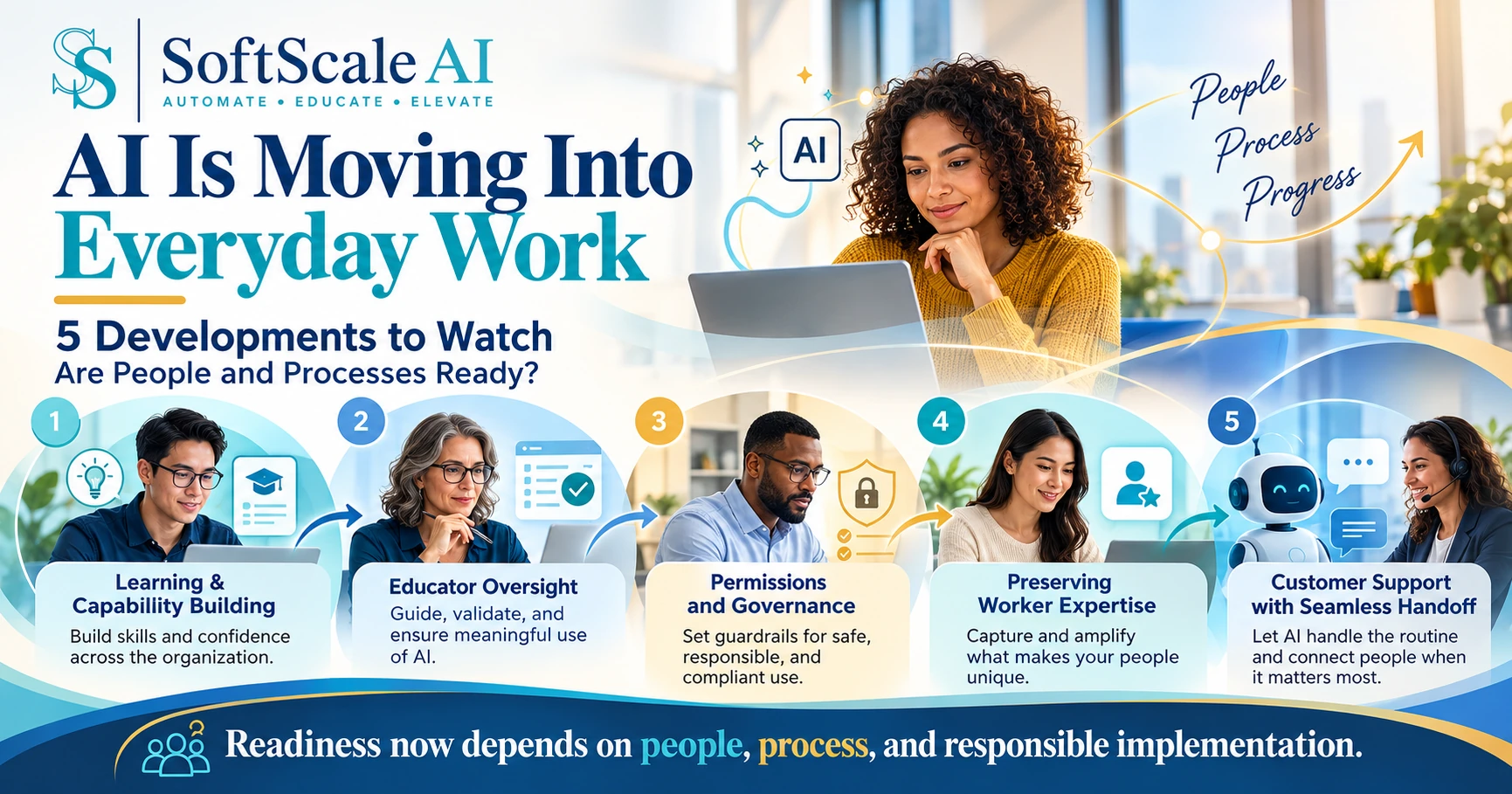 This Week in AI with Pamela Gosa
AI Is Moving Into Everyday Work. Are People and Processes Ready? 5 Developments to Watch
This week: a $70 million AI-skills initiative, new educator training, AI agents in banking, a manufacturing knowledge assistant and an AI customer-service voice agent. Plus: Ohio AI Watch.
 This Week in AI with Pamela Gosa
AI Is Getting More Capable. Are People and Organizations Ready? 5 Developments Worth Watching
Five AI developments this week are changing how schools prepare students, how employers prepare workers, how increasingly capable AI systems are governed, and how nonprofits build AI capacity—plus a new Ohio AI Watch development unfolding in Greater Cincinnati.