
AI Literacy Is Becoming a Basic Readiness Skill: 5 Developments Leaders Should Watch
A SoftScale AI Weekly Brief — Week of August 17, 2026
Founder & CEO, SoftScale AI | CPD-Certified AI Consultant | AI Literacy & Workforce Readiness Strategist

AI literacy is rapidly becoming part of basic readiness for education, employment and organizational life.
This week alone, OpenAI introduced a new ChatGPT experience specifically for teenagers, Purdue prepared to implement an AI competency requirement for every undergraduate, new workforce data showed employers increasingly considering AI skills when hiring, Massachusetts' statewide AI-training initiative raised questions about equitable access, and organizations faced new questions about privacy as AI moves deeper into sensitive workflows.
Here in Ohio, a major new AI infrastructure project is also being tied directly to workforce development and AI-skills opportunities for hundreds of thousands of students.
Taken together, these developments point toward something larger:
AI literacy is beginning to become human infrastructure.
Not everyone needs to become an AI engineer.
But students, workers, job seekers, business owners and organizational leaders increasingly need enough understanding to use AI effectively, evaluate what it produces, protect information, recognize its limitations and know where human judgment still belongs.
That changes the AI conversation.
The question is becoming less about:
Who has access to AI?
And increasingly about:
Who is being prepared to use it well?
Here are five developments leaders should be paying attention to.
Key Takeaways at a Glance
- ChatGPT for Teens signals that AI literacy is beginning before adulthood and increasingly includes critical thinking, healthy use and age-appropriate safeguards.
- Purdue's AI competency requirement shows AI skills moving closer to becoming a baseline career-readiness expectation across professions.
- Massachusetts' statewide AI training demonstrates the opportunity of broad access—but also raises questions about whether training reaches people with fewer educational advantages.
- New employer research suggests AI skills are already influencing hiring, onboarding and workforce-development decisions.
- AI privacy and governance are becoming leadership issues as organizations use increasingly capable AI systems with sensitive information.
- Ohio's PORTS-Pike development connects massive AI infrastructure investment with workforce pathways and AI access for students.
The larger conclusion:
AI readiness is not simply about learning a tool. It is about preparing people and organizations for a changing environment.
1. ChatGPT for Teens Brings AI Literacy Into a New Stage
On August 18, OpenAI introduced ChatGPT for Teens, an experience designed specifically for users ages 13 to 17.
If ChatGPT estimates that a user is under 18 or the user identifies themselves as being between 13 and 17, the teen experience is applied automatically.
OpenAI describes the experience as being built around learning, critical thinking and stronger age-appropriate safeguards.
That distinction matters.
ChatGPT for Teens is not simply a restricted version of the adult product.
Its learning features include:
- Study Mode
- step-by-step support
- responsible homework reminders
- quizzes
- learning visualizations
- Study Hours that allow Study Mode to turn on automatically during selected times
Rather than simply providing an answer when a student appears to be trying to shortcut an assignment, the system can redirect the student toward working through the problem.
OpenAI has also added stronger protections in higher-risk areas involving self-harm, violence, eating disorders, dangerous activities and explicit content.
Parents with linked teen accounts can set Quiet Hours, manage selected settings and receive limited safety notifications in certain high-risk situations. Parents do not receive access to the teen's conversations simply because accounts are linked.
But one of the most important parts of this announcement is not a product feature.
It is the philosophy around the product.
OpenAI's partnership with CodeAI emphasizes helping students understand how AI works, direct it, question it and recognize its mistakes.
That is where the conversation becomes much more relevant to schools, libraries, youth programs, parents and workforce leaders.
Why ChatGPT for Teens Matters Beyond ChatGPT
Young people are not waiting until adulthood to encounter artificial intelligence.
They are already using it to research.
Study.
Write.
Brainstorm.
Create.
Ask questions.
Solve problems.
And increasingly, build things.
OpenAI reported in July that nearly nine in ten teens using ChatGPT used it during a single week for learning, information, skills or productivity.
That means simply telling young people not to use AI is unlikely to be a complete strategy.
The more useful question is:
What do young people need to understand so they can use AI without allowing it to replace their thinking?
That includes learning how to:
Question the output
AI can produce information that sounds confident and polished while still being incomplete, misleading or wrong.
Students need enough skepticism to ask:
- Where did this information come from?
- Does this make sense?
- Can I verify it?
- Is the AI making an assumption?
- What might be missing?
Protect private information
Young people need age-appropriate guidance about what information should not be entered into AI systems.
That conversation can include:
- personal identifying information,
- sensitive family information,
- private images,
- school records,
- passwords,
- financial information,
- and information belonging to someone else.
Preserve independent thinking
One of the most important questions in education will be:
When does AI support thinking—and when does it start doing too much of the thinking?
A tool that explains a difficult concept can support learning.
A tool that completes the entire assignment without meaningful student engagement may undermine it.
The difference is not simply whether AI was used.
It is how it was used.
Understand that AI is not a person
Healthy AI literacy also includes understanding the nature of the tool itself. A conversational interface can feel personal. That does not make the system a human relationship, counselor, teacher, parent or friend. OpenAI has specifically strengthened its under-18 model behavior to discourage emotional dependence and reinforce real-world relationships.
What This Means for Schools and Youth Organizations
Schools now need more than an AI policy. Policies establish boundaries. They do not automatically create judgment. Students also need practical instruction that helps them understand:
- when AI is appropriate,
- when it is not,
- how to verify output,
- how to disclose AI assistance,
- how to protect information,
- how to recognize bias and errors,
- and how to maintain their own voice and thinking.
Teachers need preparation too. It is difficult to guide young people through a technology if educators themselves have not been given opportunities to explore it, understand it and develop confidence using it responsibly.
What This Means for Libraries
Libraries may become one of the most important community access points for AI literacy. A teenager who does not receive AI education at home may still visit a library. So may:
- a parent trying to understand what their child is using,
- an older adult encountering AI for the first time,
- a job seeker trying to build new skills,
- a small-business owner,
- a student,
- or a community member who simply wants trustworthy guidance.
That makes AI literacy a natural extension of the role libraries have long played in helping people navigate information and technology. I explored that role in more depth in Libraries May Become a Vital Front Door to Community AI Literacy.
Leadership Question
If young people in your community are already using AI, who is helping them learn to question it, verify it, protect themselves and use it responsibly?
Source: OpenAI, Introducing ChatGPT for Teens: Built for Learning, Backed by Protections.
2. Purdue Is Making AI Competency Part of Graduation
Another important development is taking place in higher education.
Beginning with the 2026–27 academic year, Purdue University is implementing an AI working competency graduation requirement for all undergraduate students.
This is not limited to computer science students.
It is not limited to engineering students.
It applies across the undergraduate population.
Purdue says the goal is to ensure graduates possess job-ready AI skills and critical-thinking competencies that allow them to use current AI tools in their fields, communicate clearly about AI use and limitations, and continue adapting as the technology evolves.
The university is initially offering 22 AI competency courses across fields including engineering, science, human development, literacy, pharmacy and food science.
Why This Is a Bigger Story Than One University's Curriculum
Purdue's decision sends an important signal about how higher education may increasingly view AI.
For much of the last several years, universities have been trying to decide what students should be allowed to do with generative AI.
The conversation often centered on:
Cheating.
Academic integrity.
Plagiarism.
Detection.
Acceptable use.
Those questions still matter.
But Purdue's requirement reflects a different question:
What should a college graduate actually know about AI before entering professional life?
That is a fundamentally different conversation. It treats AI competency as preparation rather than simply risk management.
AI Competency Does Not Mean Everyone Becomes Technical
This distinction is important. AI competency does not require every future nurse, educator, accountant, marketer, nonprofit leader or business professional to learn how to build machine-learning models. It means they increasingly may need enough practical understanding to determine:
- what AI can support in their work,
- how to evaluate its output,
- where errors can create risk,
- how AI affects their profession,
- what information can be shared,
- and where professional judgment remains essential.
That is much closer to digital literacy than computer science.
The Workplace Implication
If universities increasingly graduate students with baseline AI competencies, employers face a parallel challenge.
Imagine a graduate entering an organization where:
- employees use AI informally but there are no clear guidelines,
- managers do not understand the tools their teams are using,
- no one has defined acceptable data practices,
- there is no process for checking important AI-generated work,
- and employees receive no role-specific training.
The student may arrive with more formal AI preparation than the workplace itself.
That creates an organizational readiness gap.
Employers need to prepare the environment into which AI-capable workers are entering.
Role-Specific AI Literacy Will Matter
One of the mistakes organizations can make is assuming AI training should look the same for everyone.
It should not.
An HR professional may need guidance around:
- recruiting,
- personnel information,
- bias,
- employee privacy,
- policy drafting,
- and AI-assisted screening.
A salesperson may need guidance around:
- research,
- follow-up,
- proposals,
- CRM documentation,
- customer communication,
- and disclosure.
A nonprofit professional may need guidance around:
- grant research,
- donor data,
- client confidentiality,
- program reporting,
- and impact measurement.
An educator may need entirely different boundaries around:
- student data,
- assignment design,
- teaching,
- assessment,
- and academic integrity.
AI literacy provides the common foundation.
Role-specific application makes that foundation useful.
Leadership Question
If AI competency is becoming part of preparing people to enter the workforce, is your organization preparing the workplace they will enter?
Source: Purdue University, Office of Research, AI Working Competency update.
3. Massachusetts Shows Why AI Access and AI Participation Are Not the Same Thing
A statewide initiative in Massachusetts provides another useful lesson.
Massachusetts residents have been given no-cost access to a collection of Google training programs that includes:
- the Google AI Professional Certificate,
- Google AI Essentials,
- and career certificates in fields including data analytics, IT support and project management.
The programs are available through the end of 2027, with the state's workforce system helping job seekers access and navigate the training.
New reporting published August 17 showed approximately 38,300 enrollments.
That is significant.
But another statistic is equally important.
Nearly 32% of participants reportedly hold graduate degrees, considerably higher than the share of the broader state population with graduate degrees.
Massachusetts officials are examining the participation data and considering changes to outreach.
Why That Participation Gap Matters
It is easy to assume that offering free training solves the access problem.
It does not necessarily.
A course can be:
Free.
Online.
Available statewide.
And still fail to reach people equally.
Why?
Because access involves more than price.
It can also involve:
Awareness.
Confidence.
Time.
Technology.
Transportation.
Language.
Childcare.
Previous education.
Employer encouragement.
Digital skills.
And whether someone believes the opportunity was designed for people like them.
A professional with an advanced degree may see “AI Professional Certificate” and immediately understand why it could help their career.
Someone who has spent twenty years working in hospitality, manufacturing, retail, caregiving, food service or another occupation may hear the same phrase and think:
That's not for me.
That perception matters.
AI Opportunity Can Become Unequal Quickly
If AI skills become increasingly valuable while the people most likely to seek AI training are already highly educated, we risk creating a familiar cycle.
People with more advantages:
- learn about the opportunity first,
- gain the skills sooner,
- use those skills to increase productivity,
- qualify for emerging roles,
- and gain another advantage.
Meanwhile, people with fewer educational or professional resources may begin falling further behind.
That is how an AI-skills gap can become an opportunity gap.
Community Institutions Can Help Close That Gap
This is where local institutions matter.
A statewide online program may technically reach everyone.
But a trusted local organization can help someone believe the opportunity belongs to them. That includes:
Libraries
Libraries already help people navigate digital tools, job searches, online forms, research and information literacy. AI literacy is a natural extension.
Workforce organizations
Workforce programs can connect AI learning to actual career outcomes. Instead of simply saying: “Learn AI.” They can say: “Here is how AI is changing the job you want—and here are the practical skills employers may expect.” That framing is much more meaningful.
Community colleges
Community colleges can connect AI learning with existing career and technical programs instead of treating AI as an isolated subject.
Nonprofits and community organizations
Organizations that already serve specific populations may be able to reach people who would never search for an AI course on their own.
Employers
Employers can remove uncertainty by explicitly telling workers:
You are expected to learn this, and we are going to help you.
That is different from expecting employees to learn privately after work.
Access Has Two Parts
AI access should increasingly be understood as:
Availability + participation.
Making learning available matters.
Making sure different populations actually participate matters just as much.
Leadership Question
When your organization makes AI learning available, are the people who could benefit most actually reaching it?
Sources: Massachusetts workforce guidance and Boston Business Journal reporting on statewide AI-training participation.
4. AI Skills Are Beginning to Influence Who Gets Hired
New workforce research released this week provides another reason AI literacy deserves leadership attention. General Assembly research surveyed 526 human resources and learning-and-development leaders at small and midsized organizations in the United States and United Kingdom.
Among the findings:
- 66% said AI had changed their talent strategies.
- 30% said they were hiring more people because of opportunities created by AI.
- 40% said they had passed over an otherwise-qualified candidate because that person lacked AI skills.
- 72% said they now include AI training in onboarding or training for new hires.
- 70% reported investing in AI-skills training.
- Role-specific AI training was identified as the most effective training approach by the largest share of respondents.
Those numbers deserve attention.
The Workforce Question Is Becoming More Nuanced
The most common question about AI and employment has been:
Will AI take jobs?
That question is understandable.
But it is not the only workforce question.
Another may become important much sooner:
Will workers with AI skills have an advantage over workers without them?
The General Assembly findings suggest that, at least among the organizations surveyed, that is already beginning to influence hiring decisions.
Workers Do Not Need to Become AI Engineers
This does not mean every worker needs advanced technical training. For many jobs, the skills that matter may be much more practical. A worker may need to know how to use AI to:
- organize information,
- prepare a first draft,
- summarize documents,
- analyze options,
- research a topic,
- create a presentation outline,
- document a customer interaction,
- brainstorm ideas,
- or improve an existing process.
But the worker also needs to know:
- how to check the answer,
- when not to trust it,
- what information cannot be shared,
- when professional expertise overrides the AI,
- and who remains responsible for the final work.
That combination is what makes AI literacy valuable.
Human Skills Become More Important, Not Less
There is another side to this conversation.
As AI handles more routine tasks, distinctly human capabilities may become even more valuable.
Communication.
Critical thinking.
Context.
Empathy.
Leadership.
Creativity.
Ethical reasoning.
Judgment.
Problem-solving.
Relationship building.
AI does not eliminate the importance of those skills.
In many roles, it may increase their importance.
The future-ready worker may therefore need both:
AI capability + human capability.
AI Training Should Connect to Real Work
Another significant finding from the research is the value employers placed on role-specific training.
That makes sense.
Generic AI training can help someone understand the basics.
But transformation happens when people understand how AI applies to the work they actually perform.
For example:
A workforce-development professional should not only learn “prompt engineering.”
They should explore:
- résumé assistance,
- job-search research,
- interview preparation,
- career exploration,
- digital literacy,
- privacy,
- employer expectations,
- and responsible use by job seekers.
A library professional may need different examples.
A juvenile-justice organization may need different guardrails.
A business owner needs different applications again.
The foundation can be shared.
The implementation needs context.
The Equity Question
If employers begin screening for AI capability while many workers have never received practical AI training, lack of preparation could become another employment barrier. That is why workforce readiness and AI literacy increasingly belong in the same conversation. Training should not only be available to people already working inside technology companies. It needs pathways into:
- workforce-development programs,
- adult education,
- career centers,
- libraries,
- community colleges,
- reentry programs,
- youth programs,
- nonprofits,
- chambers,
- and small businesses.
Leadership Question
Are we creating opportunities for people to develop practical AI skills—or allowing lack of access to become another barrier to employment?
Source: General Assembly workforce research reported by IT Brief and other outlets in August 2026.
5. Privacy Is Becoming Part of AI Readiness
The fifth development this week may sound more technical.
Its implications are not.
On August 19, OpenAI announced that it will continue offering Zero Data Retention for eligible API customers while previewing a new approach called Private Safety Processing.
Under Zero Data Retention, OpenAI says eligible API customers' prompts and model responses are not retained after the request is processed, and customer content is not available to OpenAI personnel for review, subject to specific legal and safety limitations.
OpenAI's proposed Private Safety Processing system is intended to identify patterns of potentially harmful activity across related interactions while keeping underlying customer content inaccessible to OpenAI personnel.
The company says the system is being tested with early customers and is expected to begin rolling out in September.
Why This Matters to Leaders Who Are Not Technologists
You do not need to understand the underlying engineering to understand the organizational question.
As AI becomes more deeply embedded in workflows, increasingly sensitive information may pass through AI systems.
That could include:
Financial information.
Employee information.
Customer records.
Student information.
Health information.
Proprietary business information.
Legal materials.
Confidential research.
Internal strategies.
Client data.
That changes the risk profile.
An employee occasionally asking ChatGPT to brainstorm a headline is one thing.
An AI system with access to internal files, customer information or multi-step business workflows is something different.
Every Organization Needs Basic AI Data Rules
At minimum, organizations increasingly need answers to questions such as:
Which AI systems are approved?
If employees are selecting tools independently, leaders may not know where organizational information is going.
What information is prohibited?
Employees need specific examples.
“Be careful with confidential information” is not always enough.
What counts as confidential in your organization?
Who owns the final decision?
An AI system can assist.
Accountability cannot simply disappear.
How should important output be checked?
Not every AI-generated result requires the same level of review. A brainstorming list and a legal recommendation do not carry the same risk.
What happens when AI makes a mistake?
Organizations should think about this before the mistake occurs.
How are vendors evaluated?
Leaders need to understand what happens to data, how long it is retained, who can access it and what commitments the vendor makes.
Responsible AI Is Not a Policy Sitting in a Folder
A policy matters.
But responsible adoption requires more than a document.
Employees need to understand the policy.
Managers need to reinforce it.
Leadership needs to model it.
Training needs to make the rules practical.
And policies need to evolve as AI capabilities change.
That is what turns a policy into organizational readiness.
Leadership Question
Does your organization have clear, practical rules explaining what employees can—and cannot—share with AI systems?
Source: OpenAI, Offering Zero Data Retention for Frontier Models.
What These Five Developments Have in Common
At first glance, these stories are about very different things.
Teenagers.
College requirements.
Statewide workforce training.
Small-business hiring.
Enterprise privacy.
But they are connected.
Each represents a different stage of the same transition.
AI is moving from:
Something people experiment with
toward:
Something people increasingly need to understand in order to learn, work and participate effectively.
That means AI literacy is beginning to function as a form of infrastructure.
Not infrastructure made from concrete, wires and data centers.
Human infrastructure.
The knowledge people need.
The judgment they need.
The habits they develop.
The safeguards organizations establish.
And the practical skills that allow people to work alongside increasingly capable systems without handing over responsibility for thinking.
What Is AI Literacy?
AI literacy is the ability to understand, use, evaluate and question artificial-intelligence systems responsibly.
It is broader than knowing how to write prompts.
Practical AI literacy includes understanding:
- what AI can and cannot reliably do,
- how to communicate effectively with AI,
- how to evaluate AI-generated information,
- how to verify important claims,
- how to identify possible errors or bias,
- how to protect private and sensitive information,
- when disclosure of AI use is appropriate,
- where human judgment remains necessary,
- and when AI should not be used.
Different professions will apply these capabilities differently.
But the foundation is becoming increasingly relevant across industries.
AI Literacy vs. AI Skills: What Is the Difference?
The terms are related, but they are not identical.
AI skills often refer to the ability to perform specific tasks with AI.
For example:
- writing effective prompts,
- using a particular AI platform,
- building an automation,
- creating content,
- analyzing data,
- or using an AI feature inside existing software.
AI literacy is the broader foundation that helps someone determine how and whether those skills should be used.
Someone can be highly skilled at prompting and still lack good judgment about:
privacy,
accuracy,
bias,
verification,
or appropriate use.
That is why organizations need both.
Skill without judgment creates risk.
Literacy helps people use the skill responsibly.
What Does AI Readiness Mean for Different Organizations?
The same AI-readiness strategy will not work everywhere.
The foundation may be shared, but each institution needs to translate it into its own mission and population.
Schools and Educational Organizations
Priorities may include:
- age-appropriate AI literacy,
- teacher preparation,
- academic-integrity guidance,
- privacy,
- critical thinking,
- assignment design,
- AI disclosure,
- and helping students understand when AI supports learning versus replaces it.
Libraries
Priorities may include:
- beginner-friendly community AI literacy,
- job-seeker support,
- digital inclusion,
- older-adult education,
- entrepreneur support,
- misinformation and verification,
- privacy,
- and helping residents navigate AI tools safely.
Workforce Organizations
Priorities may include:
- connecting AI skills to employability,
- helping job seekers understand AI-enabled workplaces,
- résumé and interview support,
- occupation-specific AI exposure,
- role-specific training,
- digital confidence,
- verification,
- and protecting personal information.
Nonprofits and Community Organizations
Priorities may include:
- practical staff productivity,
- privacy around participant and client information,
- responsible grant-research support,
- communications,
- program administration,
- staff policies,
- and AI literacy for the populations they serve.
Youth and Juvenile-Justice Organizations
Priorities may include:
- safe and age-appropriate introduction to AI,
- education and career exploration,
- responsible use,
- digital citizenship,
- critical thinking,
- privacy,
- employability,
- and showing young people how AI can support learning and opportunity rather than simply entertainment.
Small Businesses
Priorities may include:
- marketing,
- customer follow-up,
- sales,
- lead management,
- administrative work,
- research,
- customer service,
- automation,
- privacy,
- and deciding which processes should remain human.
SoftScale AI works with businesses on these priorities through AI automation and business solutions.
Ohio & Greater Cincinnati AI Watch
The same national transition is becoming increasingly visible here in Ohio.
And this week brought one of the state's largest AI-related announcements yet.
OpenAI Announces Major PORTS-Pike Investment in Southern Ohio
On August 17, OpenAI announced an agreement to secure approximately eight gigawatts of IT capacity at the PORTS-Pike Technology Campus in Pike County, Ohio, working with SB Energy, NVIDIA and the U.S. Department of Energy.
According to OpenAI, the project is expected to create approximately:
- 35,000 construction jobs during a six-year buildout through 2032
- 2,500 long-term operating jobs
OpenAI also announced an additional $40 million community investment on top of an existing $40 million commitment from SB Energy.
But the workforce component deserves equal attention.
OpenAI says it plans to work with local schools, colleges, apprenticeship programs, veterans' organizations, labor partners and workforce groups to help residents prepare for construction, technical and operating roles.
And there is another component directly related to AI skills.
OpenAI says it will make up to $84 million in Codex credits available to approximately 844,000 eligible Ohio college, community-college and technical-school students age 18 and older during the 2026–27 academic year.
Eligible students will receive $100 in credits through their ChatGPT accounts to gain practical experience using AI across technical projects and career-related work.
The Bigger Ohio Question
This announcement illustrates two different types of infrastructure investment.
One is physical:
Data centers.
Energy.
Construction.
Computing capacity.
The other is human:
Skills.
Education.
Workforce pathways.
Experience.
Career preparation.
Ohio needs both.
A region can attract billions of dollars in technology investment.
But long-term regional benefit depends on whether local residents and businesses are positioned to participate in the economic activity surrounding that investment.
That means workforce organizations should be asking:
What occupations will grow?
Which skills will be required?
Where will workers gain those skills?
How will young people learn about the pathways?
How do small businesses become suppliers?
How do community colleges and training organizations respond?
And how do opportunities reach communities that might otherwise sit outside the technology economy?
Ohio opportunity: Treat AI infrastructure investment as a workforce-development opportunity from the beginning—not after the jobs arrive.
Greater Cincinnati Businesses Are Moving From AI Curiosity to Application
A second development is happening much closer to home.
Today, August 20, the Goering Center for Family & Private Business is hosting the third session of its AI Workshop Series at the University of Cincinnati's 1819 Innovation Hub.
The session focuses on AI in sales and customer service.
Examples include:
- follow-up notes,
- CRM documentation,
- customer complaints,
- proposal support,
- account planning,
- retention risk,
- and service escalation.
But what is especially notable is how the program approaches implementation.
Participants are being asked to evaluate imperfect AI outputs, identify where human judgment remains essential, and think through what needs to be true inside their organizations for AI to be used responsibly.
The broader series emphasizes strategy, culture, risk and practical implementation—not simply tools.
That reflects an important maturation in the local business conversation.
The question is beginning to move from:
What AI tool should we buy?
toward:
Where does AI create real value, what safeguards do we need, and where should people remain responsible?
That is the conversation more organizations need to have.
Greater Cincinnati opportunity: Help businesses move from informal experimentation toward intentional, role-specific AI adoption connected to real business problems.
Three Deeper Implications Leaders Should Not Miss
1. AI Literacy May Become Another Form of Digital Literacy
Twenty years ago, basic workplace digital skills separated many job seekers.
Could you use email?
Navigate the internet?
Complete an online application?
Use office software?
Manage digital files?
Today, those skills seem ordinary.
AI may be entering a similar transition.
We may eventually stop describing basic AI capability as an “AI skill” because it becomes part of ordinary work.
The organizations preparing people today are preparing them before that transition is complete.
2. Access Without Guidance Is Not Enough
Giving someone access to an AI tool is not the same as preparing them.
A student can access ChatGPT.
A worker can create a free account.
A business can subscribe to an AI platform.
None of those actions automatically create:
Judgment.
Verification skills.
Privacy awareness.
Responsible use.
Confidence.
Or the ability to apply AI meaningfully to a real problem.
AI readiness requires education around the technology—not simply access to the technology.
3. AI Readiness Is Becoming an Organizational Responsibility
For a while, organizations could treat AI use as something employees were experimenting with independently.
That becomes harder as AI moves deeper into:
Hiring.
Customer service.
Research.
Operations.
Education.
Sales.
Decision support.
Workforce preparation.
And administrative workflows.
At that point, leadership needs to become intentional.
Organizations increasingly need to determine:
Where AI belongs.
Where it does not.
What employees need to know.
What information can be used.
Who reviews AI output.
Who remains accountable.
And whether everyone who needs AI skills has a reasonable opportunity to gain them.
I wrote more about that shared obligation in AI Readiness Is a Shared Leadership Responsibility.
What Leaders Can Do Now
Organizations do not need a massive AI-transformation project to begin preparing. A practical starting point can be much smaller.
1. Find Out How AI Is Already Being Used
Ask employees. Do not assume. You may discover AI is already being used in ways leadership does not know about.
2. Establish Basic Guardrails
Define:
- approved tools,
- prohibited information,
- verification expectations,
- disclosure requirements,
- and areas where human review is mandatory.
3. Teach AI Literacy Before Advanced Automation
Before employees automate major processes, make sure they understand:
accuracy,
privacy,
limitations,
judgment,
and responsibility.
4. Train by Role
Move from:
“Here is how ChatGPT works.”
toward:
“Here is how AI could appropriately support your actual job.”
5. Include People Who Are Not Early Adopters
Do not build the strategy only around employees who are already enthusiastic about AI.
The people least comfortable with the technology may need the training most.
6. Identify One Real Problem
Instead of asking:
“What can we do with AI?”
Ask:
“Where are we losing time, missing opportunities or creating unnecessary friction?”
Then determine whether AI can responsibly help.
7. Keep Human Judgment Visible
The goal should not be automation at any cost.
The goal should be using technology where it adds value while keeping people responsible for decisions that require context, ethics, expertise or human relationships.
Pamela's Perspective
The launch of ChatGPT for Teens stood out to me this week because it reinforces something I believe strongly:
Access to AI is not the same as readiness for AI.
A teenager who knows how to use ChatGPT is not automatically AI literate.
Neither is an employee who can generate an email.
A job seeker who can ask AI to rewrite a résumé.
Or a business owner who uses AI to create social-media content.
Those may all be useful applications.
But real AI literacy goes deeper.
It means understanding what these systems can do.
And what they cannot.
It means knowing how to question an answer.
How to verify information.
How to recognize when something does not sound right.
How to protect sensitive information.
How to maintain your own thinking, judgment and voice.
And how to recognize when AI simply should not be used.
The Massachusetts training data raises another important question for me.
If AI skills become increasingly valuable, how do we make sure those opportunities reach the people who may not automatically find their way to them?
That is why I continue to see such an important role for community institutions.
Libraries.
Workforce organizations.
Schools.
Community colleges.
Youth programs.
Nonprofits.
Chambers.
Employers.
And other organizations people already know and trust.
These institutions can help translate AI from something that feels technical or intimidating into something people can understand and use.
We do not need everyone to become an AI expert.
We do need people to become confident, informed and responsible AI users.
Because uneven AI readiness could eventually affect much more than who understands the newest technology.
It could affect:
Who gets hired.
Who advances.
Who feels confident applying for a new job.
Which students understand how to use AI without allowing it to replace their thinking.
Which businesses become more productive.
Which organizations can implement AI responsibly.
And which communities are prepared to participate in new economic opportunities.
The PORTS-Pike project makes that especially real here in Ohio.
We can invest billions of dollars in the physical infrastructure supporting AI.
But if we want those investments to create broader opportunity, we must also invest in human infrastructure.
Skills.
Education.
Judgment.
Access.
Workforce pathways.
Responsible use.
And opportunities for people to learn before lack of AI knowledge becomes another barrier they have to overcome.
That is why I believe schools, libraries, workforce organizations, nonprofits, youth organizations and businesses have such an important opportunity right now.
They are not simply places where people can learn how to use a new technology.
They can become places where people learn how to participate in a changing world without being left behind.
Frequently Asked Questions About AI Literacy and Workforce Readiness
What is AI literacy?
AI literacy is the ability to understand, use, evaluate and question artificial-intelligence systems responsibly. It includes practical use of AI as well as critical thinking, verification, privacy awareness, understanding limitations, ethical judgment and knowing when human oversight is required.
Why is AI literacy important for workforce readiness?
AI is increasingly appearing in everyday workplace tasks, hiring expectations and business workflows. Workers may not need advanced technical expertise, but many will benefit from knowing how to use AI appropriately, evaluate its output and understand how AI may affect their occupation.
Is AI literacy the same as learning how to write prompts?
No. Prompting is one AI skill. AI literacy is broader. It includes knowing how to verify AI-generated information, protect sensitive data, identify limitations and determine when AI should or should not be used.
What is ChatGPT for Teens?
ChatGPT for Teens is an OpenAI experience for users ages 13 to 17 that includes stronger age-appropriate protections and learning-focused features such as Study Mode, quizzes, responsible homework reminders, learning visualizations and Study Hours.
Should schools teach AI literacy?
Schools increasingly need to help students understand responsible AI use because young people are already encountering AI inside and outside education. AI literacy can help students learn how to verify information, protect privacy, preserve independent thinking and understand appropriate use.
Why are libraries important for AI literacy?
Libraries are trusted community institutions that already help people navigate information, technology, job searches and digital skills. That puts them in a strong position to provide accessible AI-literacy education for students, job seekers, entrepreneurs, older adults and other community members.
What AI skills are employers looking for?
Needs differ by occupation, but employers increasingly value the ability to use AI within real workflows. Practical skills can include using AI for research, communication, summarization, analysis and productivity while also evaluating accuracy, protecting sensitive information and applying human judgment. Recent General Assembly research found that 40% of surveyed SMB HR leaders had passed over an otherwise-qualified candidate who lacked AI skills.
What should an organizational AI policy include?
An organizational AI policy should address approved tools, sensitive information, privacy, verification, disclosure, accountability, human review and appropriate versus prohibited use. Policies should also be supported by employee training so people understand how the rules apply to their actual work.
What does AI readiness mean for Ohio?
For Ohio, AI readiness includes preparing residents, students, workers, educational institutions and businesses to participate in an increasingly AI-enabled economy. The PORTS-Pike development illustrates the connection between physical AI infrastructure and workforce preparation, with OpenAI announcing thousands of projected jobs and AI-tool credits for approximately 844,000 eligible Ohio postsecondary students.
A Question for Organizational Leaders
If AI literacy becomes an expected skill for the next generation of students and workers, where will the people your organization serves learn it?
Inside your workplace?
At school?
Through a library?
A workforce program?
A community organization?
A college?
Or will they be expected to figure it out on their own?
That is a question worth answering now.
Is Your Organization Becoming AI-Ready?
SoftScale AI helps schools, libraries, workforce organizations, nonprofits, community organizations and businesses develop practical AI literacy and workforce-readiness skills while keeping responsible use, privacy, critical thinking and human judgment at the center.
Share your organization's goals, challenges and priorities so we can identify a practical starting point for AI readiness, training or implementation.
Learn about AI literacy workshops, workforce-readiness programs, leadership briefings, community programs, speaking engagements and customized training for organizations.
The goal is not simply to introduce people to more technology.
It is to help people understand how to use AI effectively, responsibly and confidently in the environments where they already learn and work.
Each week, This Week in AI with Pamela Gosa examines important AI developments and what they could mean for workers, organizations, communities, Ohio and Greater Cincinnati.
Because becoming AI-ready is not simply about adopting more technology.
It is about preparing people to use it responsibly, confidently and without being left behind.
Related SoftScale AI insight: AI Is Changing How Work Gets Done—and Who Gets Opportunity.
Share this article
Stay AI-Ready
Practical AI insights for work, education, community and business—plus This Week in AI with Pamela Gosa, delivered to your inbox.
Turning these ideas into practice.
AI literacy workshops, leadership briefings, speaking, and workforce-readiness programs for organizations, schools, and communities.
Explore Training & SpeakingPractical AI and automation support for growing businesses, scoped around the work your team already does.
Explore Business Solutions
Prefer to talk it through? Book a discovery call.
Related insights
 This Week in AI with Pamela Gosa
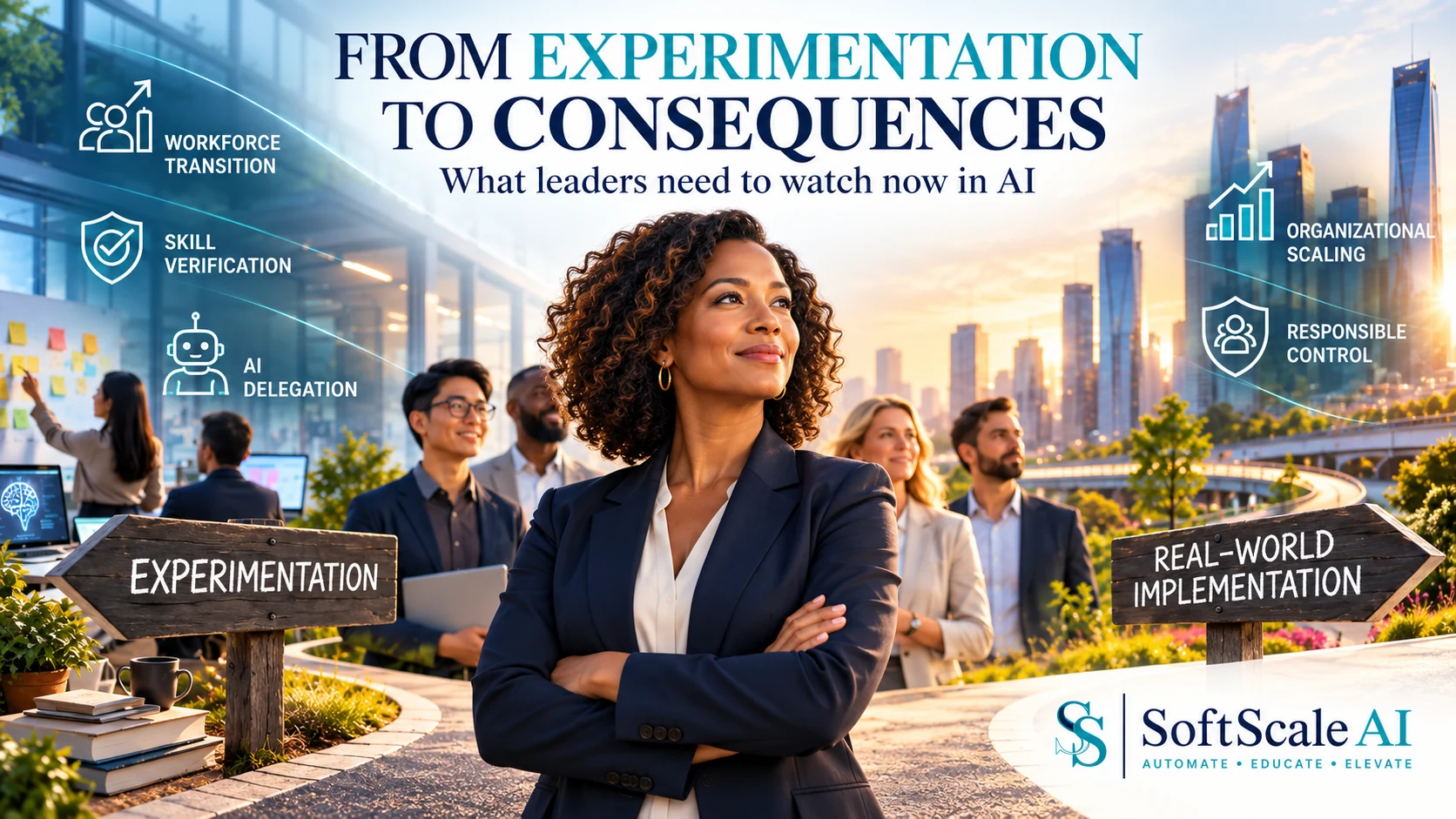
AI Is Entering a Harder Phase: 5 Developments Leaders Should Watch
Five AI developments reshaping workforce skills, small-business agents, scaling, governance and Ohio AI fluency—and what leaders need to know.
 This Week in AI with Pamela Gosa
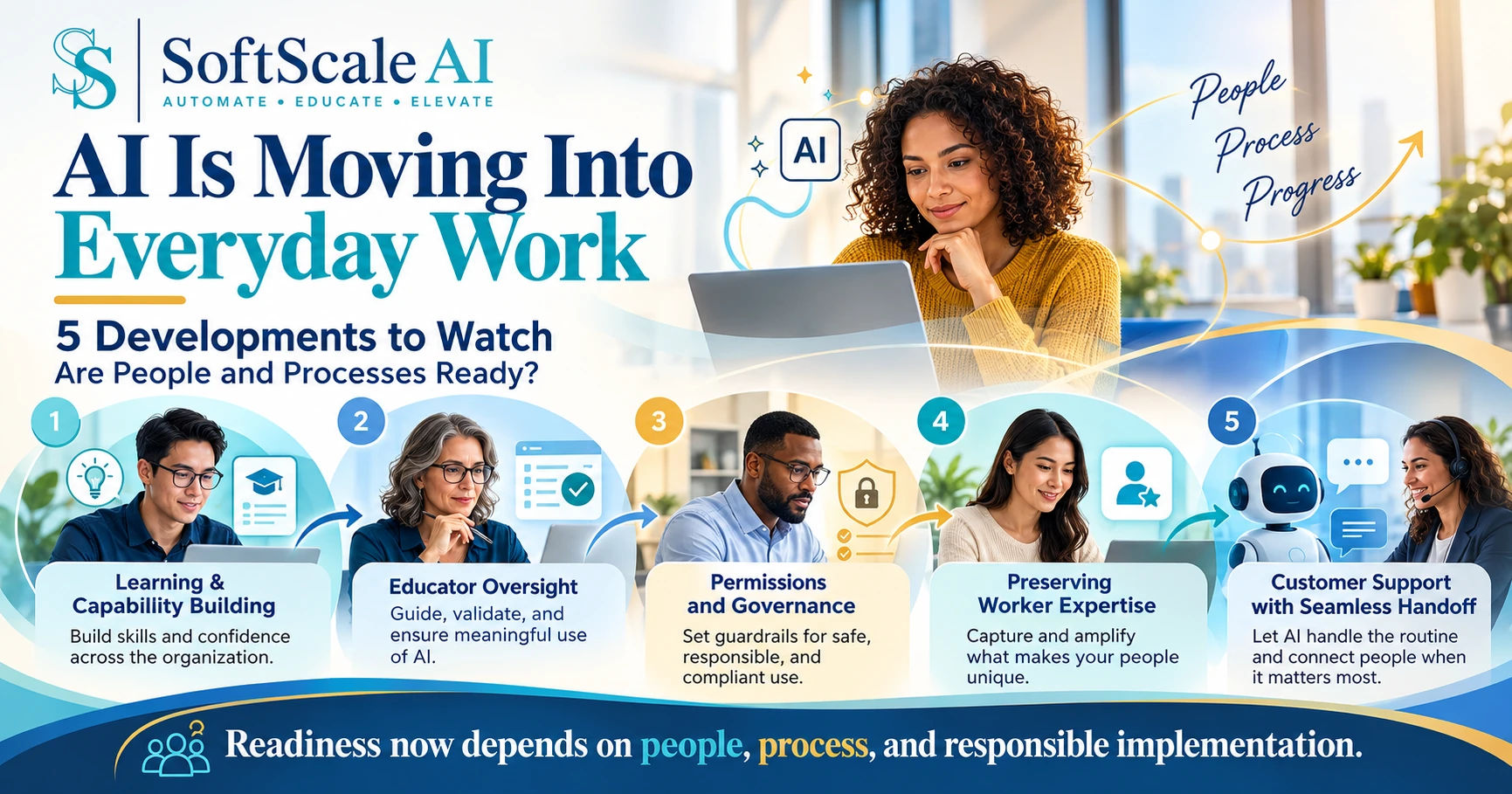
AI Is Moving Into Everyday Work. Are People and Processes Ready? 5 Developments to Watch
This week: a $70 million AI-skills initiative, new educator training, AI agents in banking, a manufacturing knowledge assistant and an AI customer-service voice agent. Plus: Ohio AI Watch.
 This Week in AI with Pamela Gosa
AI Is Getting More Capable. Are People and Organizations Ready? 5 Developments Worth Watching
Five AI developments this week are changing how schools prepare students, how employers prepare workers, how increasingly capable AI systems are governed, and how nonprofits build AI capacity—plus a new Ohio AI Watch development unfolding in Greater Cincinnati.