
AI Is Getting More Capable. Are People and Organizations Ready? 5 Developments Worth Watching
Five AI developments this week are changing how schools prepare students, how employers prepare workers, how increasingly capable AI systems are governed, and how nonprofits build AI capacity—plus a new Ohio AI Watch development unfolding in Greater Cincinnati.
Founder & CEO, SoftScale AI | CPD-Certified AI Consultant | AI Literacy & Workforce Readiness Strategist

This week in AI, the biggest story was not simply that the technology became more capable.
It was how quickly schools, employers, technology companies and community organizations are being forced to decide what responsible preparation should look like.
New York City introduced one of the clearest distinctions yet between giving students access to generative AI and teaching them how to understand it.
New Federal Reserve Bank of New York research showed businesses using AI are still much more likely to retrain employees than eliminate their jobs.
OpenAI introduced GPT-6 Astra, pushing AI further into complex professional and computer-based work.
Anthropic introduced Claude Fable 5.1 and Claude Mythos 5.1, providing another example of how access and safeguards may need to change as AI systems become more capable.
And IREX, working with Microsoft's Tech for Society team, launched an initiative specifically designed to help nonprofits and community organizations build the skills, governance and safeguards necessary to adopt AI responsibly.
Then, here in Greater Cincinnati, Waymo began mapping approximately 50 square miles of Cincinnati and Northern Kentucky.
These are very different developments.
But they raise one common question:
As AI becomes more capable, are we preparing people and organizations just as intentionally?
Key Takeaways at a Glance
- AI literacy and AI access are not the same thing. New York City is restricting student-facing generative AI through eighth grade while introducing AI literacy instruction for high school students.
- AI adoption does not automatically mean layoffs. New York Fed researchers found retraining remained the most common workforce response among regional businesses adopting AI.
- AI is moving further from answering toward doing. OpenAI's GPT-6 Astra expands computer use, coding, research and complex multistep work.
- More powerful AI may require different levels of access. Anthropic's Fable 5.1 and Mythos 5.1 demonstrate how safeguards and availability can change based on capability and risk.
- Community organizations need AI readiness too. IREX and Microsoft's ASCEND initiative is focused on helping nonprofits and civil-society organizations build practical capacity for responsible AI adoption.
- Plus — Ohio AI Watch: Waymo has begun mapping Cincinnati and portions of Northern Kentucky, although autonomous passenger service has not been announced.

1. New York City Is Separating AI Access From AI Literacy
New York City Public Schools announced a one-year moratorium on student-facing generative AI for students in grades 2-K through 8 during the 2026–27 school year.
But the policy does something else that deserves just as much attention.
High school students will receive AI literacy instruction addressing topics including how AI works, privacy, bias and appropriate use. Limited, supervised use of vetted AI tools will also be permitted in approved high school settings.
Companion chatbots are prohibited across all grade levels.
That creates an important distinction.
New York City is not treating:
“Students should not have unrestricted access to generative AI”
as the same statement as:
“Students should not learn about AI.”
Why It Matters
Schools everywhere are facing versions of the same challenge.
AI tools are increasingly accessible to students outside school whether or not a school officially adopts them.
That means restriction alone cannot provide the complete answer.
Young people also need to understand why AI can be wrong, how to verify information, how bias can appear in AI-generated content, what information should remain private, when AI assistance is appropriate and when their own thinking needs to lead.
AI literacy does not require unrestricted access.
And restricting access does not eliminate the need for AI literacy.

Pamela's Practical Takeaway
Youth-serving organizations should separate two questions:
What AI tools should young people be allowed to use?
and
What should young people understand about AI regardless of which tools they are allowed to use?
Those questions overlap, but they are not identical.
A strong youth AI-literacy program should teach skills that remain useful even when platforms, policies and products change:
Verification. Privacy. Critical thinking. Bias awareness. Responsible use. Independent judgment.
Related SoftScale AI insight: ChatGPT for Teens Changes the AI Literacy Conversation.
Leadership Question
If young people in your school or organization could not use a generative AI tool tomorrow, would they still understand enough about AI to navigate it responsibly outside your doors?
Source: New York City Mayor's Office and New York City Public Schools.
2. Businesses Are Retraining Workers for AI More Than Replacing Them
New research from the Federal Reserve Bank of New York provides a useful counterweight to some of the most dramatic predictions about AI and employment.
The New York Fed's regional business surveys found AI adoption continuing to rise sharply.
Among surveyed service firms, 61% reported using AI, up from 40% in 2025. Among manufacturers, 51% reported using AI, up from 26%.
Despite that increase, AI-related layoffs remained uncommon among participating businesses.
Only 4% of service firms reported AI-related layoffs during the previous six months, while none of the manufacturers surveyed reported them.
Some firms reported reducing hiring. Others reported hiring employees because of AI.
But retraining existing employees remained the most common way businesses were adapting their workforces to AI.

Why It Matters
The question:
“Will AI eliminate jobs?”
receives enormous attention.
But leaders also need to ask:
“How will AI change the jobs people already have?”
An employee may remain in the same position while the skills required to perform that position change significantly.
A job description may stay familiar while workflows change.
A worker who never needed AI knowledge before may suddenly be expected to use AI-assisted systems, evaluate generated information or work alongside automation.
That makes workforce development an AI issue before a layoff ever occurs.
Pamela's Practical Takeaway
Do not wait for workforce disruption before beginning workforce preparation.
Start by identifying where AI is entering existing jobs, which tasks are changing, what employees need to understand, what new skills are becoming useful, what information employees need to protect and where human judgment must remain in the process.
AI training should connect to actual work, not simply to an AI demonstration.
Related SoftScale AI insight: AI Is Changing How Work Gets Done—and Who Gets Opportunity.
Leadership Question
If none of your employees lost their jobs to AI this year but half of their jobs changed because of AI, would your workforce-development strategy be ready?
Source: Federal Reserve Bank of New York, Liberty Street Economics.
3. GPT-6 Astra Pushes AI Further Into Real Work
OpenAI introduced GPT-6 Astra on September 3.
Astra expands AI capability across coding, research, computer use, document creation and complex multistep professional work.
That makes Astra important for reasons beyond benchmark performance.
AI is moving further from:
“Give me an answer.”
toward:
“Complete this work.”
OpenAI is initially rolling Astra out to a limited set of organizations, with broader availability planned.
OpenAI has also classified Astra at the Critical level for cybersecurity capability under its Preparedness Framework and introduced additional safeguards and monitoring around its deployment.
Why It Matters
The more an AI system can do, the more important organizational boundaries become.
When AI primarily generated text, leaders needed to think about accuracy and information security.
When AI can also interact with software and perform multistep work, additional questions emerge:
- What can it access?
- What can it change?
- What can it send?
- What actions can it take without approval?
- What should always require human authorization?
And who remains accountable when AI performs part of a process?
Pamela's Practical Takeaway
Before giving an AI system more ability to act, create a simple authority map.
Ask:
- What may the AI read?
- What may it create?
- What may it change?
- What may it send or submit?
- What requires human approval?
- What is completely off limits?
Capability and permission should never be treated as the same thing.
An AI system being able to perform an action does not automatically mean it should be authorized to perform it.
Leadership Question
As AI systems become capable of completing more work independently, has your organization clearly decided where the AI's authority ends?
Source: OpenAI — GPT-6 Astra.
4. Anthropic's New Models Show Why AI Access May Need to Be Role-Based
Anthropic introduced Claude Fable 5.1 and Claude Mythos 5.1 on September 1.
The models share the same underlying model, but their safeguards and availability differ.
Fable 5.1 is broadly available with safeguards around particular higher-risk cybersecurity and biology capabilities.
Mythos 5.1 allows greater access to advanced capabilities in those areas but remains restricted to vetted organizations.
The larger lesson is not limited to Anthropic.
As AI systems become more capable, not every person necessarily needs identical access to every capability.
Why It Matters
Organizations already understand role-based access in other areas.
Not every employee has permission to view payroll records, approve financial transactions, access confidential personnel information, modify databases or authorize purchases.
AI permissions should mature in the same direction.
The employee using AI to brainstorm event ideas does not necessarily need the same access as someone handling confidential client information.
An AI assistant drafting an email does not need the same authority as an autonomous system taking actions inside organizational software.

Pamela's Practical Takeaway
Move beyond asking:
“Do we allow AI?”
Start asking:
“Which people should have access to which AI capabilities for which work?”
That may lead to different expectations by role, department, data sensitivity, task, level of autonomy and degree of required human oversight.
A mature AI policy does not have to treat every employee, every tool and every use case exactly the same.
Leadership Question
If everyone in your organization currently has the same AI permissions, is that because you intentionally decided they should—or simply because no one has reviewed the question yet?
Source: Anthropic — Claude Fable 5.1 and Claude Mythos 5.1.
5. IREX and Microsoft Are Addressing the Nonprofit AI-Readiness Gap
IREX announced ASCEND—AI Skills, Capacity, and Enablement for NGOs and Defenders—in collaboration with Microsoft's Tech for Society team.
The initiative is designed to help civil-society organizations, nonprofits and community-based organizations adopt AI safely and effectively.
Its focus goes beyond teaching organizations how to use an AI tool.
ASCEND addresses AI readiness, organizational safeguards, governance, digital security, practical implementation and leadership capacity.
That makes this development particularly relevant for organizations that may see real opportunities in AI but do not have large technology teams or dedicated AI departments.
Why It Matters
Nonprofits are often expected to accomplish significant missions with limited staff, limited time and limited resources.
AI may help organizations with research, communications, administrative work, analysis, program development and other time-consuming responsibilities.
But access to a tool does not automatically create readiness.
An organization still needs to know:
- What information is safe to use?
- Which tools are appropriate?
- How should outputs be reviewed?
- Where does human accountability remain?
- What policies are necessary?
And how do we make AI useful without creating new risk?
Pamela's Practical Takeaway
Small organizations do not need an enterprise-sized AI strategy to get started.
Begin with four questions:
- Where could AI provide practical value?
- What information or activities carry the greatest risk?
- What do staff members need to learn before using AI in their work?
- What simple rules should everyone understand from the beginning?
AI readiness should fit the organization—not the other way around.
Leadership Question
If your nonprofit or community organization began using AI more extensively tomorrow, would your people understand both how to use it and how to use it responsibly?
Source: IREX — ASCEND: AI Skills, Capacity, and Enablement for NGOs and Defenders.
Five Stories. One Readiness Question.
These five developments do not tell one identical AI story.
They raise different questions.
For education:
How do we teach young people about AI without allowing AI to replace foundational learning?
For workforce development:
How do we prepare workers for changing jobs before disruption forces the issue?
For increasingly capable AI systems:
How much authority should AI have?
For organizational governance:
Who needs access to which capabilities?
For nonprofits and community organizations:
How do smaller organizations gain the benefits of AI without taking on risks they are unprepared to manage?
Those are different conversations.
But they lead back to one central question:
Are we preparing people as intentionally as we are advancing technology?
Related SoftScale AI insight: AI Is Moving Into Everyday Work. Are People and Processes Ready?.
Ohio AI Watch
Waymo Begins Mapping Greater Cincinnati
This week's additional Ohio AI development is happening on our own streets.
Waymo has begun mapping approximately 50 square miles of Cincinnati and Northern Kentucky.
Trained autonomous specialists are manually driving Waymo-equipped vehicles through the region as the company creates the detailed maps its autonomous-driving technology uses.
There is an important distinction:
Waymo has not announced autonomous passenger service in Greater Cincinnati.
It has not announced a date for driverless testing here either.
For now, this is a mapping project.

Why It Matters
Greater Cincinnati now has something valuable:
time to think before widespread deployment.
Autonomous transportation could eventually raise questions around mobility, accessibility, transportation employment, ride-hailing services, emergency response, local infrastructure, regulation and public trust.
Those conversations do not need to wait until a passenger opens an app and requests a driverless ride.
Pamela's Practical Takeaway
Pay attention to early signals.
AI does not arrive in communities only through software.
It is increasingly entering transportation, healthcare, education, public services, business infrastructure and physical environments.
The earlier communities recognize those signals, the more opportunity leaders have to educate residents, prepare workers and consider implications before technology becomes ordinary.
That is why Ohio AI Watch is part of this weekly brief.
Important AI developments are not only happening somewhere else.
They are increasingly happening here.
Leadership Question
If autonomous transportation eventually expands in Greater Cincinnati, which organizations should already be part of the conversation about workforce, accessibility, public education and community impact?
Sources: Axios Cincinnati and WVXU.
Pamela's Perspective: Readiness Is Becoming the Real AI Advantage
What stayed with me most this week was not which company released the most powerful model.
It was how many different institutions are now confronting the same underlying challenge.
A school district deciding what students should understand before they use AI independently.
An employer determining how workers need to be retrained.
A technology company deciding how much capability an AI system should have.
Another technology company deciding who should be allowed to access its most powerful capabilities.
A nonprofit initiative helping community organizations build enough capacity to use AI responsibly.
And here in Greater Cincinnati, an autonomous-driving company mapping streets many of us travel every day.
AI is no longer sitting in one category.
It is entering education.
Work.
Organizations.
Community institutions.
Transportation.
And increasingly, everyday life.
That is why I believe the conversation has to move beyond:
“How do we use AI?”
We also have to ask:
- Are our people prepared?
- Do they understand what the technology can and cannot do?
- Do organizations have reasonable boundaries?
- Do leaders understand enough to make informed decisions?
- Are workers being prepared before new skills become expectations?
- Are young people learning judgment as well as technology?
- And are community organizations receiving the support they need to participate rather than being left to figure this out alone?
The organizations and communities that navigate AI well may not be the ones that adopt everything first.
They may be the ones that become very good at preparing people before capability outruns readiness.
Frequently Asked Questions
Is New York City banning AI in all public schools?
No. New York City Public Schools announced a one-year moratorium on student-facing generative AI for grades 2-K through 8 during the 2026–27 school year. High school students will receive AI-literacy instruction, and limited supervised use of vetted AI tools may occur in approved settings.
Are businesses replacing workers with AI?
Some jobs and tasks may change as AI develops, but the latest Federal Reserve Bank of New York regional business surveys found AI-related layoffs remained uncommon among participating businesses. Retraining existing workers was the most common workforce response reported by firms using AI.
What is GPT-6 Astra?
GPT-6 Astra is OpenAI's frontier model introduced September 3, 2026. It expands capabilities in coding, research, computer use, document creation and complex multistep professional work. Its initial rollout is limited, with broader availability planned.
Why are Claude Fable 5.1 and Claude Mythos 5.1 treated differently?
They share the same underlying model, but Anthropic applies different safeguards and access restrictions to higher-risk capabilities. Mythos 5.1 is restricted to vetted organizations.
What is ASCEND?
ASCEND stands for AI Skills, Capacity, and Enablement for NGOs and Defenders. IREX developed the initiative with Microsoft's Tech for Society team to help nonprofits, civil-society organizations and community-based organizations develop skills, safeguards and organizational capacity for responsible AI adoption.
Is Waymo launching driverless rides in Cincinnati?
Not at this time. Waymo is currently mapping Cincinnati and parts of Northern Kentucky using manually driven vehicles. Autonomous passenger service has not been announced for Greater Cincinnati.
One Question for Leaders This Week
As AI capabilities continue to advance, ask:
What is becoming possible faster than our people, policies or organization are becoming prepared for it?
That gap may be where your next AI-readiness priority belongs.
Found This Week's Brief Useful?
If something in this week's This Week in AI with Pamela Gosa gave you a new perspective on AI, education, work or community readiness, help continue the conversation.
Share this article with a colleague, educator, entrepreneur, workforce leader, nonprofit leader or organizational decision-maker who might find it useful too.
Share this article
Want to Bring Practical AI Education to Your Organization?
SoftScale AI provides practical, approachable AI training and facilitated learning experiences for organizations, workforces, businesses and communities.
Engagements may include:
- practical AI literacy,
- workforce and career preparation,
- responsible AI use,
- staff professional development,
- youth AI literacy,
- leadership briefings,
- hands-on workshops,
- and customized learning experiences built around the organization and audience.
Ready to Talk About What Your Organization Needs?
If your organization is considering AI training, workforce preparation, a community initiative, leadership support or another practical AI program, a discovery conversation is a good place to begin.
You do not need to know exactly what program or solution you need before the conversation.
We can begin with who you serve, what you are trying to accomplish and what success would look like.
You can also review our Business Solutions or contact SoftScale AI directly.
Sources & Further Reading
- New York City Mayor's Office — Announcement on student-facing generative AI and AI literacy.
- New York City Public Schools — Guidance on Artificial Intelligence.
- Federal Reserve Bank of New York — Businesses Are Using AI to Transform Work, Not Cut Jobs.
- OpenAI — GPT-6 Astra.
- OpenAI — Safety Overview: GPT-6 Astra.
- Anthropic — Claude Fable 5.1 and Claude Mythos 5.1.
- Anthropic — Claude Mythos.
- IREX — IREX Launches ASCEND to Advance Responsible AI Adoption.
- Axios Cincinnati — Waymo coming to Cincinnati for mapping, only for now.
- WVXU — Waymo self-driving vehicles begin mapping Cincinnati.
This Week in AI with Pamela Gosa examines timely AI developments affecting work, education, businesses and communities—and what those developments may mean for the people and organizations navigating what comes next.
Stay AI-Ready
Practical AI insights for work, education, community and business—plus This Week in AI with Pamela Gosa, delivered to your inbox.
Turning these ideas into practice.
AI literacy workshops, leadership briefings, speaking, and workforce-readiness programs for organizations, schools, and communities.
Explore Training & SpeakingPractical AI and automation support for growing businesses, scoped around the work your team already does.
Explore Business Solutions
Prefer to talk it through? Book a discovery call.
Related insights
 This Week in AI with Pamela Gosa
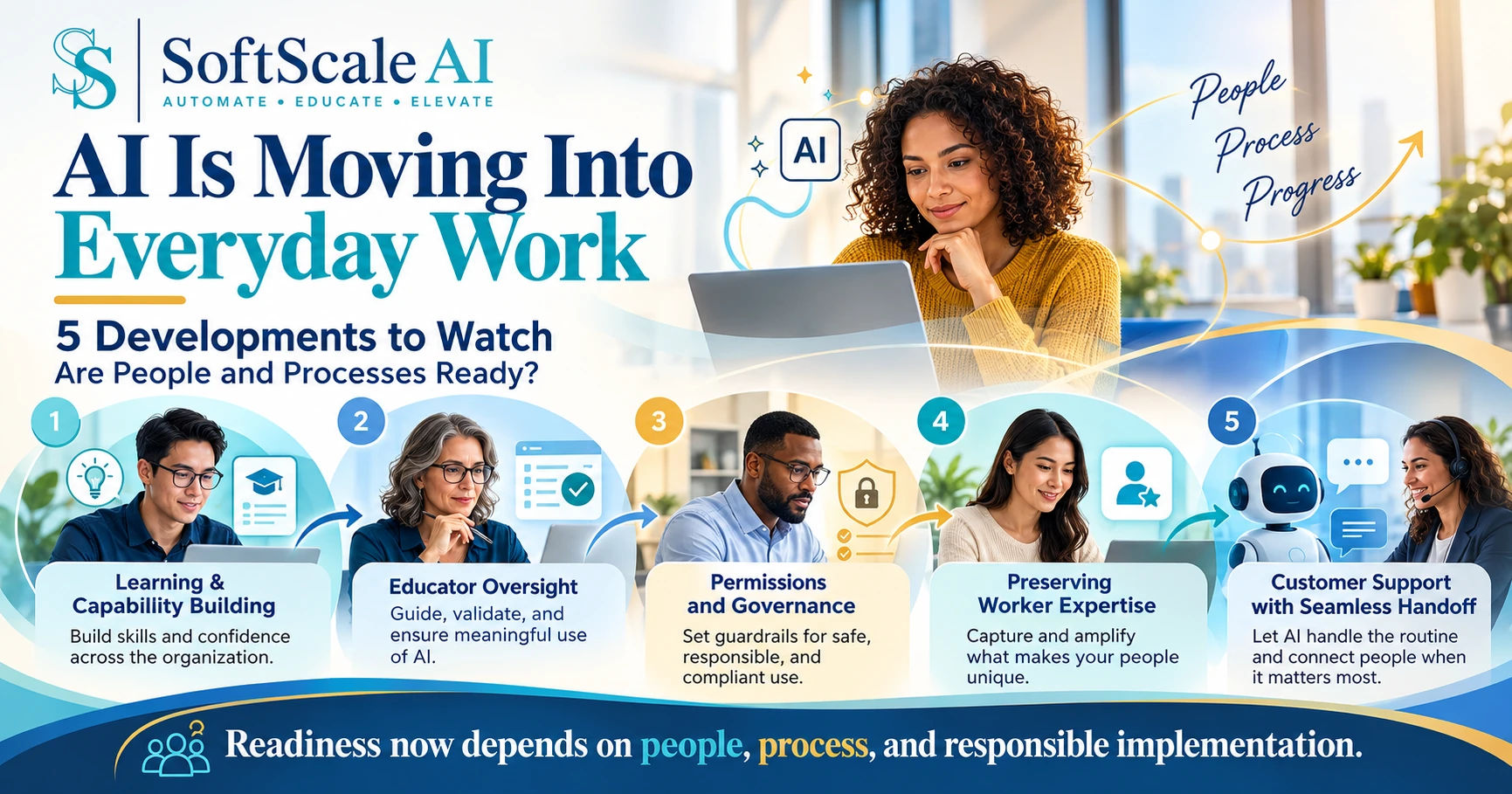
AI Is Moving Into Everyday Work. Are People and Processes Ready? 5 Developments to Watch
This week: a $70 million AI-skills initiative, new educator training, AI agents in banking, a manufacturing knowledge assistant and an AI customer-service voice agent. Plus: Ohio AI Watch.
 This Week in AI with Pamela Gosa
AI Is Entering a Harder Phase: 5 Developments Leaders Should Watch
Five AI developments reshaping workforce skills, small-business agents, scaling, governance and Ohio AI fluency—and what leaders need to know.
 This Week in AI with Pamela Gosa
AI Readiness Is Now a Leadership Challenge: 5 Developments That Explain Why
Five major AI developments show why leaders must strengthen workforce skills, responsible AI oversight and business processes. Plus an Ohio education spotlight.