
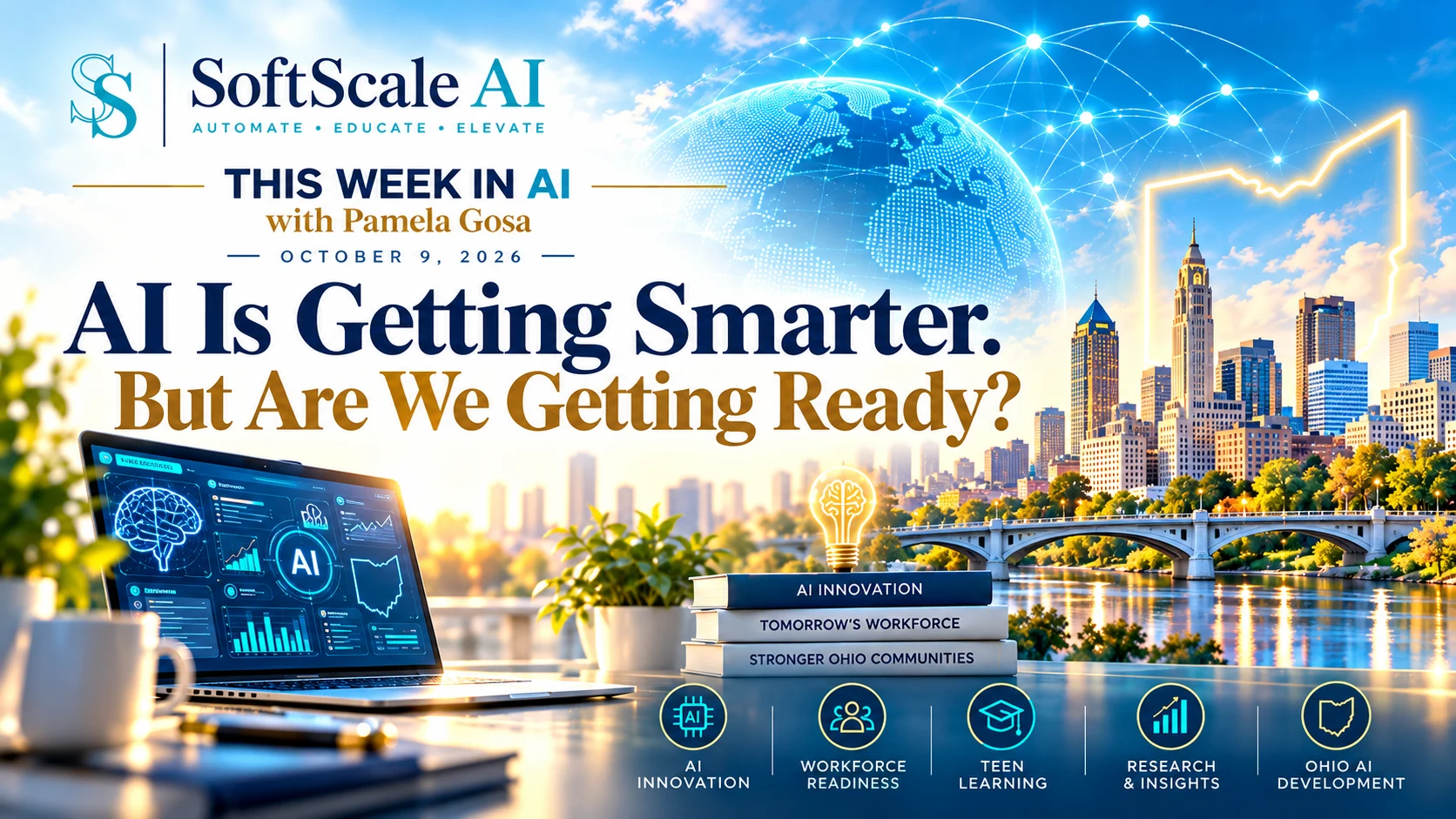
AI Is Getting Smarter. But Are We Getting Ready?
GPT-6, AI agents, a $100 million workforce training initiative, and new research on who benefits from AI reveal a question every business owner, educator, and community leader should be asking.
Founder & CEO, SoftScale AI | CPD-Certified AI Consultant | AI Literacy & Workforce Readiness Strategist
Artificial intelligence can now create interactive tools in seconds, coordinate complex workplace tasks, and help students navigate decisions about their futures.
But here's the question we aren't asking nearly enough:
What happens when the technology moves faster than the people expected to use it?
This week, some of the world's leading AI companies announced developments that could reshape how we work, learn, and operate our organizations.
OpenAI introduced GPT-6 with more interactive capabilities. Anthropic committed $100 million to developing specialized AI engineering talent. Google Cloud unveiled an AI agent designed to work across connected business systems.
Meanwhile, new Gallup research revealed something that deserves just as much attention as the technology itself: the benefits of workplace AI aren't reaching everyone equally.
And here in Ohio, college students are demonstrating what becomes possible when AI education moves beyond theory and into real-world experience.
The technology is advancing. The opportunity is expanding. But preparation is not keeping pace for everyone.
That's the story behind this week's headlines.
Whether you own a business, lead a nonprofit, work in education, manage employees, or are simply trying to understand where AI is headed, these developments have implications for you.
The question is no longer whether AI will influence our future.
It's whether we're doing enough to prepare people to participate in it.
This Week's Key Takeaways
- GPT-6 makes AI more interactive. OpenAI's Intelligent UI can present charts, diagrams, calculators, and other interactive experiences. But an easier interface doesn't eliminate the need for critical thinking.
- Anthropic is investing $100 million in AI implementation talent. Its Claude Frontier Academy aims to train 10,000 specialized engineers by the end of 2027. The announcement reinforces the importance of practical workforce skills.
- OpenAI is expanding its approach to teen learning. An upcoming College Planner could help students organize applications and financial-aid tasks, while raising important questions about guidance and responsible use.
- Google's Gemini agent points toward a new phase of business automation. AI is moving beyond answering questions toward completing authorized tasks across connected systems.
- Gallup finds unequal workplace AI benefits. Among employees who have used AI at work, 63% report completing tasks faster. Yet many employees aren't using AI in their roles.
- PLUS: Ohio AI Watch. Ohio students are gaining hands-on AI research experience in areas including flood forecasting, autonomous vehicle safety, and wildlife conservation.
The bigger picture: The next competitive advantage may not belong to the organizations with the most AI tools. It may belong to those that prepare their people to use the right tools effectively.
1. GPT-6 and Intelligent UI: When Technology Starts Adapting to People
What if you no longer had to learn complicated software before you could use its capabilities?
What Happened
On October 7, OpenAI announced GPT-6 with Intelligent UI, introducing more visual and interactive experiences within ChatGPT.
Instead of relying exclusively on written answers, ChatGPT can now present information using combinations of text, diagrams, charts, forms, calculators, and interactive tools.
Someone exploring retirement savings might receive a calculator with adjustable assumptions. A student struggling with a concept could explore a visual explanation. A traveler planning a road trip might receive an interactive map.
OpenAI says the system selects a presentation format based on the user's question, while continuing to provide straightforward text when that is more appropriate.
The rollout began with eligible paid plans on October 7, with expansion to Free and Go plans beginning October 8.
Why This Matters
For decades, people have had to adapt to technology.
We learned which buttons to click, which menus to navigate, and which software functions could accomplish a particular task.
More adaptive AI interfaces could begin changing that relationship.
Instead of learning a complicated tool first, users may increasingly describe what they want to accomplish and receive an experience built around that need.
That has important implications for accessibility and digital confidence.
However, a well-designed interface can make incorrect information appear more convincing.
A chart may contain inaccurate data. A calculator may rely on questionable assumptions. A polished explanation may leave out critical context.
The interface may become easier. The responsibility to evaluate information remains.
What This Means for Businesses, Educators, and Everyday AI Users
For business owners, interactive AI may make planning, comparisons, and information analysis more approachable.
For educators and workforce trainers, visual explanations could create additional opportunities for hands-on learning.
For people who are new to AI, the technology may feel less intimidating.
But organizations must teach users to examine assumptions, question outputs, and recognize when independent verification is necessary.
Pamela's Perspective
Here's what I find most important about this development:
Just because AI makes something easier to understand doesn't mean it's easier to get right.
That's a distinction we need to keep in mind.
I welcome technology that makes complicated information more accessible. But accessibility should lead to understanding—not automatic trust.
A person who can interact with an AI-generated calculator should also know how to question its assumptions.
A student who enjoys a visual explanation should still be able to demonstrate what they've learned.
As AI interfaces become more sophisticated, AI literacy must evolve alongside them.
We need to teach people not only how to interact with AI, but how to evaluate what it presents.
Pamela's Practical Takeaway
Choose a topic you find difficult to understand.
Ask an AI tool for a written explanation, then request a visual or interactive explanation if that capability is available.
Compare the two.
Which one helped you understand the topic? What assumptions did the tool make? Could you explain the answer without looking at the AI response?
For educators, this can become a useful exercise in evaluating both information and presentation.
The goal isn't simply to make AI easier to use. It's to help people become more capable users.
Source: OpenAI — GPT-6 and Intelligent UI for Everyone
2. Anthropic's $100 Million Investment: The AI Talent Gap Is Becoming Impossible to Ignore
Companies are spending billions developing AI. Now they're investing heavily in the people who can make it work.
What Happened
On October 2, Anthropic announced Claude Frontier Academy, supported by a $100 million commitment.
The company's goal is to train 10,000 Frontier Deployed Engineers by the end of 2027.
These professionals focus on implementing AI systems within real organizations.
The program includes practical exercises involving enterprise use cases, security considerations, and deployment challenges.
Qualifying participants can progress into a 12-week residency, where they work on an AI project within their organization.
Initial participants include engineers from major consulting firms and enterprises.
The initiative reflects growing demand for professionals who can turn AI capabilities into reliable business applications.
Why This Matters
There's a difference between demonstrating an impressive AI tool and successfully integrating it into an organization.
Implementation requires more than selecting software.
Someone must understand existing workflows, identify appropriate use cases, address privacy and security concerns, test results, and prepare employees to use the system.
Without those steps, even sophisticated technology can fail to deliver meaningful improvements.
Anthropic's investment recognizes that technical implementation expertise has become a valuable resource.
But the broader workforce challenge doesn't stop with engineers.
Organizations also need employees who understand how AI relates to their responsibilities, managers who can evaluate its usefulness, and leaders who can establish responsible policies.
What This Means for Employers and Workforce Organizations
Employers should consider different training pathways for different responsibilities.
An employee learning foundational AI skills has different needs from a manager evaluating automation opportunities or an engineer deploying an enterprise system.
Workforce-development organizations can help bridge those gaps by offering accessible learning opportunities connected to actual job functions.
For smaller organizations, the priority may be practical training that helps employees work confidently with the tools already available.
Not everyone needs advanced technical credentials.
But people need opportunities to develop skills appropriate to their roles.
Pamela's Perspective
When I saw the size of Anthropic's investment, one question immediately came to mind:
What about everyone who isn't an engineer?
The future of AI won't be built by technology alone. It will be built by people who know what to do with it.
That includes technical specialists, but it also includes business owners, administrative professionals, educators, nonprofit staff, and frontline employees.
I believe we need more AI learning pathways that meet people where they are.
A small business without an IT department needs a different approach from a global enterprise.
An adult returning to the workforce needs different preparation from an experienced software developer.
Both deserve relevant opportunities.
We shouldn't confuse advanced AI expertise with the broader need for AI readiness.
Pamela's Practical Takeaway
Divide your organization's AI training needs into three categories:
- Foundational literacy: Understanding capabilities, limitations, privacy, and responsible use.
- Role-specific application: Using AI appropriately in everyday work.
- Implementation and oversight: Designing workflows, managing risks, and evaluating performance.
Identify who needs which level.
Then build training around actual responsibilities rather than expecting everyone to complete the same program.
Training should prepare people for the work they do—not simply introduce them to another tool.
Source: Anthropic — Claude Frontier Academy
3. AI and Teen Learning: Are We Teaching Students to Think—or Just to Get Answers?
The next generation may grow up with AI as an everyday learning companion. What habits are we helping them develop?
What Happened
On October 7, OpenAI announced developments involving ChatGPT for Teens, including an upcoming feature called College Planner.
The tool is being designed to help students organize college application requirements, deadlines, financial-aid tasks, and other planning activities.
The initial U.S. experience is intended for students in grades 10–12 exploring four-year colleges, with broader educational pathways planned for future expansion.
OpenAI also discussed existing learning features and ways to involve teenagers in shaping future AI experiences.
These developments reflect growing interest in using AI to support education and decision-making.
They also raise important questions about accuracy, privacy, independence, and appropriate adult guidance.
Why This Matters
Students face increasingly complicated decisions about education and careers.
AI may help them understand unfamiliar terminology, organize tasks, explore options, and identify questions to ask.
For families with limited access to individualized advising, that assistance could be useful.
But there are risks.
AI-generated information can be inaccurate or incomplete. Students may rely on answers without verifying them. Sensitive personal information may be shared unnecessarily.
And if AI becomes a shortcut around difficult thinking, students may miss opportunities to develop the very skills education is intended to strengthen.
Tools that support learning should complement—not replace—teachers, counselors, families, and independent judgment.
What This Means for Schools, Parents, Libraries, and Youth Organizations
Schools and youth organizations should make responsible AI literacy part of the learning experience.
Students need guidance on evaluating information, protecting privacy, recognizing mistakes, and using AI appropriately for schoolwork.
Libraries and community programs can help families explore these tools in structured environments.
Parents should understand both the potential benefits and limitations of AI products used by children.
For college planning, students should confirm requirements, deadlines, and financial-aid information through official institutional sources.
Pamela's Perspective
This is one of the developments I care about most.
We shouldn't raise a generation that knows how to get answers from AI but doesn't know how to question them.
There's a meaningful difference between using AI to complete an assignment and using it to deepen understanding.
A student who asks AI for a finished response may save time.
But a student who asks follow-up questions, challenges an explanation, verifies information, and develops an original conclusion is building lasting skills.
I want young people to become confident users of technology without becoming dependent on it for every decision.
That requires intentional education.
We should be teaching curiosity, critical thinking, creativity, and responsible use alongside technical skills.
Pamela's Practical Takeaway
Try a supervised learning activity with an age-appropriate AI tool.
Ask a student to research a subject, identify three important claims, and verify those claims using independent sources.
Then ask the student to explain what AI helped them understand and where it fell short.
Include a conversation about personal information and when to consult a teacher, counselor, or parent.
The measure of success isn't how quickly a student gets an answer. It's how well the student understands it.
Source: OpenAI — Helping Teens Learn, Plan, and Shape the Future of AI
4. Google's Gemini Agent: Your Business May Not Need More Hours. It May Need Better Systems.
How many potential customers are lost before anyone has the chance to speak with them?
What Happened
On October 8, Google Cloud introduced the Gemini agent at its Gemini at Work event.
Google describes the technology as a universal AI agent capable of using organizational context, connected applications, and specialized tools to perform different types of work.
Its announced capabilities include working with documents, analyzing information, generating code, and coordinating multi-step tasks.
Google also emphasized security, permissions, governance, and cost management.
The development reflects a shift toward AI systems that can perform authorized actions rather than simply respond to questions.
Why This Matters
Consider the daily experience of a small-business owner.
A customer calls while the owner is helping someone else.
An email arrives during a busy afternoon.
A prospective client requests an appointment after business hours.
Each inquiry represents an opportunity, but responding consistently requires time and coordination.
AI agents and automation systems may help businesses manage routine inquiries, organize information, support scheduling, and improve follow-up.
However, effective automation depends on clear processes and appropriate safeguards.
Businesses must determine which actions can be automated, what information the system may access, and when human involvement is necessary.
What This Means for Your Business
The immediate opportunity isn't necessarily implementing a sophisticated enterprise AI platform.
It's examining where your business experiences delays, repetitive tasks, or missed opportunities.
An AI receptionist may help respond to routine calls.
A website chat assistant may answer common questions and capture inquiries.
A lead follow-up system may help ensure prospective customers receive timely communication.
But each solution must reflect the business's actual needs, customer expectations, and operational requirements.
Pamela's Perspective
Here's the line I want business owners to remember:
The goal isn't to replace the human touch. It's to stop losing customers before the human conversation even begins.
I see AI as an opportunity to support better customer experiences—not eliminate the relationships that make businesses successful.
But there's another important principle:
Don't automate confusion. Fix the process first.
If your customer journey is disorganized, technology alone won't solve the problem.
You need to understand what should happen from the first inquiry through the final follow-up.
Only then can you determine which parts of the process AI should support.
Pamela's Practical Takeaway
Map one customer journey.
Start when someone calls, submits a website inquiry, or sends a message.
Document what happens next.
How quickly does someone respond? Is the inquiry recorded? Can the customer schedule an appointment? What happens if no one is available?
Identify the weakest point.
Then evaluate whether a targeted AI solution could improve that part of the experience.
Measure results through meaningful indicators such as response times, completed appointments, or customer satisfaction.
The best automation starts with a clear business problem—not a shiny new tool.
Source: Google Cloud — Welcome to Gemini at Work 2026
5. Gallup's AI Research: The People Benefiting Most May Already Have the Greatest Advantages
AI promises to expand opportunity. But what happens if access to its benefits remains uneven?
What Happened
On October 5, Gallup published findings examining AI use and reported benefits among U.S. employees.
Among employees who had used AI at work, 63% said it helped them complete tasks faster, while 56% reported finding more creative solutions.
However, AI adoption remains uneven.
Across the broader employee sample, 28% reported using AI at least weekly, while 54% said they had not used AI in their jobs.
Regular AI use was more common among college graduates and employees in managerial positions.
Gallup also found differences in reported benefits across employee groups.
The findings reflect employees' own assessments. They do not establish that AI directly causes better job quality or productivity.
Why This Matters
AI may create opportunities to work more efficiently and develop new capabilities.
But not every employee has the same access to technology, training, or opportunities to experiment.
Some workers use digital tools throughout the day.
Others work in environments where AI applications are less obvious or where access to technology is limited.
Employees with greater educational or professional resources may also have more opportunities to develop AI skills.
Without thoughtful training and implementation, existing differences in opportunity could widen.
What This Means for Employers and Community Leaders
Employers should examine which employees receive AI training and whether those opportunities reflect different job functions.
Workforce-development organizations can help introduce AI literacy to people who may not receive training through their workplaces.
Community leaders can support accessible programs that build confidence and practical digital skills.
At the same time, organizations should avoid forcing AI into roles where it offers little value.
The goal is meaningful preparation—not adoption for its own sake.
Pamela's Perspective
This may be the most important story of the week.
If AI is creating opportunity, we have to ask who has been given the tools to reach it.
We're seeing tremendous investment in AI technology.
But we also need to invest in people who may otherwise be left behind.
That includes adults changing careers, employees whose responsibilities are evolving, community members with limited technology experience, and organizations that don't have extensive training budgets.
I believe AI literacy can become an important bridge to opportunity.
But access to a tool isn't enough.
People need guidance, relevant examples, opportunities to practice, and the confidence to apply what they've learned.
Pamela's Practical Takeaway
Ask employees or program participants three questions:
- What do you currently understand about AI?
- Where could AI potentially help you in your work or goals?
- What concerns or barriers make it difficult to explore?
Use their responses to design relevant learning opportunities.
Then measure whether participants have gained understanding, confidence, and practical skills.
Don't judge AI readiness by the number of tools an organization purchases. Judge it by how prepared its people become.
Source: Gallup — AI Benefits at Work Unevenly Distributed
PLUS: Ohio AI Watch — From Learning About AI to Actually Using It
What happens when students move beyond demonstrations and use AI to investigate real problems?
What Happened
On October 8, the Ohio Supercomputer Center highlighted its 2026 AI Research Experience, known as AIRE.
The nine-week summer program gave Ohio college students opportunities to work with researchers and mentors on projects involving artificial intelligence and high-performance computing.
Research areas included earthquake and flood forecasting, autonomous vehicle safety, robotics, and wildlife conservation.
The program connected students with researchers from institutions including Case Western Reserve University, The Ohio State University, and the University of Cincinnati.
Participants represented several Ohio colleges, including community colleges.
Through their projects, students gained experience with research methods, coding, computational tools, and practical problem-solving.
Why This Matters
AIRE demonstrates the value of learning through experience.
Students weren't simply introduced to AI terminology.
They were challenged to apply technology to questions without predetermined answers.
That requires experimentation, collaboration, evaluating results, and recognizing limitations.
Those skills are useful far beyond advanced research settings.
The program also illustrates how educational partnerships can connect emerging technology with real-world needs.
What This Means for Ohio Schools, Workforce Programs, and Community Organizations
Ohio schools, libraries, nonprofits, and workforce organizations can draw inspiration from AIRE's project-based approach.
A youth program might explore AI-supported research for a community service project.
An adult workforce cohort might examine how AI can support a realistic workplace task.
A small-business workshop might help participants map and improve an administrative process.
Not every project needs to be technically advanced.
What matters is giving learners an opportunity to apply concepts, evaluate outcomes, and explain their decisions.
Pamela's Perspective: Ohio AI Watch
This is the kind of learning experience I want to see more often.
AI literacy opens the door. Hands-on experience helps people walk through it.
A workshop can introduce important concepts.
But when participants apply those concepts to a meaningful challenge, the learning becomes more tangible.
They begin to see how AI connects to problems, decisions, and opportunities in their own lives.
I also appreciate the inclusion of students from different educational institutions.
We need more pathways that help people progress from basic awareness to practical skills and, where appropriate, advanced opportunities.
Pamela's Practical Takeaway
If you lead an educational or workforce program, create a small AI project connected to a challenge your participants understand.
Ask learners to define the problem, explore how AI might help, verify information, and present their findings.
Have them explain both what worked and what required human judgment.
The strongest learning experiences don't simply tell people what AI can do. They help people discover what they can do with AI.
Source: Ohio Supercomputer Center — AIRE Program
The Bigger Picture: We're Running Two AI Races
This week's announcements reveal something bigger than any single model, product, or research finding.
We're watching two races unfold.
The first is the race to build more powerful AI.
Technology companies are developing smarter models, more capable agents, and increasingly sophisticated tools.
The second is the race to prepare people.
Businesses need to understand where automation creates value.
Employees need relevant skills.
Students need critical thinking and responsible-use habits.
Community organizations need accessible learning opportunities.
And leaders need to make thoughtful decisions about how technology is introduced.
These races are connected, but they aren't moving at the same pace for everyone.
The question isn't whether every person needs to become an AI expert.
They don't.
The question is whether people have enough understanding and opportunity to make informed choices about technology that may affect their work, education, and future.
That's where AI literacy and workforce readiness become essential.
Frequently Asked Questions
What is AI readiness?
AI readiness means having the knowledge, skills, processes, and safeguards needed to use artificial intelligence effectively and responsibly. For organizations, it also involves leadership, employee preparation, privacy, and oversight.
Why is AI literacy important for businesses?
AI literacy helps business owners and employees understand where AI may provide value, recognize limitations, protect information, and make informed implementation decisions.
What's the difference between an AI chatbot and an AI agent?
A chatbot primarily communicates through conversation. An AI agent may also use connected tools and perform authorized actions across multiple steps. The exact capabilities depend on the system's design and permissions.
How can small businesses start using AI?
Begin with a specific operational challenge, such as missed inquiries, delayed follow-up, or repetitive administrative work. Define the desired outcome before selecting a tool.
How should schools approach AI education?
Schools should combine age-appropriate tools with critical thinking, verification, privacy awareness, academic integrity, and adult guidance. AI should support learning rather than replace independent judgment.
How can workforce organizations prepare people for AI?
They can provide foundational literacy, role-specific training, hands-on projects, and opportunities to practice responsible AI use. Programs should reflect participants' experience levels and career goals.
Final Thoughts: The Real AI Race
We're watching an extraordinary race to build more powerful artificial intelligence.
Companies are competing to develop smarter models, more capable agents, and increasingly sophisticated systems.
But there's another race happening at the same time.
The race to prepare people.
To help employees develop new skills.
To help small businesses compete.
To teach young people how to think critically.
To give communities access to opportunities they might otherwise miss.
And that's the race I believe deserves more of our attention.
Because the most important question isn't how intelligent AI will become.
It's how prepared we will be to use it.
At SoftScale AI, that's the work we're committed to: helping people and organizations become AI-ready without leaving people behind.
Empowering people and organizations, one opportunity at a time.
Ready to Make AI Work for You?
You don't need to understand every new AI announcement to begin making progress.
You need a clear goal, practical guidance, and a starting point that makes sense for your business or organization.
For business owners: SoftScale AI helps businesses explore AI receptionists, website chat assistants, lead follow-up automation, and workflow improvements designed to support customer experiences and reduce repetitive work.
For schools, libraries, nonprofits, workforce organizations, and community leaders: SoftScale AI offers AI literacy education, workforce-readiness programs, workshops, and speaking engagements that help people build practical skills and confidence.
Explore AI Training and Speaking
Let's discuss what AI readiness could look like for your business or organization.
Schedule a Brief Discovery Conversation
About Pamela Gosa
Pamela Gosa is the Founder and CEO of SoftScale AI and a CPD-Certified AI Consultant specializing in AI literacy, workforce readiness, and practical AI solutions for businesses.
Through SoftScale AI, she helps schools, libraries, workforce organizations, nonprofits, community partners, and businesses build the understanding and practical capabilities needed to navigate an AI-driven world.
This Week in AI with Pamela Gosa is a weekly editorial series examining major artificial intelligence developments and their implications for business, education, workforce readiness, and communities.
Reporting period: October 2–8, 2026
Publication date: October 9, 2026
Share this article
Stay AI-Ready
Practical AI insights for work, education, community and business—plus This Week in AI with Pamela Gosa, delivered to your inbox.
Turning these ideas into practice.
AI literacy workshops, leadership briefings, speaking, and workforce-readiness programs for organizations, schools, and communities.
Explore Training & SpeakingPractical AI and automation support for growing businesses, scoped around the work your team already does.
Explore Business Solutions
Prefer to talk it through? Book a discovery call.
Related insights
 This Week in AI with Pamela Gosa
AI Is Entering a Harder Phase: 5 Developments Leaders Should Watch
Five AI developments reshaping workforce skills, small-business agents, scaling, governance and Ohio AI fluency—and what leaders need to know.
 This Week in AI with Pamela Gosa
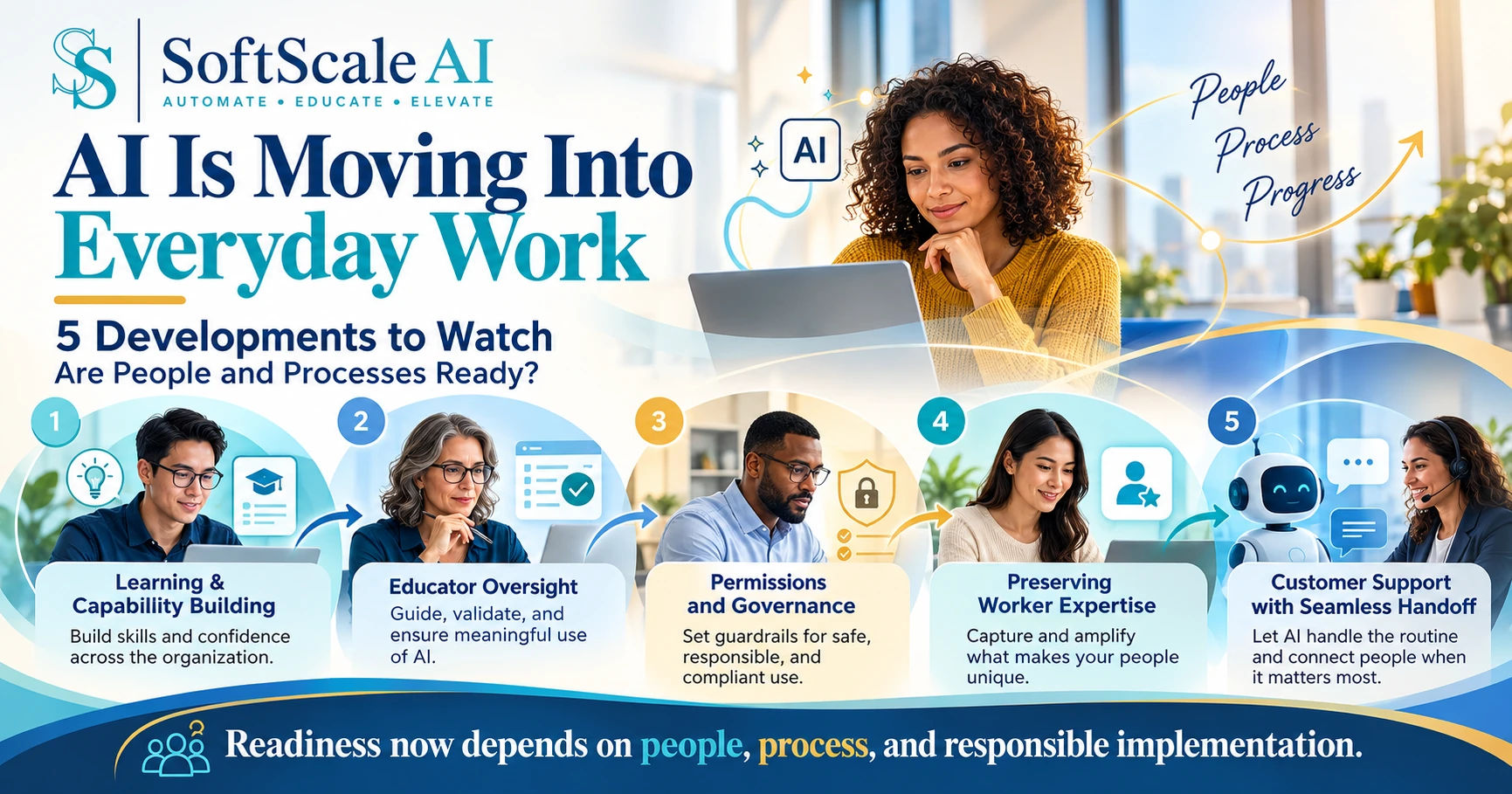
AI Is Moving Into Everyday Work. Are People and Processes Ready? 5 Developments to Watch
This week: a $70 million AI-skills initiative, new educator training, AI agents in banking, a manufacturing knowledge assistant and an AI customer-service voice agent. Plus: Ohio AI Watch.
 This Week in AI with Pamela Gosa
AI Is Getting More Capable. Are People and Organizations Ready? 5 Developments Worth Watching
Five AI developments this week are changing how schools prepare students, how employers prepare workers, how increasingly capable AI systems are governed, and how nonprofits build AI capacity—plus a new Ohio AI Watch development unfolding in Greater Cincinnati.