
Why Children Need AI Literacy, Not Just Access to AI Tools
Giving children access to AI is not the same as teaching them how to use it wisely. Youth AI literacy helps young people question outputs, protect their privacy, think critically, create responsibly, and prepare for an AI-enabled future.
Founder & CEO, SoftScale AI | CPD-Certified AI Consultant | AI Literacy & Workforce Readiness Strategist

Children need AI literacy because access to artificial intelligence does not teach them how to evaluate answers, protect their privacy, recognize misinformation, think critically, or use AI responsibly.
Youth AI literacy gives children the knowledge and judgment to use AI as a tool for learning, creativity, and problem-solving without replacing their own thinking.
Artificial intelligence is already becoming part of how children learn, search, create, communicate, and explore the world around them.
But access to AI is not the same as AI literacy.
Knowing how to type a question into an AI tool is only the beginning. Young people also need to understand that AI can make mistakes, that personal information should be protected, that generated content should be questioned, and that human judgment still matters.
That is why youth AI literacy matters.
At its best, AI literacy helps young people become thoughtful, responsible, confident users of technology rather than passive consumers of whatever an AI system gives them.
What Is AI Literacy for Children and Teens?
Youth AI literacy is an age-appropriate understanding of what artificial intelligence is, how it can be used, where it can go wrong, and how to interact with it responsibly.
It is much broader than teaching a child how to use a chatbot.
AI-literate young people should gradually learn how to:
- recognize when artificial intelligence may be involved in something they see or use;
- ask clearer, more thoughtful questions;
- evaluate AI-generated information instead of automatically accepting it;
- understand that AI can produce inaccurate or misleading answers;
- protect private and personal information;
- recognize appropriate and inappropriate uses of AI;
- use AI to support learning, creativity and problem-solving;
- understand when human judgment is more important than an automated response; and
- know when to involve a parent, teacher, mentor or other trusted adult.
These are not simply technology skills.
They are increasingly becoming part of digital literacy, critical thinking and future readiness.

Why Isn’t Access to AI Enough?
Access to AI is not enough because comfort with a tool is not the same as understanding the tool.
Children are often comfortable experimenting with new technology, but using a tool confidently does not mean they can evaluate what it gives them.
A student can learn how to generate an impressive paragraph without understanding whether the information is accurate.
A child can ask an AI system a question without realizing that the answer may contain invented information.
A young person can create or upload content without considering privacy, ownership, misinformation, or whether that information should have been shared in the first place.
That is why access without education creates a different kind of risk.
Recent research from Common Sense Media found that 86% of surveyed children ages 9–17 use AI, while more than four in ten said a parent or guardian had never talked with them about AI safety.
Young people need to learn not only how to use AI, but how to think while using AI.
Children Need to Know That AI Can Be Wrong
One of the most important AI literacy lessons is also one of the simplest:
AI can sound confident and still be wrong.
Young people should learn early that an AI-generated answer is not automatically a fact.
Depending on a child’s age and the situation, checking an answer might mean:
- comparing it with a trusted source;
- asking a teacher, parent, librarian or mentor;
- looking for supporting evidence;
- checking more than one source; or
- asking follow-up questions to better understand the information.
The goal is not to make children afraid of artificial intelligence.
The goal is to help them develop the habit of asking:
“How do I know this is true?”
That habit will matter far beyond AI.
Privacy Should Be Part of Youth AI Literacy
Children also need clear guidance about the types of information that should not be shared with AI tools.
That may include:
- passwords;
- home addresses;
- school login credentials;
- private family information;
- financial information;
- sensitive photographs;
- identifying information; and
- other information that should remain private.
“Be careful online” is too broad to be enough.
Young people benefit from concrete examples, practice and age-appropriate conversations about what information is safe to share and what should stay private.
UNICEF’s Guidance on AI and Children identifies children’s data and privacy protection, safety, transparency, responsible AI practice, and preparing children with AI-related skills as key elements of child-centered AI.
The U.S. Department of Education’s report Artificial Intelligence and the Future of Teaching and Learning also identifies student privacy and appropriate data handling as important considerations when AI is used in education.
These lessons also strengthen broader digital citizenship skills.
AI Should Support Thinking, Not Replace It
One of AI’s most exciting possibilities for young people is its ability to support creativity and exploration.
Children can use AI to:
- brainstorm a story;
- explore a new idea;
- practice questions;
- investigate a topic;
- develop a project;
- think through a problem;
- create characters or concepts;
- practice explaining something they have learned; or
- explore subjects connected to their interests.
But there is an important difference between:
“Do this for me.”
and
“Help me think through this.”
That distinction is worth teaching early.
The goal is not to teach young people how to hand their thinking over to artificial intelligence.
A 2026 Common Sense Media survey found that 70% of teens surveyed use AI for schoolwork, while only 27% reported that a teacher had discussed what AI is and how it works with them—highlighting the gap between AI use and AI literacy education.
The goal is to help them use AI to extend their curiosity, creativity, communication and problem-solving abilities.

Can Prompting Help Children Build Other Skills?
Yes.
Prompting can teach much more than how to operate an AI tool.
To get a better response, a young person often has to:
- explain what they want;
- provide context;
- choose useful details;
- clarify the audience;
- recognize when the first answer is not good enough;
- revise the question; and
- try again.
Those are communication and problem-solving skills.
For example, compare:
“Tell me about space.”
with:
“Explain why astronauts float in space in a way a fifth grader can understand. Give me three examples, then ask me two questions to check whether I understood.”
The second prompt requires more thought.
The child has to consider the goal, the audience, the format, and what would make the answer useful.
That is where prompting begins to support deeper learning.
Why Do Youth-Serving Organizations Matter in AI Literacy?
Youth-serving organizations matter in AI literacy because they are trusted, accessible places where young people already learn, grow, and prepare for their futures—and schools should not have to carry the responsibility alone.
Libraries, after-school programs, Boys & Girls Clubs, Girl Scouts, community organizations, nonprofits, mentoring programs, youth workforce initiatives and other organizations already help young people build confidence, explore interests, develop leadership skills and prepare for their futures. Community institutions are already becoming a front door to community AI literacy.
AI literacy can become part of that work.
And it does not have to begin with advanced coding, robotics or complicated technology.
It can begin with simple questions:
- What is AI?
- Where do I already encounter it?
- How does an AI system decide what to say?
- Can I believe everything it tells me?
- What information should I never give it?
- How can I use AI to create something instead of simply consuming something?
Those questions create a foundation young people can build upon over time.
What Should Responsible AI Education Look Like for Different Ages?
AI education should grow with the child.
A fourth grader should not receive the same AI education as a high school senior.
UNESCO’s AI Competency Framework for Students similarly emphasizes a progressive approach to AI education that develops human-centered thinking, ethics, AI knowledge, application, and responsible creation over time.
Elementary-Age Learners
Younger students can begin with:
- recognizing AI in everyday life;
- understanding basic prompting;
- learning simple privacy rules;
- practicing fact-checking;
- exploring creativity;
- understanding that AI can make mistakes; and
- learning responsible-use expectations.
Middle-School Learners
Middle-school students can begin exploring:
- more advanced prompting;
- misinformation;
- bias;
- responsible research;
- privacy and digital identity;
- problem-solving;
- appropriate academic use; and
- how AI-generated content should be evaluated.
High-School Learners
Older students can begin connecting AI literacy with:
- career exploration;
- workplace AI;
- advanced research;
- productivity;
- entrepreneurship;
- communication;
- ethics;
- privacy;
- responsible decision-making; and
- preparation for AI-enabled workplaces.
The goal is not to turn every young person into an AI engineer.
The goal is to make sure young people do not enter an AI-shaped world without understanding the technology surrounding them.

Why Is AI Literacy Part of Future Readiness?
AI literacy is part of future readiness because today’s young people are likely to enter a workforce where artificial intelligence is embedded across many industries and occupations.
UNICEF Innocenti’s Skills for an AI World initiative is examining the skills children need to stay safe, develop fully, and prepare for working life as AI becomes increasingly embedded in society.
Some will build AI systems.
Many more will work with AI.
Their advantage will not simply come from knowing which tool to open or which button to press.
They will need to know how to:
- ask good questions;
- evaluate information;
- communicate clearly;
- protect sensitive information;
- solve problems;
- recognize bias and misinformation;
- use technology responsibly;
- exercise judgment; and
- know when human thinking matters more than automation.
Those abilities begin developing long before someone applies for a first job.
That is why youth AI literacy is not only about technology education.
It is also about future readiness.
The Goal Is Not More Screen Time. It Is Better Prepared Young People.
Teaching children AI literacy does not mean putting them in front of technology all day.
It means preparing them for technology that is already becoming part of their lives.
We teach children how to navigate the internet because the internet exists.
We teach digital citizenship because online spaces exist.
And increasingly, young people need AI literacy because artificial intelligence is becoming part of how information is created, shared, evaluated and used.
Children deserve more than access to powerful technology.
They deserve the knowledge, judgment, confidence, curiosity and responsibility to use it well.
Frequently Asked Questions About Youth AI Literacy
What is AI literacy for children?
AI literacy for children is an age-appropriate understanding of what artificial intelligence is, what it can and cannot do, how to evaluate its outputs, how to protect personal information, and how to use AI responsibly for learning, creativity and problem-solving.
At what age should children begin learning about AI?
AI literacy can begin at an early age when the concepts are appropriate for the child’s developmental level. Younger children can start by learning where AI appears in everyday life, that AI can make mistakes, and basic rules about privacy and responsible use.
Is teaching AI literacy the same as teaching children to use ChatGPT?
No. AI literacy is broader than learning one tool. It includes critical thinking, privacy, misinformation awareness, responsible use, evaluating AI-generated information, creativity, ethics, and understanding when human judgment is needed.
Why should youth-serving organizations teach AI literacy?
Youth-serving organizations already help children build life skills, confidence, leadership, digital skills and future readiness. AI literacy can become part of that work by helping young people understand and use increasingly common technology more responsibly.
Should AI replace a child’s own thinking or schoolwork?
No. AI should be used as a support for thinking, creativity, learning, exploration and problem-solving. Young people should learn to use AI as a tool without allowing it to replace their own judgment, effort or understanding.
Further Reading & Research
The following resources offer useful context for youth AI literacy, child-centered AI policy, and age-appropriate AI education:
- UNICEF — Guidance on AI and Children
- UNESCO — AI Competency Framework for Students
- U.S. Department of Education — Artificial Intelligence and the Future of Teaching and Learning
- Common Sense Media — 2026 AI Use by Tweens and Teens Research
Helping Young People Become AI-Ready
SoftScale AI provides practical, age-appropriate AI literacy and responsible AI education for youth-serving organizations, schools, libraries, nonprofits, community programs, and other organizations preparing young people for an AI-enabled future.
Programs can be adapted to the age group, learning environment, goals, and experience level of the participants.
Interested in bringing AI literacy training to the young people you serve?
Share this article
Stay AI-Ready
Practical AI insights for work, education, community and business—plus This Week in AI with Pamela Gosa, delivered to your inbox.
Turning these ideas into practice.
AI literacy workshops, leadership briefings, speaking, and workforce-readiness programs for organizations, schools, and communities.
Explore Training & Speaking
Prefer to talk it through? Book a discovery call.
Related insights
 This Week in AI with Pamela Gosa
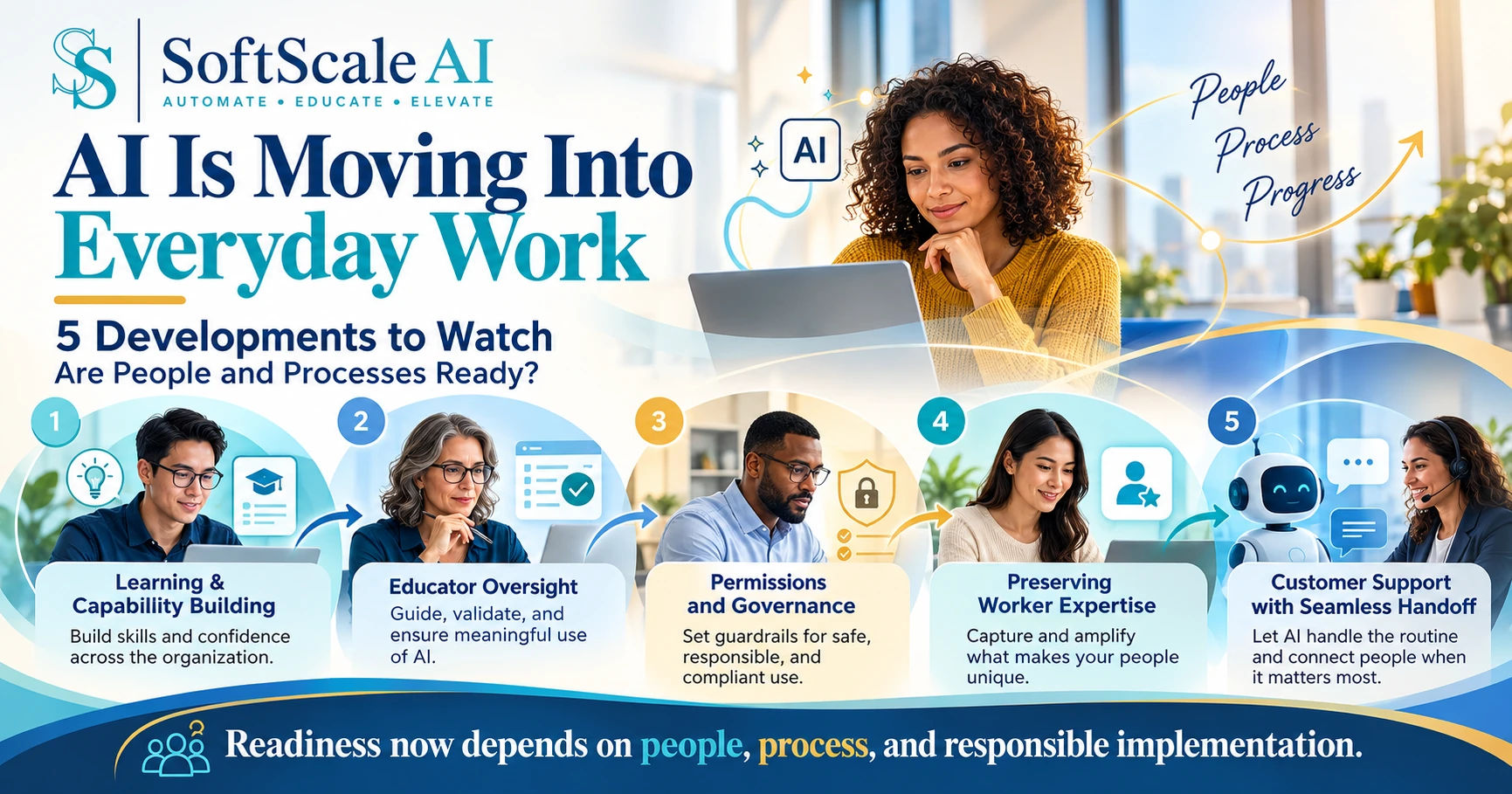
AI Is Moving Into Everyday Work. Are People and Processes Ready? 5 Developments to Watch
This week: a $70 million AI-skills initiative, new educator training, AI agents in banking, a manufacturing knowledge assistant and an AI customer-service voice agent. Plus: Ohio AI Watch.
 This Week in AI with Pamela Gosa
AI Is Getting More Capable. Are People and Organizations Ready? 5 Developments Worth Watching
Five AI developments this week are changing how schools prepare students, how employers prepare workers, how increasingly capable AI systems are governed, and how nonprofits build AI capacity—plus a new Ohio AI Watch development unfolding in Greater Cincinnati.
 Article
ChatGPT for Teens Changes the AI Literacy Conversation: What Parents, Educators and Youth Organizations Need to Understand Now
OpenAI’s new teen experience brings stronger safeguards, learning-focused features and parental controls to younger users. But safer technology alone cannot teach verification, privacy, critical thinking or responsible use. The rollout raises a larger question for families, educators and youth-serving organizations: Who is preparing young people to use AI well?