
AI Is Changing How Work Gets Done—and Who Gets Opportunity: 5 Developments Worth Watching
Five AI developments changing work and opportunity: AI inside everyday business software, Meta's workforce experiment, assistive technology expanding access to jobs, small-business adoption, and practical AI training in Ohio.
Founder & CEO, SoftScale AI | CPD-Certified AI Consultant | AI Literacy & Workforce Readiness Strategist

This week in AI, the most important developments were not simply about new tools. They were about work, opportunity and implementation. AI is entering everyday business systems, companies are learning hard lessons about AI-driven workforce change, assistive technology is opening doors for workers with disabilities, small businesses are taking a practical approach to adoption, and an Ohio economic-development organization is bringing hands-on AI training directly to entrepreneurs.
Artificial intelligence news can easily become a stream of product launches, technical announcements and predictions about what may happen someday.
But I am increasingly interested in a different question:
What is AI changing for people right now?
This week provided several very different answers.
AI is becoming part of business software employees already use every day.
One of the world's largest technology companies learned that restructuring work around AI can become much more complicated when people, processes and technology are not moving at the same speed.
Assistive AI technology is helping visually impaired employees perform warehouse work that historically presented significant barriers.
Small and midsize businesses are showing signs of choosing targeted, practical applications rather than adopting AI simply because of the hype.
And today, here in Ohio, a local economic-development organization is bringing free practical AI training directly to small-business owners.
These are not five versions of the same AI story.
They are five different signals about where AI is showing up—and what leaders should pay attention to.
Key Takeaways at a Glance
- AI is moving inside everyday business software. Employees may increasingly use AI without opening a separate AI application at all.
- Moving too fast can backfire. Meta's experience shows the risks of redesigning work around AI before the technology, workflows and people are ready.
- AI can expand access to employment. Assistive technologies are enabling visually impaired workers to perform tasks that may once have been inaccessible.
- Small businesses are being more selective than the hype suggests. Many are testing AI against specific business problems before expanding its use.
- AI training is becoming part of local economic development. An Ohio organization is hosting practical AI training for small businesses today.
1. AI Is Moving Into the Business Systems People Already Use
One of this week's less flashy developments may actually tell us a great deal about where workplace AI is headed.
Workday, a major provider of human-resources and financial-management software, reported strong adoption of its AI offerings as part of its second-quarter results.
According to Reuters, more than half of Workday's new customers during the quarter subscribed to at least one AI offering.
Those capabilities are being used in ordinary business functions such as payroll and financial forecasting.
That matters because AI adoption is no longer limited to someone intentionally opening ChatGPT, Claude or another standalone AI tool.
Increasingly, AI is being built directly into the platforms organizations already use.
- The HR system.
- The financial platform.
- The CRM.
- The scheduling system.
- The customer-service platform.
- The software someone already opens every morning.
Why It Matters
This changes the AI conversation inside organizations.
An employee may begin interacting with AI without ever making a conscious decision to “use AI.”
A software provider may add an AI capability during an upgrade.
A platform may introduce an AI assistant.
A workflow employees have followed for years may suddenly include automated recommendations or generated information.
That means leaders need visibility into more than the standalone AI tools employees choose themselves.
They also need to know:
Where is AI already entering the technology we use?
Pamela's Practical Takeaway
Add an AI inventory to your regular technology review.
Ask:
- Which platforms we already use now include AI?
- Which AI features are employees actually using?
- What information do those features access?
- What decisions are they helping make?
- Are we paying for AI capabilities we are not using?
- Are employees using features leadership does not know exist?
Organizations may discover that AI adoption has already begun—not through a dramatic technology initiative, but through ordinary software updates.
Leadership Question
If you reviewed every major platform your organization uses today, how many now contain AI capabilities that were not there two years ago?
Source: Reuters — HR software firm Workday reports revenue rise, flags strong AI uptake.
Related SoftScale AI insight: How AI Is Becoming Part of Everyday Work, Education and Business.
2. Meta's AI Workforce Experiment Shows What Can Happen When Change Moves Too Fast
One of the week's most revealing workplace stories came from Meta.
Reuters reported on an internal initiative known as Project OT, short for Organization Transformation.
The initiative attempted to redesign parts of Meta around artificial intelligence, with smaller AI-supported teams, fewer management layers and reductions of as much as 60% in some teams.
But the transformation ran into significant problems.
Reuters reported employee resistance, declining internal performance measures, technical disruptions, reliability concerns and security issues associated with moving AI agents into work too quickly.
Meta ultimately pulled back from portions of the plan.
Why It Matters
This is not simply a Meta story.
Organizations everywhere are asking whether AI can:
- reduce repetitive work,
- increase productivity,
- allow smaller teams to accomplish more,
- or change which responsibilities require human labor.
Those are legitimate questions.
But there is a major difference between:
- using AI to improve work
- and
- redesigning an organization around assumptions about what AI should be able to replace.
Technology can evolve rapidly.
Organizations do not transform at exactly the same speed.
People need clarity.
Managers need preparation.
Workflows need testing.
Systems need to be reliable.
And leaders need evidence that the new way of working actually produces better results.
Pamela's Practical Takeaway
Instead of beginning with:
“How many positions could AI replace?”
begin with:
“Which parts of this work could AI improve?”
Then ask:
“What should our people be able to do better because AI is supporting them?”
Those questions create a very different kind of transformation.
The objective should not simply be fewer people.
The objective should be better work and better outcomes.
Leadership Question
If AI significantly changes a workflow in your organization, are you redesigning the technology only—or preparing the people whose work will change too?
Source: Reuters — Mark Zuckerberg had a bold plan to replace Meta staff with AI. Here's how it imploded.
Related SoftScale AI insight: AI Readiness Is a Shared Leadership Responsibility.
3. AI Is Helping Make Some Jobs More Accessible
Not every AI-and-work story is about jobs disappearing.
Some are about people gaining access to work.
Business Insider reported this week on Bosma Enterprises, an Indiana organization and major employer of people who are blind or visually impaired.
Bosma is using a combination of assistive technologies—including screen readers, magnification software, smart glasses and AI-supported inventory technology—to help employees perform warehouse and inventory work.
One particularly interesting application involves inventory management.
AI-powered drones can move through warehouse space, capture product images and convert that visual information into inventory data.
Screen readers can then make that information accessible to employees who are visually impaired.
Workers are also using smart glasses that can assist with tasks such as reading barcodes, identifying objects and accessing information from documents.
Why It Matters
This is an AI conversation that deserves far more attention.
Technology does not only change how much work someone can do.
Sometimes it changes who gets the opportunity to do the work at all.
That has implications for disability inclusion.
It has implications for workforce-development organizations.
It has implications for employers struggling to find qualified workers.
And it challenges assumptions about which jobs people with disabilities can perform.
Sometimes the barrier is not the person's ability.
Sometimes the barrier is the way the workplace or the task has been designed.
Technology can change that equation.
Pamela's Practical Takeaway
When evaluating AI technology, add another question alongside productivity and efficiency:
Could this remove a barrier for someone?
That could include:
- visual assistance,
- reading support,
- language assistance,
- communication support,
- navigation,
- writing assistance,
- information access,
- or another workplace accommodation.
AI's value should not always be measured only in minutes saved.
Sometimes its value is measured in opportunity created.
Leadership Question
When your organization evaluates new technology, are you asking only how it could make current employees faster—or also who it might make it possible to employ?
4. Small Businesses Are Taking a More Practical Approach to AI Than the Hype Suggests
Small-business owners hear an almost endless message about artificial intelligence:
Move faster.
Adopt more tools.
Automate everything.
Don't get left behind.
New research released this week presents a more measured picture.
The Global Technology Industry Association surveyed 520 small and microbusiness decision-makers about how their organizations are actually approaching AI.
Among the findings:
- 40% are deploying AI tactically to address specific business needs.
- 50% were categorized as “AI-Invested,” using AI for operational functions and some customer-facing applications.
- 24% are evaluating AI through pilot programs before broader adoption.
- 84% report positive business impacts from AI tools and platforms.
The research also found that many businesses are creating more structure around AI use:
- 44% have acceptable-use policies for AI tools.
- 40% have employee training and accountability requirements.
- 39% have data-security and confidentiality requirements.
Why It Matters
These findings suggest that many small businesses are not trying to become “AI companies” overnight.
They are looking for places where AI makes practical business sense.
That is a much healthier way to think about adoption.
For one business, the useful application might be customer follow-up.
For another, administrative work.
Another may benefit from research.
Scheduling.
Marketing.
Proposal development.
Customer communication.
Or one specific repetitive process that consumes too much time.
Different businesses have different problems.
Their AI strategy should reflect that.
Pamela's Practical Takeaway
Before adding another AI subscription, ask three questions:
- What problem will this solve?
- How will I know whether it is working?
- What current process will it improve or replace?
If those answers are unclear, you may not need the tool yet.
A business does not win by collecting the largest number of AI applications.
It wins by using technology that makes the business work better.
Leadership Question
If you listed every AI tool your business currently pays for, could you clearly identify the business result each one is producing?
5. Ohio AI Watch: Practical AI Training Reaches Lawrence County
This week's Ohio development is happening today, August 28.
The Lawrence County Economic Development Corporation is scheduled to host Small Business B(AI)sics, part of a national initiative from the U.S. Chamber of Commerce Foundation and U.S. Chamber of Commerce, with support from Google.
The program provides free, in-person AI training for small-business owners and is designed so participants do not need a technical background.
The training focuses on practical business applications, including:
- strengthening marketing,
- improving customer relationships,
- automating time-consuming tasks,
- supporting business decisions,
- and identifying new opportunities.
The U.S. Chamber Foundation currently lists two participating Ohio organizations:
- Lawrence County Economic Development Corporation
- New Albany Chamber of Commerce
Why It Matters
What interests me about this story is not simply that another AI class exists.
It is where the training is happening.
Small-business owners already turn to chambers of commerce, economic-development organizations, libraries, colleges, workforce organizations and other trusted community institutions when they need:
- information,
- connections,
- training,
- business assistance,
- and help navigating change.
AI education is beginning to enter that ecosystem.
That matters because most entrepreneurs are not spending their days following every new AI announcement.
They need someone to translate all of that activity into practical questions:
- What does this mean for my business?
- What could actually help me?
- What should I ignore?
- Where should I begin?
Pamela's Practical Takeaway
Organizations that already support entrepreneurs and workers do not need to create a massive AI initiative before getting started.
A useful beginning could be:
- an introductory AI workshop,
- an AI-for-small-business session,
- staff professional development,
- an industry-specific demonstration,
- a hands-on implementation lab,
- or a short learning series.
The people who need practical AI education may already be walking through the doors of organizations they trust.
Leadership Question
If entrepreneurs already come to your organization for business support, where could practical AI education naturally fit into what you already provide?
Source: U.S. Chamber of Commerce Foundation — Small Business B(AI)sics.
Five Stories. Five Different Questions.
What I find especially interesting about this week's developments is that they do not tell one identical AI story.
They raise different questions.
For everyday business technology:
Where is AI entering systems people already use?
For organizational leadership:
How quickly should work change when AI capabilities are changing just as quickly?
For workforce inclusion:
Could AI remove barriers that have prevented qualified people from accessing certain jobs?
For small businesses:
Where does AI create enough measurable value to justify the investment?
For communities:
Who will help local businesses and workers understand how to use AI practically?
Those are very different conversations.
And that may be one of the most important things leaders can understand about artificial intelligence right now.
AI is no longer one story.
Its effects are showing up differently across workplaces, businesses and communities.
The challenge is not to react to every AI headline.
It is to recognize which developments actually matter for the people and organizations you serve.
Pamela's Perspective: Pay Attention to What Changes for People
What stayed with me most this week was not a particular AI tool.
It was what changed for people.
An employee beginning to use AI through software that is already part of the workday.
A workforce experiencing what can happen when organizational change moves too quickly.
A visually impaired employee gaining access to work through technology.
A small-business owner deciding whether one particular AI application is actually worth the investment.
An Ohio entrepreneur learning practical AI skills through a local economic-development organization.
These stories are very different.
But they remind us that the real impact of artificial intelligence does not happen inside a demonstration.
It happens when technology meets real people, real work and real decisions.
That is why leaders should continue asking questions beyond:
What can AI do?
We should also ask:
- What changes for the person doing the work?
- Does this create an opportunity or another barrier?
- Does it improve something that actually matters?
- Are we solving a real problem?
- Are people better equipped because this technology exists?
Those questions are harder.
But they are also more useful.
Technology will continue changing.
The organizations that navigate that change well may not be the ones that adopt everything first.
They may be the organizations that become very good at deciding:
- what is worth adopting,
- why it matters,
- and
- how it should improve the experience and outcomes of the people involved.
Frequently Asked Questions
Is AI becoming part of everyday business software?
Yes. AI capabilities are increasingly being built directly into HR, finance, customer-management, productivity, communication and other business platforms. Organizations may therefore encounter AI not only through standalone tools such as chatbots, but through software they already use.
Will AI replace employees?
AI is likely to automate or change portions of some jobs while also creating new responsibilities, roles and opportunities. The effect varies considerably by occupation, task and organization. Meta's experience this week also illustrates why replacing human work with AI is not simply a matter of assuming technology can immediately perform everything a person or team currently does.
Can AI improve workplace accessibility?
Yes. AI-supported technologies can assist with vision, reading, writing, communication, navigation and information access, among other areas. The right solution depends on the individual and the work involved, but these technologies may help reduce barriers that have historically limited workplace participation.
How should a small business decide whether an AI tool is worth using?
Begin with a specific business problem. Identify the result you want to improve, determine how you will measure success, test the technology in a limited way and compare the results with the existing process. The goal should be to solve a business problem—not simply add another AI tool.
Does a small business need many AI tools?
No. A few well-chosen tools that solve meaningful problems can be far more valuable than a large collection of software that employees rarely use or that produces no measurable benefit.
Where can small businesses learn practical AI skills?
AI education is increasingly being offered through chambers of commerce, economic-development organizations, libraries, colleges, workforce organizations, business-support organizations and private training providers. Look for training that connects AI to actual work and business needs rather than focusing only on demonstrations of the technology.
One Question for Leaders This Week
When your organization considers artificial intelligence, how often do you ask:
What will this allow our people to do better?
Not simply:
What can this technology do?
That difference may determine whether AI becomes another piece of software—or something that actually improves the work.
Found This Week's Brief Useful?
If something in this week's This Week in AI with Pamela Gosa gave you a new perspective on AI, work, business or opportunity, help continue the conversation.
Share this article with a colleague, educator, entrepreneur, workforce leader, nonprofit leader or organizational decision-maker who might find it useful too.
Share this article
Want to Bring Practical AI Education to Your Organization?
SoftScale AI provides practical, approachable AI training and facilitated learning experiences for organizations, workforces, businesses and communities.
Engagements may include:
- practical AI literacy,
- workforce and career preparation,
- responsible AI use,
- staff professional development,
- small-business AI applications,
- leadership briefings,
- hands-on workshops,
- and customized learning experiences built around the organization and audience.
Ready to Talk About What Your Organization Needs?
If your organization is considering AI training, workforce preparation, a community initiative, leadership support or another practical AI program, a discovery conversation is a good place to begin.
You do not need to know exactly what program or solution you need before the conversation.
We can begin with who you serve, what you are trying to accomplish and what success would look like.
Sources & Further Reading
- Reuters — HR software firm Workday reports revenue rise, flags strong AI uptake.
- Reuters — Mark Zuckerberg had a bold plan to replace Meta staff with AI. Here's how it imploded.
- Business Insider — Amid warehouse staffing shortages, AI-powered drones and Meta glasses help visually impaired workers get the job done.
- Global Technology Industry Association — SMBs Taking a “Slow and Steady” Approach to AI Adoption as Business Benefits Outpace Hype.
- U.S. Chamber of Commerce Foundation — Small Business B(AI)sics.
This Week in AI with Pamela Gosa examines timely AI developments affecting work, education, businesses and communities—and what those developments may mean for the people and organizations navigating what comes next.
Stay AI-Ready
Practical AI insights for work, education, community and business—plus This Week in AI with Pamela Gosa, delivered to your inbox.
Turning these ideas into practice.
AI literacy workshops, leadership briefings, speaking, and workforce-readiness programs for organizations, schools, and communities.
Explore Training & SpeakingPractical AI and automation support for growing businesses, scoped around the work your team already does.
Explore Business Solutions
Prefer to talk it through? Book a discovery call.
Related insights
 This Week in AI with Pamela Gosa
AI Readiness Is Now a Leadership Challenge: 5 Developments That Explain Why
Five major AI developments show why leaders must strengthen workforce skills, responsible AI oversight and business processes. Plus an Ohio education spotlight.
 This Week in AI with Pamela Gosa
AI Is Entering a Harder Phase: 5 Developments Leaders Should Watch
Five AI developments reshaping workforce skills, small-business agents, scaling, governance and Ohio AI fluency—and what leaders need to know.
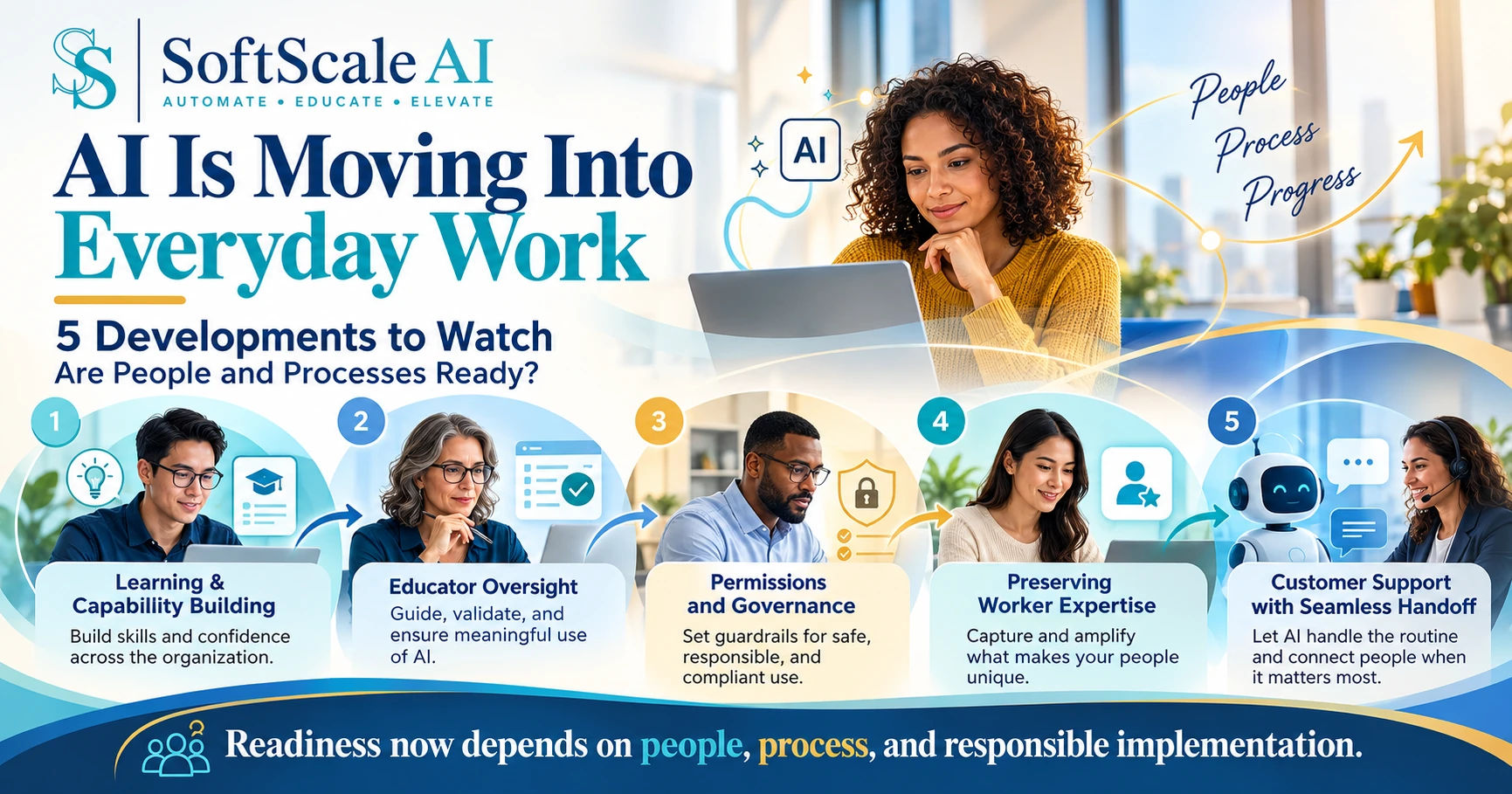 This Week in AI with Pamela Gosa
AI Is Moving Into Everyday Work. Are People and Processes Ready? 5 Developments to Watch
This week: a $70 million AI-skills initiative, new educator training, AI agents in banking, a manufacturing knowledge assistant and an AI customer-service voice agent. Plus: Ohio AI Watch.