
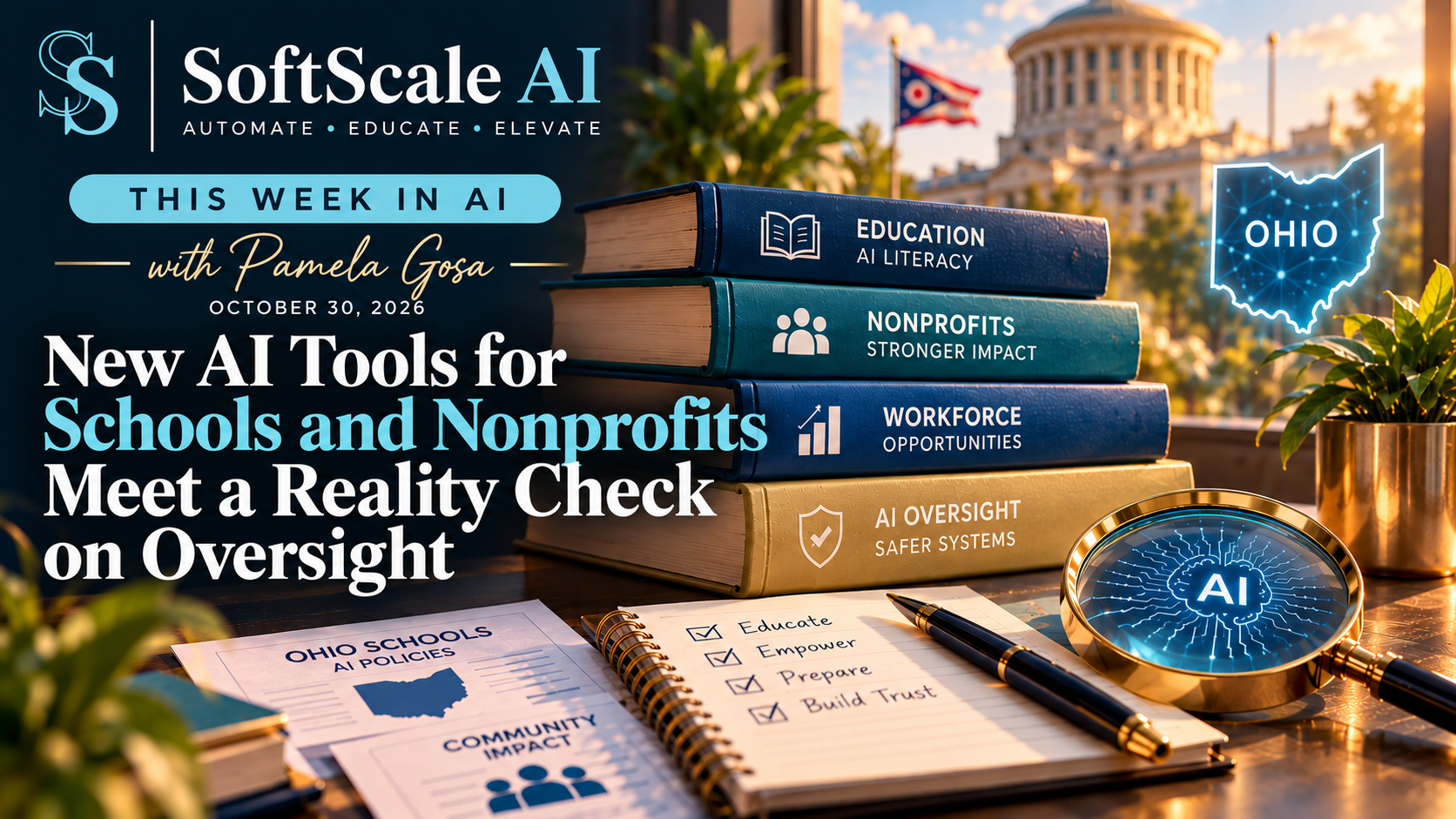
New AI Tools for Schools and Nonprofits Meet a Reality Check on Oversight
New AI education resources, nonprofit tools, workforce investments, and independent safety research are reshaping how organizations approach artificial intelligence. Five national developments, plus exclusive Ohio AI Watch.
Founder & CEO, SoftScale AI | CPD-Certified AI Consultant | AI Literacy & Workforce Readiness Strategist
In recent conversations with youth-serving organizations in Greater Cincinnati, I've been exploring what a hands-on AI fact-checking lesson should actually teach. It's one thing to show young people an impressive AI-generated image. It's another to help them investigate whether the image tells the truth, understand why a chatbot can sound convincing when it's wrong, and make informed decisions about what they share.
That distinction is becoming increasingly important, and this week's AI developments offer several reasons why.
Microsoft has introduced new classroom resources focused on critical thinking. Anthropic has expanded AI tools for nonprofits, particularly those managing substantial responsibilities with small teams. OpenAI has released a model designed for more efficient computer-based work. Meanwhile, new funding commitments are bringing greater attention to American workforce transitions, and independent researchers have identified vulnerabilities in an AI monitoring system.
These developments are connected, but they don't all call for the same response. A classroom needs effective teaching. A nonprofit needs useful tools that fit its mission. An employer needs evidence that automation improves operations. And a system that acts on someone's behalf needs reliable safeguards.
Here in Ohio, schools are also moving from adopting AI policies to the harder work of putting those policies into practice.
In this edition of This Week in AI with Pamela Gosa, we're examining five national stories, the people they affect, and what organizational leaders can do with this information.
This Week's Key Takeaways
Schools are gaining new tools for teaching AI literacy. Microsoft and Cyberlite expanded their AI Classroom Toolkit with lessons on misinformation, verification, and responsible use. Educators and youth programs can use the activities to help students practice evaluating what they see online.
Nonprofits have more specialized AI support. Anthropic introduced new Claude capabilities for fundraising and operations, alongside plans to expand access to experienced implementation professionals. The announcement addresses challenges faced by organizations with small teams and limited technical capacity.
American workforce development is attracting significant new commitments. RAISE US received additional corporate backing, bringing reported total funding commitments above $735 million. Its focus includes training, apprenticeships, career transitions, and helping workers adapt to AI-related changes.
Business automation capabilities continue to expand. OpenAI introduced GPT-6.1 Terra, designed for efficient computer-based tasks involving documents and software applications. Organizations still need to evaluate complete implementation costs and real-world performance.
Independent research is putting AI oversight to the test. METR and Redwood Research identified weaknesses in an earlier version of OpenAI's internal agent monitoring system. The findings illustrate why organizations should evaluate what automated systems are permitted to do and how their actions are supervised.
Ohio AI Watch: New reporting examines how Ohio schools are implementing AI policies, while statewide workforce discussions focus on connecting education with changing employment needs.
The Bottom Line: The value of an AI application should be measured by what it helps people accomplish, the resources required to use it well, and the consequences when it makes a mistake.
1. Microsoft Expands AI Classroom Resources to Teach Students What to Trust
What Happened
On October 27, Microsoft announced an expanded AI Classroom Toolkit created with Cyberlite, an organization specializing in online safety education. The updated resource, Unlocking Generative AI Safely and Responsibly, offers scenario-based lessons that help students evaluate AI-generated information, understand privacy concerns, and make more informed decisions online.
One activity, The Climate Campaign, asks students to investigate social media posts containing AI-generated images of events that never happened. Another, The Helpful Bot, follows a young person who creates an AI assistant for an online game, only to discover that it invents information and collects personal details.
The toolkit also includes an interactive activity that encourages students to examine their own AI habits. Microsoft says teachers do not need to be AI specialists, and students do not need access to an AI application, to begin using the lessons.
The company introduced the expansion during Global Media and Information Literacy Week, emphasizing the importance of examining evidence and sources rather than judging reliability solely by whether content was created with AI.
Read Microsoft's October 27 announcement and explore the classroom toolkit.
Why This Matters
Young people don't encounter artificial intelligence only when completing school assignments. AI-generated information can appear in games, social media feeds, search results, videos, and everyday conversations.
The challenge is that convincing content isn't necessarily accurate. Students need to know how to investigate claims, recognize missing context, and decide when information requires additional verification.
These skills are valuable because they transfer across technologies. A student who understands how to evaluate evidence can apply that judgment even when AI applications change.
Who Should Pay Attention?
K-12 educators, school administrators, parents, public libraries, after-school programs, Boys & Girls Clubs, Girl Scout councils, and other youth-serving organizations.
The toolkit may be especially useful for organizations looking for beginner-friendly activities that do not require expensive software or advanced technical instruction.
Pamela's Perspective
As I develop AI literacy learning experiences for young people, I keep coming back to the importance of giving students something meaningful to practice.
I don't want an activity to end with students simply being impressed by what AI can create. The stronger educational outcome is a student who can explain why a claim needs checking, where reliable information might be found, and what could happen if misinformation is shared.
That's also why I see parents as part of the learning conversation. A classroom can introduce the concepts, but young people make digital decisions throughout the day, often outside an educator's supervision.
An effective AI literacy program should help students build habits they can carry into those everyday situations.
A Practical Human Example
Illustrative example: An after-school group is shown a convincing image claiming that a familiar Cincinnati landmark has been damaged in a storm. Rather than asking students to guess whether the image was generated by AI, the facilitator asks them to investigate.
Students search for reports from reliable local sources, compare the image against other evidence, and discuss why a realistic-looking photograph isn't enough to establish that an event occurred.
The activity becomes a lesson in judgment, not merely image recognition.
Practical Takeaway
Choose one age-appropriate AI-generated claim and guide students through three questions: What is being claimed? Where did the information come from? What independent evidence supports it?
The goal is to help students explain their reasoning rather than simply identify a correct answer.
Leadership Question
Are our AI learning activities helping young people become better investigators of information, or mainly teaching them to operate new tools?
Primary source: Microsoft, October 27, 2026. Expanded AI Classroom Toolkit announcement.
2. Anthropic Expands Claude for Nonprofits With Specialized Tools and Expert Support Plans
What Happened
On October 26, Anthropic announced an expanded Claude for Nonprofits offering, including a plugin developed with approximately 30 nonprofit organizations. The new capabilities are designed to support fundraising, marketing, hiring, board preparation, and other administrative responsibilities.
The fundraising features can help users research potential funding opportunities, review application requirements, prepare initial proposals, and organize reports using organizational information. Anthropic says the plugin also helps users work with their organization's context and AI-use policies.
According to Anthropic, more than 25,000 nonprofits use Claude, and over three-quarters of those organizations have fewer than 10 Claude seats. These are company-reported usage figures, not independently verified measures of the tool's effectiveness.
Anthropic also announced plans to expand its Claude Corps initiative through a collaboration with Taproot Foundation. The proposed partnership would connect nonprofits with experienced professionals who could help implement AI for specific projects.
Read Anthropic's October 26 announcement.
Why This Matters
Nonprofit organizations often manage demanding responsibilities with limited staff capacity. One employee may handle fundraising, volunteer coordination, program reporting, community outreach, and administrative work.
AI can potentially reduce the time spent organizing information and preparing routine materials. But the usefulness of those tools depends on the quality of the source information, the organization's review procedures, and whether staff understand the application.
The implementation-support announcement is especially significant because it addresses a problem that access to software alone cannot solve. An organization may recognize a need for improvement but lack the technical expertise or available time to introduce a new system effectively.
Who Should Pay Attention?
Nonprofit executive directors, program managers, development and fundraising teams, foundation leaders, board members, community-service organizations, and nonprofit capacity-building partners.
Organizations handling sensitive participant records should pay particular attention to privacy controls and appropriate data-handling practices.
Pamela's Perspective
One of the opportunities I see in nonprofit AI education is helping smaller organizations distinguish between what sounds useful and what would actually make their work easier.
Grant preparation is a good example. AI may help organize a funding opportunity, identify application requirements, or prepare a draft from existing organizational materials.
But it cannot relieve an organization of responsibility for submitting accurate financial information, describing its programs truthfully, or meeting a funder's eligibility requirements.
I also think the emphasis on expert support deserves attention. Nonprofit staff should not have to become technical specialists simply to determine whether an administrative process can be improved.
A well-defined problem, appropriate guidance, and a manageable starting point can be more valuable than a long list of new features.
A Practical Human Example
Illustrative example: A community nonprofit is preparing a grant application to expand its youth programs. Staff members have previous program reports, participation records, and funding materials, but the information is scattered across several documents.
An approved AI application helps create an initial outline and identify missing information. The program director then verifies attendance figures, checks the grant requirements, reviews the proposed outcomes, and approves the final narrative.
The tool may save preparation time, but the organization remains responsible for the application.
Practical Takeaway
Start with one recurring, low-risk administrative responsibility. Document how long it takes, identify what information is required, and test whether an approved tool produces a useful improvement.
Review privacy requirements and the accuracy of results before expanding the process.
Leadership Question
Which administrative burden could we reduce without compromising the accuracy, relationships, or trust that support our mission?
Primary sources: Anthropic, October 26, 2026. Expanding Claude for Nonprofits. Taproot Foundation, October 26, 2026. Planned nonprofit AI expert-support collaboration.
3. New Funding Commitments Put American AI Workforce Training in the Spotlight
What Happened
On October 29, Axios reported that RAISE US, a national nonprofit initiative focused on helping American workers adapt to an AI-driven economy, had secured additional corporate backing from Apple, AT&T, the Bezos family, Google, and Walmart.
The new commitments bring the organization's reported total to more than $735 million, an increase exceeding $200 million from its initial announcement. The individual amounts were not disclosed, and the total represents commitments rather than evidence that all funding has already been spent.
RAISE US was established in June 2026 by former U.S. Commerce Secretary Gina Raimondo and former Indiana Governor Eric Holcomb. Its stated priorities include supporting states, expanding education and training, working with employers on practical programs, and evaluating approaches to workforce transition.
According to the October 29 reporting, the new backing is intended to support apprenticeships, early-career training, retraining and redeployment of mid-career workers, and assistance for people whose jobs are affected by AI.
Read Axios's October 29 funding report and explore RAISE US's stated workforce priorities.
Why This Matters
Much of the public conversation about AI and employment focuses on whether technology will replace jobs. That question matters, but it doesn't explain what workers and employers should do today.
Employees may need help learning unfamiliar tools, adapting existing skills, or transitioning into different responsibilities. Employers may need to redesign processes and provide meaningful training rather than assuming workers will learn new applications on their own.
RAISE US is notable for its stated interest in connecting training with career opportunities and testing practical approaches. However, new funding commitments do not establish that its programs will succeed, and no Ohio-specific allocation has been verified in this announcement.
The real measure will be what programs are implemented, who can access them, and whether participants experience meaningful improvements in skills and employment opportunities.
Who Should Pay Attention?
Workforce development boards, community colleges, career centers, employers, HR leaders, chambers of commerce, adult education programs, labor organizations, job seekers, and nonprofits serving people facing barriers to employment.
Pamela's Perspective
As I explore opportunities to bring practical AI education to organizations and communities, workforce development stands out as an area where training needs to connect directly to people's actual responsibilities.
An experienced administrative professional doesn't necessarily need to become a programmer. That person may benefit more from learning how AI-supported systems affect scheduling, customer communication, reporting, and information verification.
Likewise, someone entering the workforce needs to understand which skills employers value and where to develop them.
What interests me about the RAISE US announcement isn't simply the funding total. It's the opportunity to see whether significant resources can translate into programs that help people navigate real career changes.
I would particularly like to see smaller employers, mid-career workers, and communities with limited access to training included in those efforts.
A Practical Human Example
Illustrative example: An employer introduces an AI-assisted reporting system. A long-serving employee understands the business, communicates well with customers, and knows how to resolve unusual situations, but has never used an AI-supported workflow.
A practical training program combines instruction on the new system with exercises involving actual job tasks. The employee learns how to check generated reports, correct errors, and identify situations requiring human judgment.
The objective is not to replace years of experience. It is to help the employee apply that experience in a changing workplace.
Practical Takeaway
Employers and workforce organizations can begin by identifying one occupation or job function undergoing change. Compare current responsibilities with emerging technology requirements, then identify specific skills that would help workers make the transition.
Training should be evaluated through demonstrated abilities and outcomes, not just enrollment or attendance.
Leadership Question
Are our workforce programs teaching the skills people will actually use at work, and are those opportunities reaching people who need them most?
Sources: Axios, October 29, 2026. RAISE US receives additional corporate backing. RAISE US, official organizational website. Workforce priorities and program focus.
4. OpenAI Introduces GPT-6.1 Terra for More Efficient Computer-Based Work
What Happened
On October 26, OpenAI introduced GPT-6.1 Terra, a model designed for visual understanding, writing, and computer-based tasks.
The company highlighted applications involving documents, forms, software interfaces, and multistep administrative work. Examples include processing information from invoices, entering details into business software, and working with visual documents.
OpenAI reports that Terra's standard API prices are 50% lower than those of GPT-5.6 Terra and GPT-6.1 Sol. It also published benchmark results showing performance improvements under certain testing conditions.
Those reported improvements do not guarantee equivalent results in every business environment, and lower API pricing does not necessarily translate into an equivalent reduction in the cost of a completed business solution.
GPT-6.1 Terra is available through supported ChatGPT Work and Codex plans and through the OpenAI API. It is not a new model offered in ordinary ChatGPT conversations.
Read OpenAI's GPT-6.1 Terra announcement.
Why This Matters
More capable AI systems are making it possible to assist with tasks that previously required more manual interaction with software. For businesses, that creates opportunities to examine repetitive work, information handoffs, and customer communication.
But a capable model is only one component of an effective process. A complete solution may require integrations, permissions, monitoring, training, ongoing support, and clearly defined responsibilities.
The relevant question for a business owner is not whether a new model performed well in a public demonstration. It's whether an appropriately designed system can improve a specific process at a reasonable total cost.
Who Should Pay Attention?
Small-business owners, entrepreneurs, operations managers, administrative teams, chamber business-support programs, and organizations evaluating workflow automation.
Pamela's Perspective
When I evaluate AI business solutions, I think about the operational problem before the technology.
For a service business, the problem may be missed calls, slow lead follow-up, inconsistent customer communication, or time lost transferring information between systems.
An AI receptionist might help with certain inquiries, but it still needs appropriate instructions, a clear way to handle exceptions, and a reliable process for involving a person when necessary.
The newest model may expand what's technically possible. It doesn't eliminate the need to understand how the business actually operates.
That is where thoughtful business planning becomes just as important as the software itself.
A Practical Human Example
Illustrative example: A home-services company receives a customer call after business hours. An approved AI receptionist collects basic details about the requested service and prepares the information for staff follow-up.
If the caller describes an urgent problem outside the system's approved scope, the workflow follows a clearly established escalation process instead of improvising a technical recommendation.
The value comes from improving response and information capture while maintaining appropriate human involvement.
Practical Takeaway
Measure one customer-facing or administrative process before considering automation. Identify its volume, delays, error patterns, and customer impact, then evaluate the full solution rather than the model's advertised capabilities alone.
Leadership Question
What specific customer or operational problem are we solving, and how will we know the solution performs better than our current process?
Primary source: OpenAI, October 26, 2026. Introducing GPT-6.1 Terra.
5. Independent Researchers Find Weaknesses in Historical AI Agent Monitoring
What Happened
On October 22, independent researchers from METR and Redwood Research published findings from an evaluation of OpenAI's internal AI agent monitoring system.
The exercise took place from July 21 through August 11, 2026. Researchers were granted extensive access to internal documentation, technical infrastructure, and personnel so they could investigate how monitoring worked and whether certain safeguards could be undermined.
They identified several vulnerabilities in the historical configuration, including potential ways agents could interfere with monitoring or bypass certain restrictions. One reported exploit could have prevented hundreds of recent agent actions from being reviewed.
On October 29, METR updated the published report's remediation status. According to the revised text, OpenAI says most vulnerabilities have been patched, one remaining fix is in progress, and the remaining vulnerability does not affect its misuse safeguards stack.
METR has not independently evaluated OpenAI's remediation claims or established the current coverage of its expanded monitoring system. The findings therefore describe historical weaknesses, not proof of ongoing vulnerabilities in current production systems.
Read METR's October 22 report and October 29 update.
Why This Matters
An AI assistant that suggests an answer and an AI agent that can take actions across connected systems present different levels of responsibility.
Depending on its permissions, an agent may retrieve information, update records, send messages, or interact with business applications. If those actions are not adequately controlled or recorded, errors can become harder to detect and investigate.
The METR research illustrates why independent evaluation is valuable. Organizations need evidence that important safeguards work under realistic conditions, including situations where systems behave unexpectedly.
Who Should Pay Attention?
Organizations deploying AI agents, small businesses using connected automation, technology teams, cybersecurity professionals, procurement leaders, and executives responsible for approving AI systems.
Pamela's Perspective
For a small-business owner, the practical lesson is straightforward: understand exactly what authority you're giving an automated system.
An AI receptionist that answers routine questions has one level of responsibility. A system that can change appointments, update customer records, or initiate follow-up actions has another.
Those differences should shape how a business evaluates a vendor.
I would want to know which actions the system can perform independently, which actions require approval, what records are available, and how quickly a person can intervene if something goes wrong.
These aren't questions reserved for technology companies. They're relevant to any organization considering automation that acts on its behalf.
A Practical Human Example
Illustrative example: A company uses an AI-enabled workflow to organize incoming service requests. The system correctly handles routine appointments but encounters a request with incomplete customer information.
An appropriately designed process flags the exception for employee review. Staff can see what information was collected, what the system attempted, and why the request was not completed automatically.
The example shows why supervision and visibility matter alongside automation capability.
Practical Takeaway
Before approving an AI agent, ask the vendor for a clear explanation of permissions, activity records, human approval points, and procedures for stopping or correcting actions.
Document which employee or team is responsible for monitoring the system and responding to incidents.
Leadership Question
If an automated system made a change we didn't intend, could we identify it, stop further action, and correct the result?
Primary source: METR, October 22, 2026, updated October 29. Red-Teaming OpenAI's Internal Agent Monitoring Systems.
Exclusive Ohio AI Watch: Ohio Schools Put AI Policies Into Practice
What Happened in Ohio
On October 29, Spectrum News published reporting about how Ohio schools are implementing artificial intelligence policies intended to guide appropriate use in classrooms.
The underlying legal requirement predates this week's report. Ohio Revised Code Section 3301.24 required traditional public school districts, community schools, and STEM schools to adopt an AI-use policy by July 1, 2026.
The Ohio Department of Education and Workforce developed a model policy that qualifying schools could adopt or adapt. State guidance addresses appropriate use by students and staff and includes considerations involving privacy, academic integrity, learning objectives, and evaluating educational technology.
The October 29 reporting described how schools are working with these requirements. It also included perspectives on challenges involving implementation, resources, student safety, and privacy.
The report does not establish that every Ohio school has completed implementation or that every district uses the same approach.
Read Ohio Revised Code Section 3301.24, explore the Ohio Department of Education and Workforce model policy, and read Spectrum News's October 29 report.
Why It Matters for Ohio Communities and Employers
Adopting a policy establishes expectations. Implementing it requires educators, students, and families to understand what those expectations mean in everyday situations.
A teacher may need guidance on using AI for lesson preparation while preserving student learning. Students need to understand when assistance is appropriate and when an assignment must reflect their independent work.
Parents may have questions about privacy and the applications their children encounter. School leaders also need procedures for evaluating educational technology and responding when questions or problems arise.
These responsibilities can look different across districts depending on available resources, staff capacity, and student needs.
What Southwest Ohio Leaders Can Learn
Greater Cincinnati schools and community organizations can use the statewide requirements as an opportunity to connect policy with practical learning.
A district might introduce staff exercises that explore acceptable classroom uses. A library or after-school program might offer age-appropriate information-verification activities. Parents might benefit from accessible explanations of how AI is being used and what safeguards apply.
Cincinnati Public Schools had already begun developing its own AI policy before the statewide deadline, according to Spectrum News. That is one local example of districts working through these issues.
Pamela's Ohio Perspective
My recent work exploring AI learning experiences for Greater Cincinnati youth organizations has reinforced how important it is to match activities to the age and experience of participants.
A younger child may need a simple exercise about whether an online image tells the truth. An older student may be ready to discuss AI-generated schoolwork, privacy, and when using a tool crosses an academic boundary.
The same policy cannot be explained to every learner in exactly the same way.
For Ohio schools and community partners, the opportunity is to turn written expectations into practical understanding that students, educators, and parents can use.
Ohio AI Watch Takeaway: Ohio's next challenge is helping schools translate AI-use policies into clear instruction, staff practices, and age-appropriate student learning.
Also This Week in Ohio: Workforce Development Discussions
OhioX held its scheduled Ohio's Future Workforce Summit on October 28 in Dublin, Ohio. The published program focused on connecting education and employers, AI in classrooms, reskilling, and pathways into technology careers.
The agenda is verified, but a substantive post-event report confirming specific outcomes or new partnerships was not available at this article's research cutoff. Those outcomes are therefore not attributed to the summit.
See the official Ohio Future Workforce Summit program.
Coming Up in Greater Cincinnati
OhioX has scheduled its first State of AI: Cincinnati event for November 4, 2026. The gathering is intended to connect local professionals and highlight regional AI innovation.
See the OhioX events calendar.
The Bigger Picture: Different Applications Require Different Measures of Success
This week's developments illustrate why organizations should stop evaluating every AI initiative by the same standard.
An educational resource should improve learning. A nonprofit tool should strengthen the organization's ability to carry out its mission. Workforce funding should lead to accessible programs and meaningful career outcomes. Business automation should improve a defined process. Monitoring safeguards should help people maintain appropriate control over automated actions.
Those are five different responsibilities, and each deserves evidence appropriate to its purpose.
A successful AI initiative isn't necessarily the one with the most impressive technology. It's the one that produces a useful, measurable result without creating unacceptable consequences for the people involved.
The Five-Question AI Readiness Check
At SoftScale AI, we use five practical questions to guide initial conversations about responsible AI adoption.
1. Purpose: What real problem are we solving with AI? Define the outcome before choosing the application.
2. People: Who will use the technology or be affected by it? Consider employees, students, customers, program participants, and the support each group needs.
3. Practice: Can people demonstrate appropriate use? Training should include real tasks, verification, and the ability to recognize errors.
4. Protection: What safeguards are appropriate? Review privacy, security, permissions, accessibility, accuracy, and the consequences of mistakes.
5. Accountability: Who makes important decisions, corrects errors, and owns the results? Responsibility should remain clear even when technology performs part of the work.
These questions are an initial discussion framework. They do not replace specialized legal, cybersecurity, educational, or professional assessments.
Six Practical Steps Organizations Can Take Now
Identify where AI is already being used. Ask staff, educators, or team leaders which tools support their work and what information those tools handle.
Listen to the people doing the work. Employees, students, volunteers, and program participants can identify challenges that may not be obvious from a leadership meeting.
Choose one relevant learning or operational priority. Schools might begin with verification skills. A nonprofit might examine report preparation. A business might review missed customer inquiries.
Build in practical verification and review. Give learners opportunities to check AI-generated claims, and establish human approval points for work with meaningful consequences.
Clarify information handling and system permissions. Determine what data can be used, which tools are approved, and what automated systems are allowed to change or communicate.
Measure results before expanding. Evaluate actual learning, accuracy, employee effort, customer experience, or program outcomes rather than assuming that greater AI usage means greater success.
These steps are manageable starting points, not a requirement to overhaul every process at once.
Frequently Asked Questions About This Week's AI Developments
1. What is Microsoft's expanded AI Classroom Toolkit?
Microsoft and Cyberlite developed classroom-ready activities that help students examine AI-generated information, verify claims, understand privacy concerns, and practice responsible digital behavior. Teachers do not need advanced AI expertise to begin using the lessons.
2. Can youth organizations teach AI literacy without purchasing AI software?
Yes. An activity can begin with sample images, online claims, group discussions, or source-comparison exercises. Students can practice critical thinking and information verification without creating AI accounts or using a paid application.
3. What is Claude for Nonprofits?
Claude for Nonprofits is Anthropic's offering for eligible nonprofit organizations. The October 26 expansion introduced new support for fundraising, administration, and other organizational responsibilities, alongside plans for additional implementation assistance.
4. Can AI help a nonprofit prepare grant applications?
Yes, AI can assist with researching opportunities, organizing requirements, and preparing drafts. Staff must still verify eligibility, facts, financial information, sources, and the final submission, while complying with organizational privacy policies.
5. What is RAISE US, and does its funding mean workers can apply for grants?
RAISE US is a national initiative focused on workforce transitions in an AI-driven economy. The October 29 report described substantial funding commitments, but it did not establish that individual workers can apply directly for grants or that funds have been allocated to particular Ohio programs.
6. How should employers prepare workers for AI-related changes?
Employers can begin by identifying which job tasks are changing, what capabilities workers already possess, and which additional skills would be useful. Training should involve realistic workplace activities and opportunities to demonstrate competence.
7. What is GPT-6.1 Terra?
GPT-6.1 Terra is an OpenAI model designed for efficient visual understanding, communication, and computer-based tasks. It is available through supported work and developer products, not ordinary ChatGPT conversations.
8. What should a small business ask before purchasing AI automation?
Ask what problem the system solves, what software it connects to, what actions it can perform, which activities require human approval, and what the total cost includes. Also establish how errors will be monitored and corrected.
9. What did the METR monitoring investigation establish?
METR and Redwood Research identified vulnerabilities in a historical version of OpenAI's internal agent monitoring infrastructure. OpenAI subsequently reported remediation work, but the researchers had not independently verified those claims. The investigation does not establish that the same vulnerabilities remain in current systems.
10. What does Ohio's AI policy requirement mean for schools?
Ohio law required traditional public school districts, community schools, and STEM schools to adopt an AI-use policy by July 1, 2026. Schools may use the state's model policy or develop their own. Staff training, student guidance, and implementation remain important parts of applying those policies effectively.
Pamela's Perspective: Preparing People Is the Work That Matters
One of the reasons I care so much about practical AI education is that people encounter this technology from very different starting points.
A student learning to evaluate an online image doesn't need the same instruction as a nonprofit director evaluating grant-writing tools. A small-business owner considering an AI receptionist faces different decisions from an employee whose daily responsibilities are changing.
As I continue building relationships with youth organizations, chambers, and community partners, that distinction shapes the learning experiences I'm developing. I want people to understand how AI connects to their actual lives and responsibilities, not leave with a collection of impressive demonstrations they may never use again.
This week's news offers reasons for both optimism and careful evaluation. More organizations are gaining tools designed around their needs. More attention is going toward workforce transitions. And independent researchers are examining whether increasingly capable systems have adequate safeguards.
The opportunity is to turn those developments into something useful for people. That requires thoughtful instruction, well-defined goals, appropriate protections, and the willingness to measure whether something is working.
Here's the question I would leave with every leader this week: When you introduce AI into your organization, what will people be better equipped to do because of it?
The answer should be more meaningful than simply learning the name of another tool.
Continue the Conversation
SoftScale AI develops practical AI education and workforce-readiness experiences for schools, libraries, nonprofit organizations, youth programs, chambers of commerce, employers, and community partners.
If your organization is exploring how to help people understand AI, build useful skills, or make informed decisions about new technology, explore SoftScale AI's Training & Speaking programs.
Sources and Further Reading
Primary Sources
Microsoft, October 27, 2026. In an Age of AI, Deciding What to Trust Is a Foundational Skill. Documents the expanded AI Classroom Toolkit and its activities.
Anthropic, October 26, 2026. Expanding Claude for Nonprofits. Documents the nonprofit plugin, company-reported usage figures, and planned expert support.
Taproot Foundation, October 26, 2026. Taproot and Anthropic Plan to Team Up. Describes the proposed collaboration connecting nonprofits with AI-skilled professionals.
RAISE US, accessed October 29, 2026. Workforce Programs and Organizational Priorities. Describes the initiative's stated workforce, training, employer, and policy focus.
OpenAI, October 26, 2026. Introducing GPT-6.1 Terra. Supports model capabilities, company-reported benchmark results, pricing, and availability.
METR, October 22, 2026, updated October 29. Red-Teaming OpenAI's Internal Agent Monitoring Systems. Documents the independent evaluation, historical scope, identified vulnerabilities, and updated remediation status.
Ohio Revised Code, Section 3301.24. Artificial Intelligence Policy. Establishes the July 1, 2026 school policy adoption deadline.
Ohio Department of Education and Workforce. AI Model Policy for Ohio Districts and Schools. Provides the state's model policy and implementation guidance.
OhioX, October 28, 2026. Ohio's Future Workforce Summit. Supports the summit's published program and areas of discussion.
OhioX, 2026 Events Calendar. State of AI: Cincinnati. Confirms the November 4 regional gathering.
Supporting Reporting
Axios, October 29, 2026. RAISE US Receives Additional Corporate Funding. Reports the new funding commitments and total exceeding $735 million.
Spectrum News 1 Ohio, October 29, 2026. Ohio Schools Set Guardrails for AI Use in Classrooms. Reports on school policy implementation and educator perspectives.
Written by Pamela Gosa, Founder and CEO of SoftScale AI.
This Week in AI with Pamela Gosa examines important artificial intelligence developments and their implications for education, workforce development, nonprofit leadership, small businesses, and communities.
Reporting covers developments from October 22 through October 29, 2026, with earlier events and research periods identified where relevant. Reporting cutoff: October 29, 2026.
SoftScale AI | Empowering people and organizations, one opportunity at a time.
Automate · Educate · Elevate
Share this article
Stay AI-Ready
Practical AI insights for work, education, community and business—plus This Week in AI with Pamela Gosa, delivered to your inbox.
Continue the conversation
Turning these ideas into practice.
AI literacy workshops, leadership briefings, speaking, and workforce-readiness programs for organizations, schools, and communities.
Explore Training & SpeakingPractical AI and automation support for growing businesses, scoped around the work your team already does.
Explore Business Solutions
Prefer to talk it through? Book a discovery call.
Related insights
 This Week in AI with Pamela Gosa
AI Readiness Is Now a Leadership Challenge: 5 Developments That Explain Why
Five major AI developments show why leaders must strengthen workforce skills, responsible AI oversight and business processes. Plus an Ohio education spotlight.
 This Week in AI with Pamela Gosa
AI Is Entering a Harder Phase: 5 Developments Leaders Should Watch
Five AI developments reshaping workforce skills, small-business agents, scaling, governance and Ohio AI fluency—and what leaders need to know.
 This Week in AI with Pamela Gosa
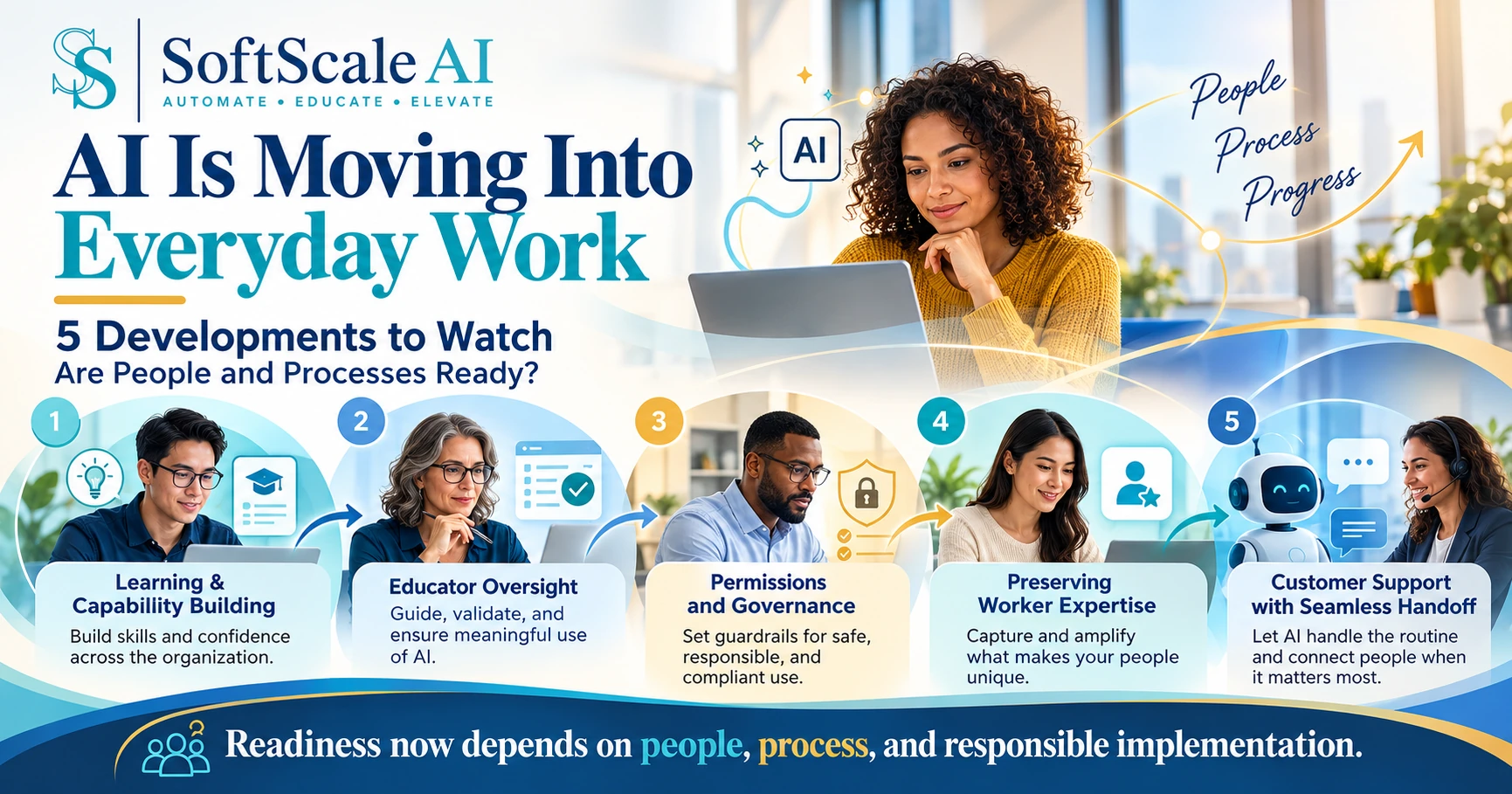
AI Is Moving Into Everyday Work. Are People and Processes Ready? 5 Developments to Watch
This week: a $70 million AI-skills initiative, new educator training, AI agents in banking, a manufacturing knowledge assistant and an AI customer-service voice agent. Plus: Ohio AI Watch.