
AI Is Moving Into Everyday Life. Are We Preparing People to Question It?
AI is changing work, education, and everyday decisions. Five developments reveal why verification, access, safeguards, and human judgment matter.
Founder & CEO, SoftScale AI | CPD-Certified AI Consultant | AI Literacy & Workforce Readiness Strategist
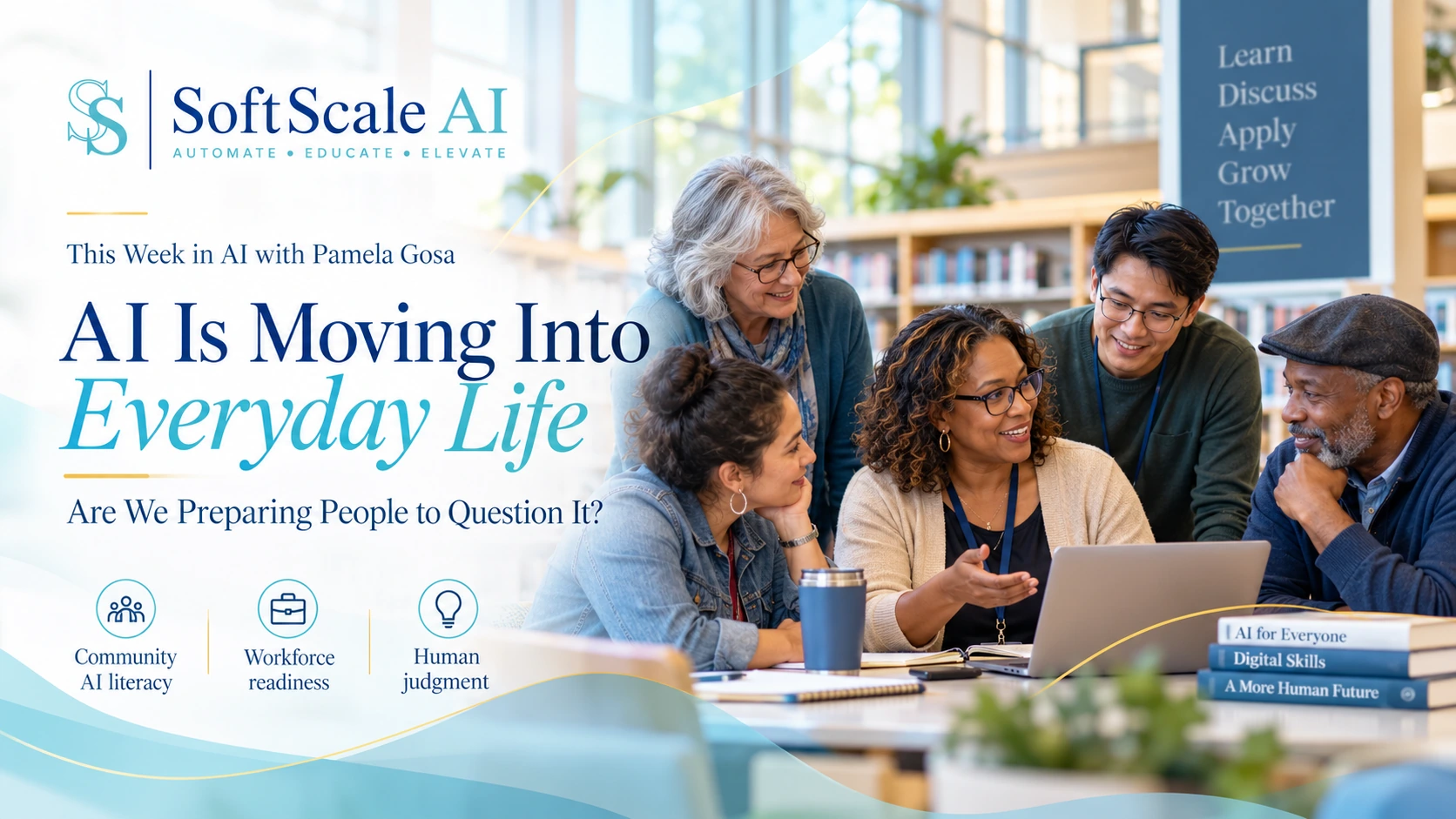
This Week in AI with Pamela Gosa | October 23, 2026
Five developments in AI literacy, professional accountability, technology security, consumer protection, and medical research reveal why human judgment matters more than ever. Plus: Ohio AI Watch.
By Pamela Gosa
Founder & CEO, SoftScale AI | CPD-Certified AI Consultant | AI Literacy & Workforce Readiness Strategist
Through my recent conversations about AI training with libraries, youth-serving organizations, and workforce partners, I keep returning to the same principle: effective AI education has to begin with the people, not the tools.
Students, jobseekers, staff, business owners, and community members bring different experiences and responsibilities. Those differences should shape what we teach. Rather than demonstrating every new application, I want people to leave with skills they can actually use: asking better questions, verifying information, protecting their data, and recognizing when human judgment should lead.
The need is growing. This week, public libraries announced a new national AI education initiative; a federal appeals court addressed serious errors in professional documents; federal agencies clarified technology security restrictions; consumer-protection officials challenged alleged fraudulent advertising; and researchers published promising—but still preliminary—medical AI findings.
Here in Ohio, employers and students are also discussing how automation is changing real jobs. I'll return to that conversation in the Ohio AI Watch section below.
Together, these developments raise a question that matters far beyond the technology industry: as AI changes how we work, learn, communicate, and make decisions, who is helping people develop the knowledge and judgment to navigate those changes?
AI readiness is not simply knowing which tools exist. It is understanding what they can and cannot do, preparing people and processes for responsible use, and protecting the human capability that technology is meant to support.
In this October 23 edition of This Week in AI with Pamela Gosa, we examine five developments, what they mean for the communities and organizations we serve, and practical questions leaders can act on now.
This Week's Key Takeaways
- Public libraries are gaining additional resources to support community AI literacy. The Public Library Association and Microsoft announced a national initiative offering no-cost AI learning resources and training opportunities for library professionals and patrons.
- AI verification is becoming an important professional accountability issue. An October 22 federal appellate decision involving serious errors in judicial documents provides a concrete example of the consequences of inaccurate AI-assisted work.
- Organizations need to understand the AI technology operating within their systems. Formal publication of federal DeepSeek restrictions highlights the importance of technology oversight, procurement requirements, and vendor transparency.
- Digital trust and consumer protection are increasingly relevant to AI literacy. Rhode Island's lawsuit against Meta over alleged fraudulent advertising raises questions about scams, automated systems, and the responsibility to protect consumers.
- Promising AI performance is not the same as proven real-world effectiveness. New Microsoft medical AI research demonstrates potentially valuable capabilities while reinforcing the need for independent evaluation and professional judgment.
- Ohio AI Watch: Ohio State Mansfield reports how regional employers and students are thinking about AI, automation, changing job responsibilities, and the human skills that remain important.
The Bottom Line: Preparing people for AI requires more than access to tools. It requires practical skills, informed judgment, organizational safeguards, and opportunities for people to participate confidently in technological change.
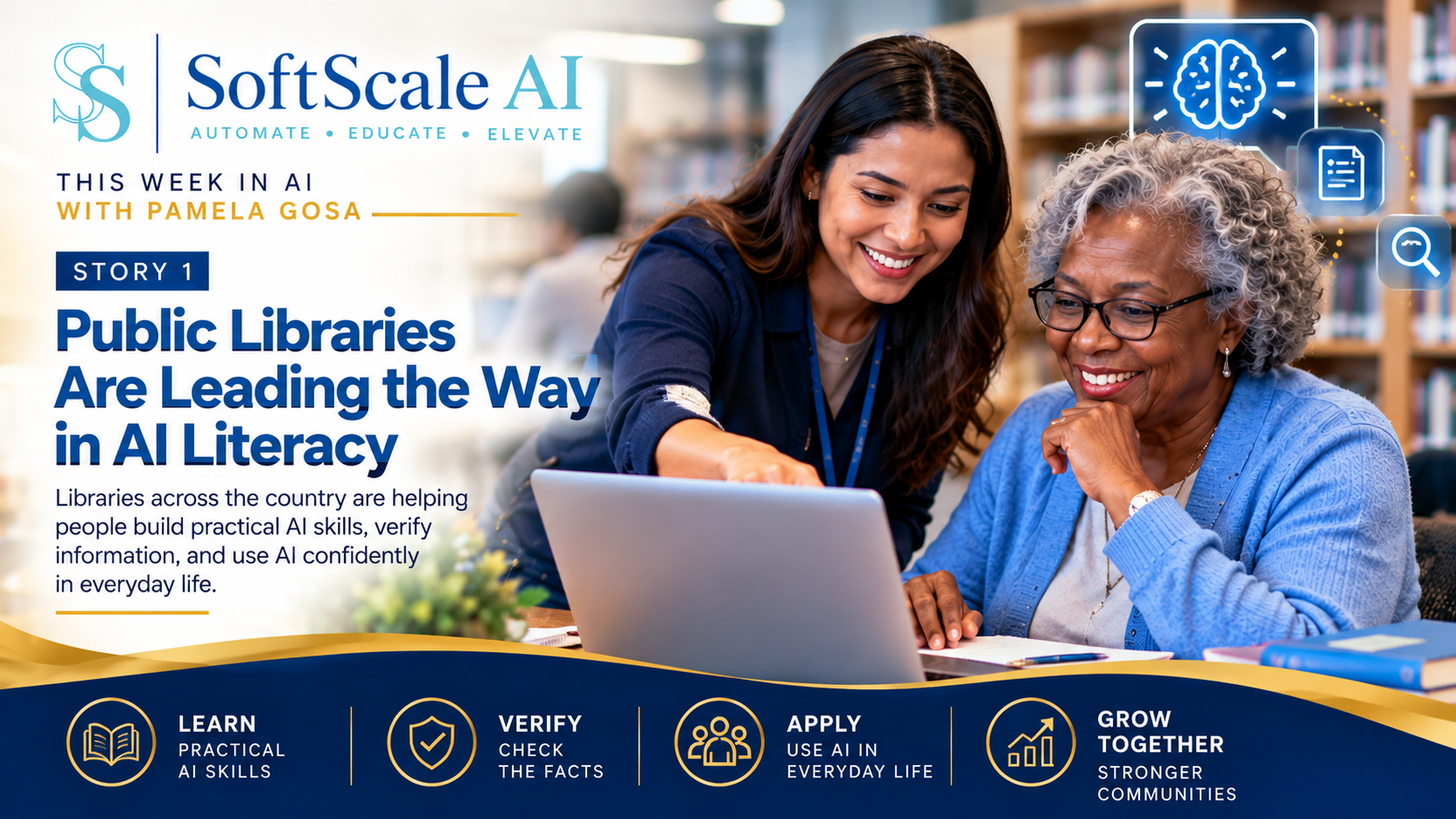
1. Public Libraries Are Taking a Larger Role in Community AI Literacy
What Happened
On October 22, 2026, the Public Library Association (PLA), a division of the American Library Association, announced a collaboration with Microsoft called Building AI Skills and Agency Through Libraries.
The initiative is designed to expand no-cost resources and training for public library employees and the people they serve.
According to the Public Library Association's official announcement, participating libraries and staff will have access to learning materials, toolkits, webinars, and opportunities to learn from other library professionals.
The initiative emphasizes practical AI skills, privacy, accuracy, critical evaluation, responsible use, and the ability to make informed choices about whether and how to use AI.
A webinar and training series is scheduled to begin in December 2026 and continue into spring 2027.
The first webinar, Building AI Agency with Libraries, is scheduled for December 3.
Why This Matters
Public libraries have long served as places where people access information, build digital skills, and find employment resources. AI creates additional needs within that familiar mission.
Consider a person returning to the workforce after several years away.
A job posting mentions AI-assisted scheduling, customer communications, and digital productivity tools.
The applicant may recognize the names of some applications but have little experience using them.
Without guidance, it may be difficult to determine which skills are essential, which are learnable, or how AI fits into an unfamiliar job.
A public library offering introductory AI literacy instruction could provide a place to begin.
That does not mean every library must offer advanced AI courses or become a technical training institution.
It means libraries may be able to extend their existing digital and information literacy work to help patrons ask better questions, understand basic concepts, and practice responsible use.
This possibility matters for people who may not have access to expensive courses, workplace training, or specialized technology programs.
The PLA initiative also recognizes something important: learning to operate an AI tool and understanding whether to trust its output are different skills.
Both deserve attention.
Who Should Pay Attention?
Public library leaders, librarians, workforce organizations, adult educators, community colleges, nonprofits, families, and government officials responsible for educational access.
Pamela's Perspective
I see community AI literacy as an access-to-opportunity issue.
In my recent outreach to libraries and youth-serving organizations, I've been thinking about what makes a workshop genuinely useful: not the number of tools introduced, but whether people can explain an answer, recognize a risk, and apply what they've learned afterward.
If AI skills become more important across occupations, we cannot assume everyone will receive training through an employer or school.
Some adults are changing careers. Some are returning to the workforce. Others are already employed but have not received practical AI instruction.
Young people may encounter AI regularly while still needing guidance about privacy, accuracy, and responsible use.
And older adults may want to understand technology that is increasingly appearing in services they already depend on.
The role of community education is not to pressure everyone to use AI.
It is to provide enough understanding for people to make informed choices.
That includes recognizing when AI can be useful, when information requires verification, and when not using AI may be the appropriate decision.
The strongest programs will likely begin with the people being served and the questions they actually have.
A Practical Human Example
Illustrative example.
Imagine a 56-year-old administrative professional preparing to return to work after several years of caregiving.
During a job interview, the employer asks about experience with AI-assisted office tools.
The applicant has heard of ChatGPT but is uncertain how it relates to administrative work.
At a library workshop, the participant practices using an AI assistant to organize a sample meeting agenda, refine a professional email, and compare information from two sources.
The instructor also demonstrates an AI-generated response containing an inaccurate detail.
Instead of treating the tool as automatically reliable, participants practice checking the information.
The result is not instant mastery of AI.
It is a foundation for further learning and greater familiarity with technology the applicant may encounter professionally.
Practical Takeaway
Library leaders can begin by identifying the questions their patrons are already asking about AI.
Programs should prioritize meaningful learning outcomes rather than simply introducing as many tools as possible.
Leadership Question
If someone in your community wants to understand AI but lacks access to employer-sponsored or paid training, where can that person go for trustworthy guidance?
Primary source: Public Library Association and Microsoft announce responsible AI skills initiative — October 22, 2026.
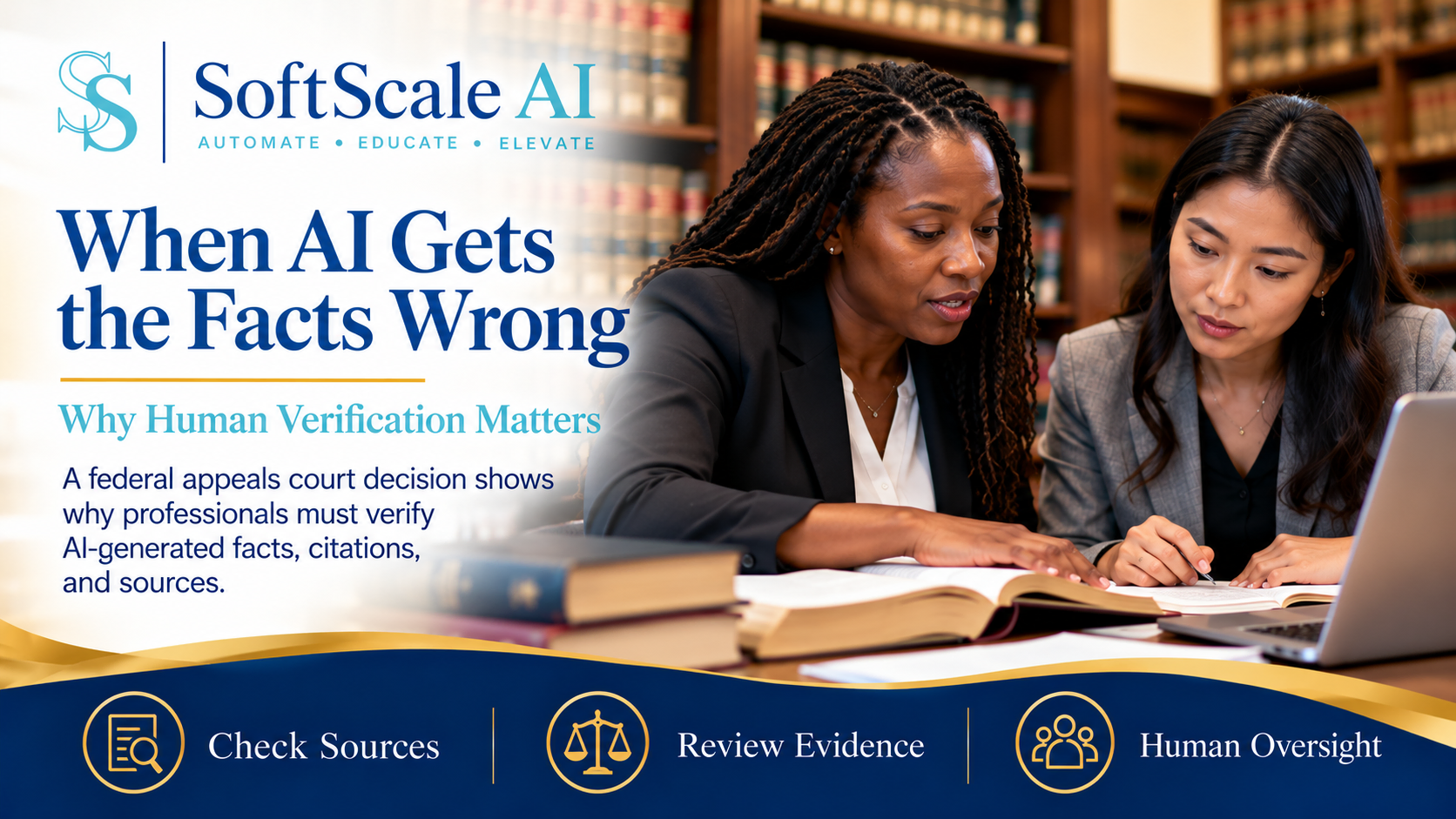
2. A Federal Appeals Court Decision Shows Why AI Verification Cannot Be Optional
What Happened
On October 22, the U.S. Court of Appeals for the Fifth Circuit issued its opinion in Jackson Federation of Teachers v. Fitch, a case involving Mississippi education legislation.
The appellate court vacated a preliminary injunction and ordered the case reassigned to a different district judge.
The opinion described serious errors in earlier judicial orders.
Those errors included unsupported statements, references to people who did not appear in the court record, and a citation to a nonexistent case.
The district judge had previously acknowledged that a law clerk used AI when preparing an earlier draft of a temporary restraining order.
The appellate court also identified broader deficiencies in the legal reasoning.
The ruling does not establish that every error was caused by AI, nor does it prohibit AI-assisted legal work generally.
It does, however, provide a documented example of how inaccurate information in consequential professional documents can become a serious problem.
The Fifth Circuit's published October 22 opinion is the primary source.
Why This Matters
Generative AI can organize information, summarize documents, and produce persuasive explanations very quickly. But polished writing is not proof that the underlying information is accurate.
A nonexistent legal case may appear in the same format as a real citation.
A fabricated statistic may look similar to a legitimate research finding.
An AI-generated summary may omit a crucial limitation while presenting its conclusions confidently.
The danger is not necessarily obvious to someone reading the finished text.
That is why verification matters.
And the lesson extends far beyond courtrooms.
Workforce organizations prepare training materials.
Nonprofits submit grant proposals.
Businesses create customer communications and operating procedures.
Schools and colleges prepare instructional resources.
Government agencies write reports and policies.
If AI contributes to these activities, the organization still needs to determine how important claims will be reviewed.
The Human Consequences of an Incorrect Answer
Consider the real appellate case.
The documents at issue were not informal brainstorming notes.
They were judicial orders with consequences for the parties and institutions involved.
The appeals court found the errors serious enough, alongside broader legal deficiencies, to vacate the preliminary injunction and require reassignment.
That is a very different situation from discovering an incorrect answer in a casual conversation.
The stakes change how careful the review process needs to be.
A similar principle applies to everyday organizational work.
An inaccurate suggestion for a social media caption may be corrected easily.
An inaccurate claim in a funding proposal, employment decision, public notice, or legal document can create more consequential problems.
Responsible AI use requires matching the level of verification to the potential consequences.
Who Should Pay Attention?
Educators, legal professionals, government agencies, employers, nonprofit leaders, workforce trainers, students, and anyone preparing consequential AI-assisted documents.
Pamela's Perspective
When I think about the skills people need to work responsibly with AI, verification is near the top of the list.
Prompting matters.
Knowing how to explain a task clearly matters.
Understanding the limitations of a tool matters.
But the ability to evaluate an answer may be even more important when the work has consequences for others.
A worker should understand how to distinguish a credible source from a fabricated one.
A student should be able to explain the evidence behind a claim.
A manager should know when information requires additional review.
And an organization should establish clear expectations for documents that cannot afford unverified errors.
AI literacy is not about becoming suspicious of every answer.
It is about developing habits that help people recognize when a claim needs to be checked.
A Practical Learning Example
Illustrative example.
Imagine an employee preparing a report about workforce trends.
The employee asks an AI system to summarize recent research and identify supporting statistics.
The response appears professional and contains several references.
Before sharing the report with leadership, the employee checks the cited sources.
One reference does not exist. Another leads to an actual report but does not support the statistic attributed to it.
The employee corrects the document and adds reliable supporting evidence.
The process takes additional effort, but it prevents inaccurate information from influencing an organizational decision.
The lesson is not that AI should never assist with research.
It is that the final work remains subject to human review.
Practical Takeaway
Organizations should teach a repeatable verification process: identify important claims, locate the original source, confirm the evidence supports the statement, and review the consequences of an error.
Leadership Question
Are employees being taught only how to generate AI-assisted work, or are they also being taught how to determine whether that work is accurate?
Primary source: U.S. Court of Appeals for the Fifth Circuit, Jackson Federation of Teachers v. Fitch — October 22, 2026.
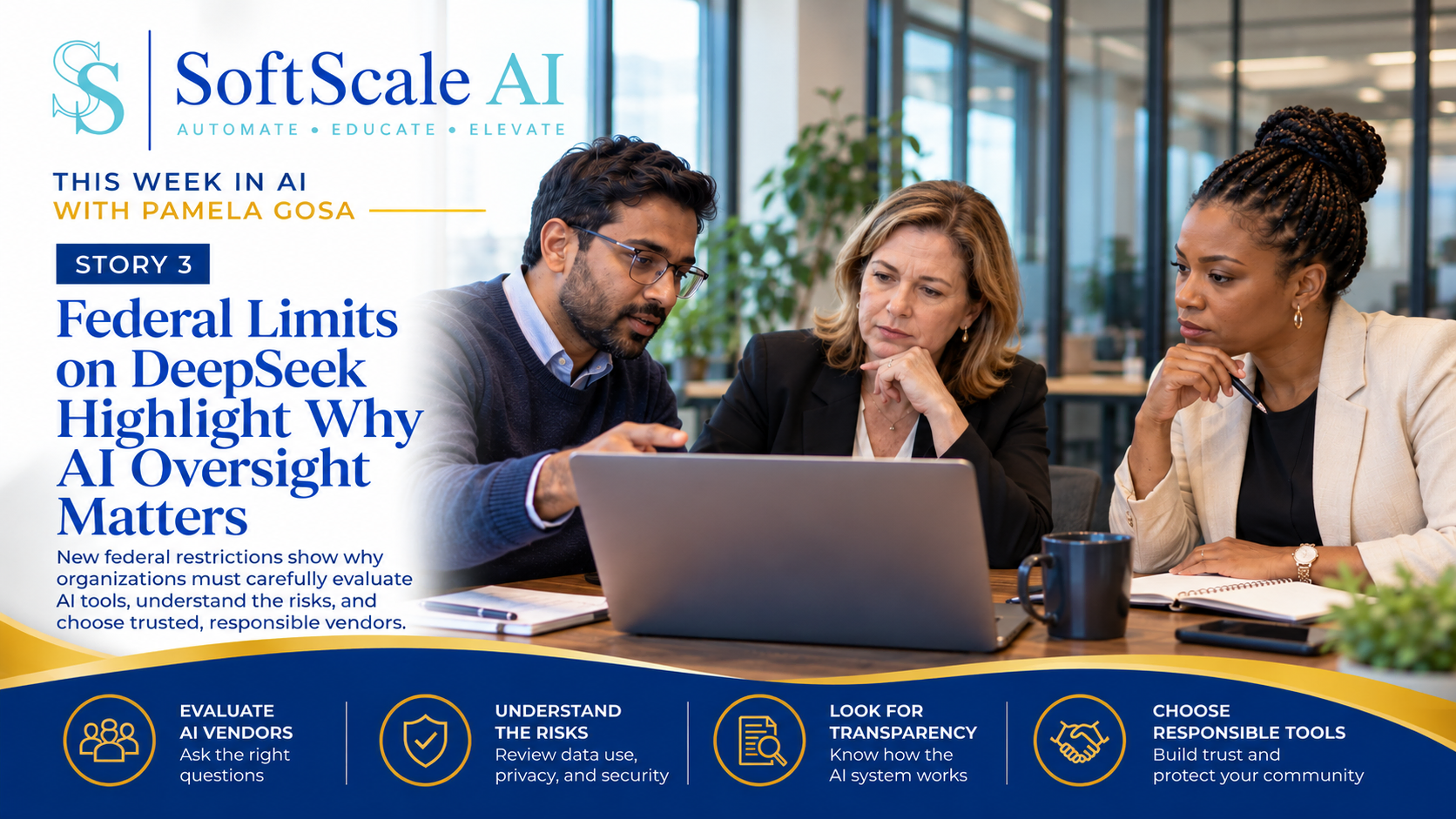
3. Federal DeepSeek Restrictions Highlight a Different Side of Responsible AI Adoption
What Happened
On October 20, the U.S. Department of Homeland Security published a formal notice in the Federal Register concerning the exclusion and removal of DeepSeek products and services from federal civilian executive-branch information technology systems and procurement.
The underlying order was issued July 24, 2026.
The October publication is the new development within this week's reporting period.
The order covers certain DeepSeek products, affiliated products, and third-party products or services developed using covered DeepSeek implementations.
The restrictions reflect federal technology supply-chain and security concerns.
Importantly, the action applies to specified federal civilian systems and procurement. It is not a general prohibition on private individuals using DeepSeek.
Why This Matters
When people think about AI adoption, they often start with the application: a chatbot, an AI receptionist, a scheduling assistant, or a document-processing tool.
But organizations may not fully understand the technology operating behind those applications.
Some AI capabilities are integrated into third-party software.
Other systems rely on external models or connect to additional services.
The applications may perform useful tasks while creating questions about access, privacy, procurement, vendor dependencies, and oversight.
An organization does not necessarily need detailed expertise in every underlying model.
But it should understand which systems are being used, what information they process, and what responsibilities accompany their use.
Who Should Pay Attention?
Federal agencies, government contractors, IT leaders, small businesses, nonprofits, technology purchasers, and organizations adopting AI-powered workflows.
Pamela's Perspective
For business owners and organizational leaders, the important lesson is to avoid treating an AI application as an isolated purchase.
A useful application becomes part of a larger system.
Take an AI receptionist as an example.
The receptionist may answer calls, collect information, and help route inquiries.
But meaningful implementation also requires decisions about the customer information collected, the employee who receives the inquiry, the business systems involved, and what happens when the AI cannot answer a question correctly.
Those surrounding processes matter just as much as the voice agent's ability to carry on a conversation.
Responsible implementation should begin with understanding the work.
What problem is being solved?
Which information is involved?
Who supervises the system?
What happens if something goes wrong?
How will the organization know whether the system is working as intended?
The federal DeepSeek development is specific to government systems. The broader lesson for other organizations is to understand their own technology environment and applicable responsibilities.
A Practical Business Example
Illustrative example.
A small home-services company begins evaluating an AI-powered customer communication platform.
The owner likes the demonstration. The system responds quickly, handles routine questions, and can request appointment information.
Before implementation, the owner reviews several questions with the vendor.
What happens to customer information collected during a call?
Which external services support the application?
Can employees review transcripts or call summaries?
How are mistakes corrected?
What happens when a customer reports an urgent situation?
Can the system be disabled or redirected when necessary?
The owner also tests how information moves to the scheduling and customer-management systems.
These steps may not be as exciting as the demonstration.
But they help determine whether the product is suitable for actual business operations.
Practical Takeaway
Maintain a basic inventory of approved AI applications, their purposes, the information they handle, and the people responsible for oversight.
Leadership Question
Does your organization understand the AI technology it already uses, including the systems embedded inside third-party applications?
Primary source: Department of Homeland Security, Federal Register notice — October 20, 2026.
4. A New Lawsuit Raises Questions About Fraudulent Advertising and Consumer Trust

What Happened
On October 22, Rhode Island Attorney General Peter Neronha filed a lawsuit against Meta concerning allegedly fraudulent advertisements on its platforms.
The complaint alleges that Meta failed to adequately prevent fraudulent products and financial scams from being advertised despite representing that it used sophisticated systems to protect users.
The complaint also alleges that the company profited from those advertising activities.
Meta disputes the allegations.
The lawsuit is a legal filing, not a court determination of liability.
The allegations should therefore be distinguished from established findings.
The case nevertheless raises important questions about digital advertising, platform responsibility, consumer protection, and the role of automated systems in distributing persuasive content.
Why This Matters
Consumers encounter digital advertisements throughout everyday life.
Some promote legitimate products or services.
Others may contain misleading claims, impersonate trusted organizations, or attempt to obtain money or sensitive information.
AI can make certain kinds of text, images, and other content easier to create.
However, fraudulent advertising does not always involve AI, and AI-generated advertising is not inherently fraudulent.
What matters is whether people can recognize warning signs and verify information before acting.
This is particularly relevant when advertisements concern financial products, medical claims, urgent payments, or personal information.
The Human Side of Digital Fraud
Consider a common situation.
A person scrolling through social media sees an advertisement that appears to come from a familiar retailer.
The photographs look professional. The logo is recognizable. The message promises a limited-time discount.
The person clicks the advertisement and reaches a website that looks legitimate.
Before entering payment information, a few questions could make an important difference.
Is this the company's actual website?
Does the offer also appear through the company's independently verified channels?
Is the payment method unusual?
Are the contact details consistent with the legitimate business?
Does the message create unnecessary urgency?
A person does not need to identify the exact technology used to create an advertisement to practice these precautions.
The goal is to evaluate the trustworthiness of the claim.
Who Should Pay Attention?
Families, older adults, libraries, small businesses, financial-literacy educators, nonprofit organizations, and government consumer-protection agencies.
Pamela's Perspective
This is one reason I believe AI literacy should extend beyond learning prompts and applications.
People also need to understand how technology can influence the information they encounter.
A convincing image is not proof.
A familiar logo is not proof.
An authoritative-sounding message is not proof.
And a message that appears personal may still be automated or fraudulent.
For community organizations, these are practical education topics.
Older adults may need information about impersonation scams.
Small-business owners may need procedures for verifying changes to payment instructions.
Families may need guidance about misleading advertising and unfamiliar websites.
Young people may need help understanding how digital content can be created, altered, and distributed.
The objective should not be to make people fearful of technology.
It should be to give them straightforward habits that reduce avoidable risks.
A Practical Community Example
This is an illustrative workshop scenario.
Participants receive three fictional online advertisements.
One is a straightforward advertisement from a legitimate business.
Another contains a false claim and misleading payment instructions.
A third uses an unfamiliar seller and provides too little information to verify its legitimacy.
Participants are asked to determine what evidence they need before trusting each offer.
They practice locating official websites independently, checking claims, reviewing the payment process, and recognizing pressure tactics.
The point is not to turn participants into digital investigators.
It is to help them become more careful and confident consumers.
Practical Takeaway
When an advertisement or message asks for money or sensitive information, verify the request through an independent official channel before responding.
Leadership Question
Are we teaching people how to protect themselves from convincing digital deception as intentionally as we are teaching them how to use AI tools?
Primary source: Rhode Island Attorney General's lawsuit announcement — October 22, 2026.
Supporting source: Reuters coverage of the case, October 22, 2026.
5. Medical AI Research Shows Promise—and Why Evidence Still Matters
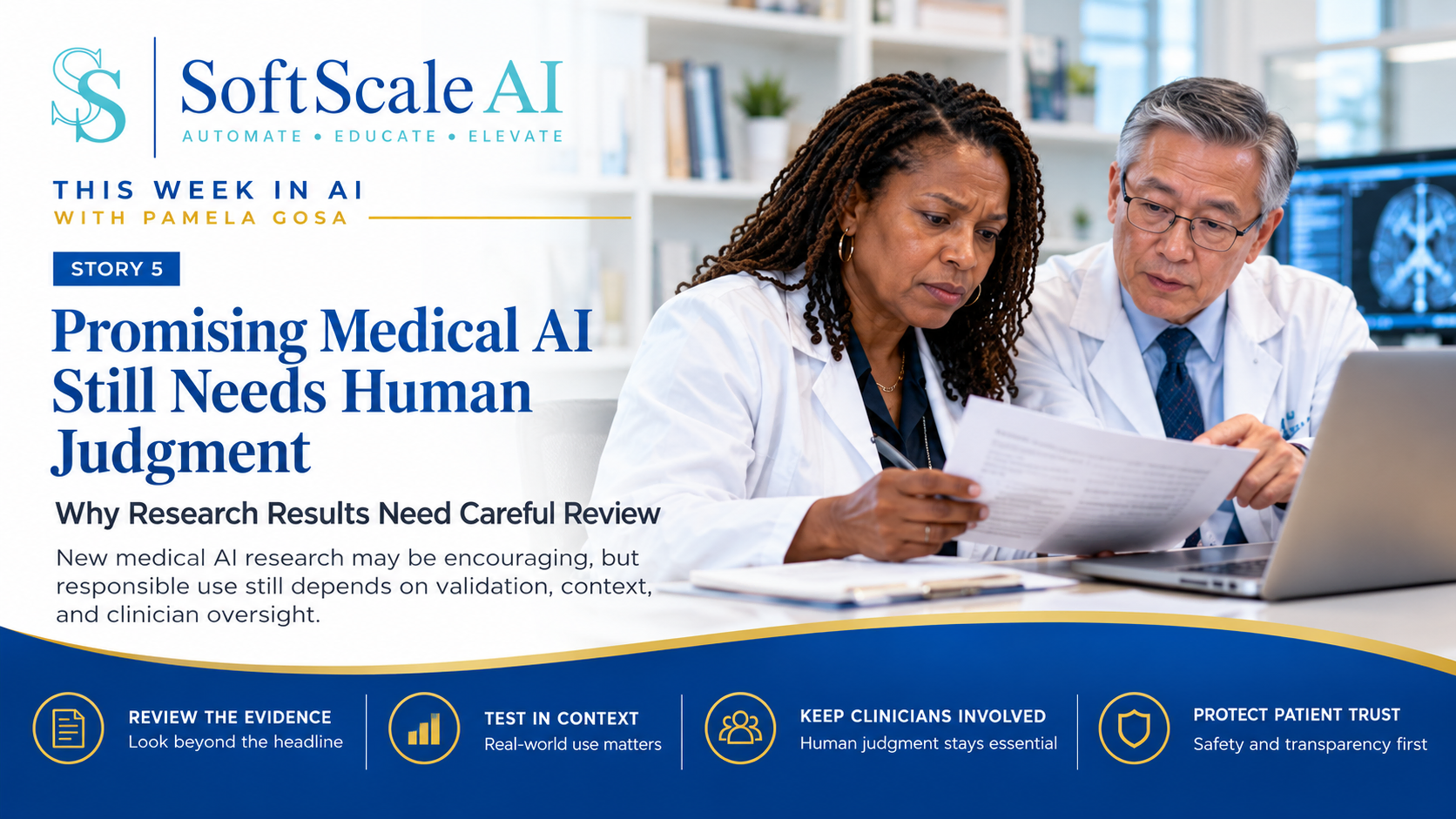
What Happened
On October 22, Microsoft researchers published findings about a diagnostic AI system called MAI-DxO.
The system is designed to work through medical cases sequentially, considering possible diagnoses and determining what additional information or tests may be helpful.
According to Microsoft's October 22 research announcement, the system demonstrated strong performance on controlled evaluations using historical medical cases.
In a simulated evaluation of complex cases from the New England Journal of Medicine, Microsoft reported that MAI-DxO reached 83% diagnostic accuracy, compared with 36% for generalist physicians working individually with reference materials.
These figures come from controlled historical-case testing, not direct evidence of better outcomes for patients in clinical practice. The comparison was with generalist physicians, not teams of medical specialists.
The research was published in Science.
Microsoft also described additional evaluation plans involving Beth Israel Deaconess Medical Center.
These results are promising, but their meaning must be carefully qualified.
Performance on historical case evaluations does not establish that an AI system delivers better outcomes for patients in routine clinical practice.
The findings also should not be interpreted as proof that AI can replace medical professionals.
Why This Matters
Healthcare is one of many fields exploring AI for specialized work, including systems that may help professionals evaluate complicated information. But the difference between a promising research result and a proven real-world application matters.
A system can perform well on an evaluation dataset yet face different challenges in daily practice, where information is incomplete, situations are unusual, professional practices vary, and consequences cannot always be captured in a benchmark.
That is why strong research findings should encourage careful evaluation rather than automatic conclusions.
Who Should Pay Attention?
Healthcare leaders, medical educators, university researchers, government decision-makers, workforce educators, and organizations evaluating specialized AI systems.
Pamela's Perspective
One of the most valuable things AI literacy can provide is the ability to interpret technology claims accurately.
When readers encounter a headline about AI outperforming professionals, it is natural to wonder what that means for jobs, expertise, and the future of an industry.
But the headline rarely tells the entire story.
We need to ask what was tested.
Who or what was involved in the comparison?
What information was available?
Were the conditions representative of everyday work?
Has the result been independently reproduced?
What limitations remain?
And what happens when the system makes a mistake?
These are not questions designed to dismiss innovation.
They help us understand where innovation stands.
Responsible AI education should make people better at interpreting evidence, not simply more impressed by performance claims.
A Practical Leadership Example
This is an illustrative organizational scenario.
A workforce organization is considering an AI-powered platform that claims to improve participant assessments.
The vendor demonstrates impressive performance statistics.
Before adopting it, leadership asks what those statistics represent.
Were assessments checked against validated outcomes?
Does the platform perform well for people with different educational backgrounds?
What information does it collect?
Can staff review and correct recommendations?
What happens when the system produces an inaccurate result?
The organization may discover that the tool is useful as a support resource but inappropriate as the sole basis for a consequential decision.
That distinction makes for a more responsible decision.
Practical Takeaway
Before trusting an impressive AI performance claim, ask what was measured, what evidence supports the result, and whether the findings apply to the intended use.
Leadership Question
Are we evaluating AI based on what its developers say it can do, or on the evidence that it can perform reliably in our particular environment?
Primary source: Microsoft AI, Building Medical Superintelligence — October 22, 2026.
Ohio AI Watch: Ohio Employers and Students Discuss the Future of Work
This week's Ohio spotlight provides a particularly useful human example of AI workforce readiness.
On October 20, Ohio State Mansfield published an account of its October 12 Business and Manufacturing Industry Hub, titled The Future Workforce: Hiring for Skills That Don't Exist Yet.
The event brought students, faculty, alumni, and regional employers together to discuss how changing technology is influencing workforce expectations.
Among the participants were Scott King, president and CEO of The Gorman-Rupp Company, and Mark Cacchio, director of human resources at Charter Next Generation.
Their examples went beyond general predictions about AI.
From Repetitive Tasks to Customer Relationships
King described how automation is changing responsibilities at Gorman-Rupp.
Customer-service employees who previously devoted considerable time to manual purchase-order entry are benefiting from systems that process much of that information.
According to the university's account, employees are receiving training to focus more on customer relationships, sales follow-up, and helping customers understand products.
This is a documented example of work redesign within a particular company—not evidence that every employer will handle automation the same way.
The important lesson is that changing technology can create a need for changing skills.
Employees may need more opportunities to apply judgment, communicate effectively, and understand the broader purpose of their work.
What Students Took Away
Ohio State Mansfield student Jackie Chen described how the discussion shifted their understanding of AI and employment toward the importance of applied knowledge and critical thinking.
Another student, Olivia Ritenour, emphasized the importance of developing both technical abilities and interpersonal skills in preparation for an engineering career.
Those reactions give the conversation a human dimension.
For students, AI workforce readiness is not an abstract policy discussion.
It affects what they choose to learn, how they prepare for careers, and what they believe employers will value.
An Unexpected Lesson About Authenticity
Cacchio also described an instance in which an employee used AI to help write a message recognizing a colleague's accomplishments.
The message did not feel genuine to him.
That example illustrates a different limitation of AI-assisted work.
Technology may help draft communication, but recognizing someone's contributions requires understanding the individual and the relationship.
Efficiency is useful.
Authenticity matters too.
Pamela's Ohio Perspective
This is the kind of workforce-readiness conversation that deserves attention in Ohio.
It brings employers and students together around the actual skills changing work may require.
But the questions are relevant to organizations throughout the state.
How are jobs changing?
Which responsibilities are becoming more automated?
What judgment will employees still need to exercise?
How can training prepare people for unfamiliar tools without neglecting communication, problem-solving, and human relationships?
Those questions should help shape local AI education.
The goal is not to promise that AI will eliminate no jobs or transform every occupation in the same way.
The goal is to understand actual changes and prepare people accordingly.
Ohio AI Watch Takeaway: AI workforce readiness is strongest when education connects technology skills with real workplace tasks, employer expectations, critical thinking, and the ability to keep learning.
Primary source: Ohio State Mansfield, Preparing for What's Next — October 20, 2026.
Also This Week in Ohio: Public Libraries Confront AI Questions
The Ohio Library Council's annual Convention and Expo took place October 21–23 in Sandusky.
Its program included discussions about trusted information and the role of libraries, journalism, and communities.
An October 22 keynote titled AI's Biggest Questions, Myths, and Mysteries addressed AI misconceptions, changing workplace expectations, privacy, and evaluating AI-generated information.
The event program demonstrates that Ohio library professionals are engaging with many of the same questions raised by the new national PLA initiative.
Source: Ohio Library Council, 2026 Convention and Expo keynote program.
The Bigger Picture: AI Readiness Requires More Than Technical Skills
The five national developments and the Ohio spotlight share a common theme.
Technology is becoming part of work, education, information, and public services.
But introducing technology does not automatically prepare people to use it wisely.
A library may have access to AI education resources but still need time and staff preparation to implement meaningful programming.
An employee may know how to generate a report but need instruction in verifying sources.
A business may purchase an AI-powered application without fully understanding how information moves through the system.
A consumer may recognize a familiar company name without knowing whether an advertisement is trustworthy.
And an executive may read an impressive AI benchmark without understanding what it actually demonstrates.
These are different problems.
They cannot all be solved by the same training session.
But each involves the relationship between technological capability and human readiness.
This is why organizations should identify the people, purposes, risks, and learning needs associated with their particular uses of AI.
The Five-Question AI Readiness Check
Before expanding AI use, leaders can begin with five questions.
1. Purpose: What problem are we trying to solve? A useful AI project should have a clear purpose. Introducing a tool simply because it is popular does not establish its value.
2. People: Who needs to understand or use it? Consider employees, customers, students, clients, and others who may be affected. Identify the knowledge and support they need.
3. Practice: Can people demonstrate responsible use? A training attendance record is not the same as demonstrated ability. People should have opportunities to apply, explain, question, and evaluate what they learn.
4. Protection: What safeguards are appropriate? Consider privacy, accuracy, accessibility, information security, approval requirements, and the consequences of errors.
5. Accountability: Who remains responsible? Organizations need clear responsibilities for decisions, corrections, oversight, and outcomes when AI supports work.
These questions are a practical discussion framework, not a substitute for legal, cybersecurity, or specialized professional assessments.
Six Practical Steps Organizations Can Take Now
Step 1: Identify current AI use. Find out which applications employees and teams already use and which tasks they support.
Step 2: Listen to the people affected. Ask employees, students, participants, or community members about their experience, questions, and concerns.
Step 3: Identify real learning needs. Prioritize skills relevant to actual responsibilities rather than teaching the same list of applications to every audience.
Step 4: Teach verification and judgment. Include examples of incorrect AI-generated information and practice checking important claims.
Step 5: Establish appropriate safeguards. Clarify approved tools, sensitive information practices, human review, and escalation procedures.
Step 6: Evaluate and improve. Measure learning, collect feedback, review outcomes, and adjust before expanding programs or implementations.
None of these steps requires an organization to become completely AI-ready overnight.
The purpose is to move from general awareness toward practical, responsible preparation.
Frequently Asked Questions About AI Literacy and Workforce Readiness
1. What is AI literacy?
AI literacy is the ability to understand basic AI concepts, recognize AI in everyday applications, evaluate AI-generated information, protect personal or organizational data, and make informed decisions about appropriate use. It includes critical thinking and human judgment, not just familiarity with tools.
2. What is AI readiness?
AI readiness is the capacity of a person or organization to use artificial intelligence effectively and responsibly for appropriate purposes. Organizational readiness may include workforce skills, leadership understanding, technology systems, processes, privacy practices, policies, and accountability.
3. What is the difference between AI literacy and AI readiness?
AI literacy focuses on what people understand and can do. AI readiness is broader. It also considers whether an organization has the people, processes, resources, and safeguards necessary to implement AI appropriately.
4. Why does AI literacy matter for workforce development?
Workers may encounter AI in customer service, administration, research, communication, scheduling, technical work, and other occupations. Workforce programs can help people understand these applications while strengthening verification, problem-solving, and professional judgment.
5. How can public libraries support AI literacy?
Libraries can provide introductory learning opportunities, information evaluation, technology guidance, privacy education, and practical workshops designed around community needs. The appropriate programming depends on each library's resources and patrons.
6. Can generative AI produce fabricated information?
Yes. AI systems can generate inaccurate facts, nonexistent citations, misleading explanations, or incomplete summaries. Important information should be checked against reliable independent sources.
7. Should businesses use AI without understanding the underlying technology?
Businesses do not need expertise in every technical component, but they should understand the application's purpose, relevant vendor practices, information handling, oversight responsibilities, and risks before implementation.
8. Can AI make scams harder to recognize?
AI can help produce convincing text, images, or other content. However, many scams do not require AI. Consumers should use established verification practices regardless of how suspicious content was created.
9. Does strong AI benchmark performance guarantee success in the real world?
No. Benchmarks provide evidence under particular evaluation conditions. Real-world reliability may require additional testing, independent validation, and safeguards appropriate to the task.
10. How can nonprofits begin providing responsible AI education?
Nonprofits can begin with accessible sessions covering AI basics, everyday applications, privacy, information verification, limitations, and practical decision-making. Programs should reflect participants' circumstances, experience, and needs.
11. Does AI readiness require every worker to become a programmer?
No. Different occupations require different competencies. Many employees may benefit from understanding how AI affects their existing responsibilities, how to evaluate its output, and when human expertise remains essential.
12. How should organizations measure AI training success?
Organizations can assess whether participants understand essential concepts, complete relevant tasks, recognize errors, protect sensitive information, and demonstrate appropriate judgment. Training quality should be evaluated through meaningful learning outcomes, not attendance alone.
Pamela's Perspective: Preparing People Is the Work That Matters
What stands out about this week's developments is that very different institutions are confronting the same fundamental challenge. Libraries are expanding access to education, courts are holding professionals accountable for accuracy, agencies are scrutinizing technology security, and researchers are evaluating new capabilities. In Ohio, students and employers are discussing what changing work will require of people.
Through conversations with organizations exploring AI training, I have learned that preparation cannot be reduced to a single tool or demonstration. People need space to practice, ask questions, check information, and understand how technology fits their actual responsibilities. Leaders need clear processes and safeguards as well as knowledgeable employees.
No one should need to become a technology specialist just to make informed choices about AI. And no community should be excluded from practical learning because its members lack access to expensive training. AI literacy should strengthen human capability—not encourage people to surrender it.
Here is the question I would leave with every leader: if artificial intelligence became a bigger part of your organization's work tomorrow, would your people know how to use it appropriately, recognize when information was wrong, and decide when human expertise must take priority?
If the answer is uncertain, that's a useful place to begin. An AI-ready future is built through capable people, responsible organizations, and communities with access to opportunity—not technology alone.
Continue the Conversation
Every organization is at a different stage of AI readiness.
Some are beginning with foundational AI literacy. Others are preparing employees for changing responsibilities, evaluating AI-powered workflows, or strengthening responsible-use practices.
SoftScale AI helps organizations connect practical AI knowledge with the people, processes, and responsibilities involved in everyday work.
For libraries, schools, workforce organizations, nonprofits, and community groups, explore our AI training and speaking programs.
For small and growing businesses considering AI receptionists, customer communication, and connected automation, explore our AI business solutions.
If your organization is ready to discuss its goals and next steps, book a discovery call with SoftScale AI.
Sources and Further Reading
Primary Sources
Public Library Association / American Library Association — October 22, 2026
Public Library Association and Microsoft announce effort to build responsible AI skills through libraries. Supports the national initiative, planned training resources, and upcoming webinars.
U.S. Court of Appeals for the Fifth Circuit — October 22, 2026
Jackson Federation of Teachers v. Fitch, No. 25-60496, published appellate opinion. Supports the court's findings regarding judicial errors and its order vacating the preliminary injunction and remanding for reassignment.
U.S. Department of Homeland Security / Federal Register — October 20, 2026
Notice of Order Regarding Exclusion and Removal of DeepSeek Products. Supports the federal order's scope and publication date.
Rhode Island Office of the Attorney General — October 22, 2026
Attorney General Neronha sues Meta for fraudulent advertisements. Supports the lawsuit's filing and the state's allegations.
Microsoft AI — October 22, 2026
Building Medical Superintelligence. Supports Microsoft-reported diagnostic AI research findings and plans for additional evaluation.
The Ohio State University at Mansfield — October 20, 2026
Preparing for What's Next: Industry Leaders Discuss the Future of Work at Ohio State Mansfield. Supports the documented student and employer experiences used in the opening and Ohio AI Watch section.
Ohio Library Council — October 21–23, 2026 event
2026 Convention and Expo keynote program. Supports the Ohio library conference programming on AI, digital trust, information literacy, and workforce change.
Supporting Sources
The American Library Association — October 22, 2026
The above PLA release also serves as direct institutional background for the national library initiative.
Written by Pamela Gosa, Founder and CEO of SoftScale AI.
This Week in AI with Pamela Gosa examines developments in artificial intelligence and their implications for education, workforce readiness, leadership, responsible adoption, businesses, and communities.
Reporting covers developments published or formally announced during October 16–23, 2026. Where an underlying event occurred earlier, the relevant date is identified. Official announcements, research findings, legal allegations, illustrative scenarios, and editorial analysis are distinguished throughout.
SoftScale AI — Empowering people and organizations, one opportunity at a time.
Share this article
Stay AI-Ready
Practical AI insights for work, education, community and business—plus This Week in AI with Pamela Gosa, delivered to your inbox.
Continue the conversation
Turning these ideas into practice.
AI literacy workshops, leadership briefings, speaking, and workforce-readiness programs for organizations, schools, and communities.
Explore Training & SpeakingPractical AI and automation support for growing businesses, scoped around the work your team already does.
Explore Business Solutions
Prefer to talk it through? Book a discovery call.
Related insights
 This Week in AI with Pamela Gosa
AI Readiness Is Now a Leadership Challenge: 5 Developments That Explain Why
Five major AI developments show why leaders must strengthen workforce skills, responsible AI oversight and business processes. Plus an Ohio education spotlight.
 This Week in AI with Pamela Gosa
AI Is Getting Smarter. But Are We Getting Ready?
AI is advancing faster than many people are being prepared to use it. This week's developments in GPT-6, AI agents, education, and workforce readiness reveal what's at stake.
 This Week in AI with Pamela Gosa
AI Is Entering a Harder Phase: 5 Developments Leaders Should Watch
Five AI developments reshaping workforce skills, small-business agents, scaling, governance and Ohio AI fluency—and what leaders need to know.