
Reentry in the Age of AI: Workforce Readiness Cannot Leave Returning Citizens Behind
As artificial intelligence reshapes hiring, learning, communication, and everyday work, preparing people for reentry must also mean preparing them for the workforce they are actually coming home to.
Founder & CEO, SoftScale AI | CPD-Certified AI Consultant | AI Literacy & Workforce Readiness Strategist

Why Does AI Literacy Matter for Reentry?
AI literacy is becoming part of workforce readiness because artificial intelligence increasingly affects how people search for jobs, communicate, learn, perform work, and interact with employers. Reentry programs that incorporate practical and responsible AI education can help returning citizens and justice-involved youth prepare for the workforce they are entering. Employers and workforce systems also have a responsibility to ensure that AI does not become another barrier to second-chance employment.
Imagine returning home after years away and discovering that even the process of getting a job has changed.
Applications are digital.
Resumes may be screened by software before a person ever sees them.
Interviews may begin through digital or automated platforms.
Employers may be using artificial intelligence for scheduling, training, customer service, communication, productivity, and other everyday functions.
Meanwhile, other job seekers are beginning to use generative AI to research careers, understand job descriptions, prepare resumes, practice interviews, learn new skills, and communicate professionally.
And while you are trying to rebuild your life, reconnect with family, secure employment, and establish stability, you may also be expected to understand the rules of a workplace that continued evolving while you were gone.
The workforce has changed.
That raises an increasingly important question for reentry leaders, workforce-development organizations, correctional systems, employers, educators, and community partners:
Are we preparing people returning from incarceration for the workforce that exists today, or for the workforce that existed several years ago?
If AI literacy is becoming part of workforce readiness, then people returning to our communities cannot be left out of that preparation.
Why AI Literacy Is Becoming Part of Workforce Readiness
AI Is Moving Into Everyday Work
Artificial intelligence is no longer confined to technology companies or highly technical occupations.
It is increasingly influencing the skills employers value, how organizations operate, and how workers perform everyday tasks.
The World Economic Forum’s Future of Jobs Report 2025 draws on input from more than 1,000 employers across 22 industries and 55 economies. Employers surveyed expect 39 percent of workers’ core skills to change by 2030. AI and big data rank among the fastest-growing skill areas, while human capabilities such as analytical thinking, resilience, leadership, collaboration, creative thinking, and lifelong learning remain highly important.
The same research found that 77 percent of employers plan to upskill workers in response to AI-driven change.
That combination matters.
Becoming AI-ready does not mean replacing human judgment with technology.
It means knowing how to work alongside changing technology while strengthening the human capabilities technology cannot replace.
For someone entering or reentering the workforce, that increasingly belongs in the same conversation as traditional workforce readiness.
AI Readiness Is Not the Same as Technical Expertise
A returning citizen does not need to become a programmer, data scientist, or AI engineer to benefit from AI literacy.
A customer-service employee may encounter AI-assisted tools.
An administrative worker may use AI to organize information or help draft communications.
A job seeker may encounter automated recruiting technology.
A small-business owner may use generative AI for research, planning, or customer communication.
An employee may simply need to understand when an AI-generated answer should be checked before acting on it.
That is why AI literacy should increasingly be viewed as a workforce capability, not solely as a technology specialization.
The question is less:
Can this person become an AI expert?
And more:
Can this person navigate an increasingly AI-enabled environment with confidence, judgment, and responsibility?

Why Reentry Creates a Unique AI-Readiness Challenge
Returning to More Than a Different Job Market
Employment has long been one of the significant challenges associated with reentry.
A Bureau of Justice Statistics study of people released from federal prison in 2010 found that 33 percent of the study population did not find employment at any point during the 16 quarters following release.
But employment is only one part of the larger reentry picture.
The National Institute of Justice’s Five Things About Reentry describes reentry as a continuum and emphasizes that services should be individualized and holistic. Housing, employment, physical and mental health, substance-use needs, family relationships, education, and other factors may interact as someone reintegrates into the community.
AI literacy does not replace any of those supports.
A technology workshop cannot substitute for stable housing.
It cannot substitute for treatment.
It cannot substitute for transportation, education, mentoring, family support, or an actual employment opportunity.
But technology readiness should not be ignored simply because other needs may be more immediate.
Existing Barriers Should Not Be Joined by a New Digital Barrier
A period of incarceration does not erase someone’s ability to contribute, learn, lead, or build a meaningful career.
But returning to a rapidly changing workforce without access to knowledge that other workers have been accumulating can create an additional disadvantage.
Consider what successful workforce reintegration may require today.
Someone may need to navigate online applications.
They may need to create or update a digital resume.
They may encounter virtual interviews.
They may need to communicate through unfamiliar workplace platforms.
They may enter an organization where AI-assisted tools are already part of everyday operations.
And outside the workplace, AI is increasingly becoming part of how people research information, learn unfamiliar concepts, compare options, and build new skills.
The goal should be to remove barriers, not quietly allow another one to develop.
That is why AI readiness belongs within a larger conversation about re-acclimation, economic participation, and long-term workforce success.
AI Literacy Is Already Entering the Reentry Workforce Conversation
The Department of Labor’s RESTART Initiative
This is no longer purely a theoretical argument.
In February 2026, the U.S. Department of Labor announced approximately $81 million in RESTART grant funding to support training and employment opportunities for individuals with criminal records or prior involvement in the criminal justice system.
Among the training services specifically identified by the Department was AI and digital literacy training.
That matters.
It signals that AI literacy is beginning to be recognized not simply as advanced technical training for people pursuing technology careers, but as part of broader workforce preparation.
For reentry organizations, workforce boards, correctional programs, employers, and community partners, that should prompt an important question:
If the workforce system is beginning to recognize AI literacy as part of employability, where should it fit within the programs we are already delivering?
What the Federal AI Literacy Framework Signals
That direction became even clearer when the Department of Labor issued its Artificial Intelligence Literacy Framework in February 2026.
The Department describes the framework as a resource for program design and for expanding AI literacy training across public workforce and education systems.
That gives reentry organizations an important opening.
AI literacy does not necessarily need to become a completely separate program.
It can be thoughtfully incorporated into workforce preparation that already exists.
Career-readiness training can include AI.
Job-search preparation can include AI.
Professional communication can include AI.
Entrepreneurship training can include AI.
Digital-safety education can include AI.
The opportunity is to integrate AI where it supports the larger goal, rather than making technology the entire goal.
What Does AI Literacy for Reentry Actually Mean?
Practical AI Skills for Employment
AI literacy becomes meaningful when participants can connect it to situations they may actually encounter.
A returning citizen might use AI to better understand a job posting and identify the skills an employer is requesting.
They might explore an unfamiliar occupation or industry.
They might practice answering interview questions.
They might ask an AI system to explain workplace terminology they do not understand.
They might use AI to improve the clarity of an email or organize their thoughts before writing a cover letter.
They might compare career pathways or build a plan for learning a new skill.
Someone considering self-employment might use AI to help research a market, brainstorm customer questions, or organize the early stages of a business plan.
Those uses are practical.
But they also require boundaries.
Using AI to improve the wording of a resume is very different from allowing AI to invent qualifications someone does not possess.
Practicing interview responses is different from memorizing fabricated answers.
Using AI as a learning aid is different from assuming everything it produces is correct.
That is where AI literacy becomes much more than simply knowing which buttons to press.
Responsible AI and Digital Judgment
A strong AI-readiness program should also teach people to ask:
Is this information accurate?
How can I verify it?
What personal or confidential information should I avoid entering into a public AI tool?
Could this answer be incomplete, biased, or misleading?
When is AI appropriate for this task?
When should I stop and ask another person?
Am I still making the decision, or am I allowing technology to make it for me?
These are technology questions, but they are also workforce questions.
They are questions about confidence, responsibility, judgment, and agency.
Confidence, Not Dependence
Access to a tool is not the same thing as confidence.
And confidence is not the same thing as judgment.
Workforce readiness increasingly requires all three.
The goal should not be to create dependence on AI.
The goal should be to help people become capable users who understand that AI can support their work without replacing their thinking, voice, responsibility, or decision-making.
AI should become another tool someone knows how to use, not another system they feel powerless in front of.
Second-Chance Employers Must Be AI-Ready Too
AI Is Changing Hiring and Workforce Management
There is another side of this conversation that cannot be overlooked.
We cannot place the entire burden of adaptation on the person returning to the workforce.
Employers are changing too.
The U.S. Equal Employment Opportunity Commission has examined the use of artificial intelligence and automated systems in employment decisions, including recruiting, hiring, monitoring, and other employment practices.
The EEOC has emphasized that employers’ use of AI and other automated technologies remains subject to the federal civil-rights laws the agency enforces.
That creates important questions for second-chance employers.
Are applicants being asked to navigate systems they understand?
Are digital onboarding processes accessible?
Are employees adequately trained on the AI tools they are expected to use?
Are managers prepared to support workers with different levels of digital experience?
Could an automated process unintentionally create another hurdle for someone who is already navigating significant employment barriers?
And when technology influences employment decisions, are people still applying appropriate human judgment?
A Second Chance Does Not End at Hiring
A second-chance employer does more than remove a barrier at the point of hiring.
A truly prepared employer creates conditions in which someone can learn, adapt, contribute, and advance once they are inside the organization.
Hiring is only the beginning.
An organization can open the door and still lose a promising employee if onboarding is confusing, technology training is insufficient, or workers are expected to understand systems they have never encountered.
Second-chance employment therefore requires a two-sided readiness strategy.
Prepare people for changing workplaces.
And:
Prepare workplaces to successfully receive, train, and develop people.
Justice-Involved Youth Should Not Have to Catch Up Later
AI Readiness Can Begin Before Adulthood
The opportunity becomes even more important when we consider justice-involved youth.
The Office of Juvenile Justice and Delinquency Prevention’s Youth Reentry and Family Engagement brief describes support for educational and vocational opportunities, employment and housing assistance, healthcare, family programming, and other services.
OJJDP also emphasizes comprehensive reentry planning while youth are confined and individualized services before and after release.
Now consider the economy those young people are preparing to enter.
For a teenager returning to school, entering career and technical education, considering college, or preparing for employment, AI will likely be part of the environment in which that young person learns and works.
We have an opportunity to prepare them earlier.
A young person should not enter adulthood already carrying the consequences of past decisions and then encounter an additional disadvantage simply because no one prepared them for the technology shaping their future.
Digital Citizenship, Career Exploration, and Future Readiness
For young people, AI literacy can sit naturally beside digital citizenship and career preparation.
They can learn how to question information.
They can understand privacy and responsible use.
They can explore careers.
They can learn how AI may influence different occupations.
They can practice communication and problem-solving while continuing to develop their own voice.
And they can understand that using AI responsibly still requires them to think.
Most importantly, they can begin seeing themselves as people who belong in the future economy.
That is not simply technology education.
It is future readiness.
AI Training Is One Part of a Larger Reentry Ecosystem
AI Literacy Does Not Replace Reentry Supports
There is an important line we should not cross.
Teaching someone AI will not, by itself, solve recidivism.
It would be irresponsible to suggest otherwise.
The National Institute of Justice’s reentry research emphasizes that successful reentry requires attention to the whole person and that employment, housing, health, family relationships, treatment, and other needs can interact.
Addressing one need while ignoring others may not produce the intended result.
People need real opportunities.
They may need housing.
Healthcare.
Treatment.
Education.
Transportation.
Mentoring.
Family support.
Employment.
Human relationships.
AI literacy belongs inside that ecosystem.
Not above it.
Not instead of it.
Technology Readiness Is an Additional Layer
If people are returning to a society where technology increasingly influences work and economic participation, understanding that environment becomes another component of readiness.
It is an additional layer.
And because AI will continue changing, effective preparation should emphasize the transferable capabilities underneath it:
Critical thinking.
Communication.
Adaptability.
Curiosity.
Digital judgment.
Responsible decision-making.
The ability to learn.
Those capabilities remain valuable even when the technology changes.
What “Without Leaving People Behind” Means in Reentry
Access Is Only Part of the Question
At SoftScale AI, our work is centered around a simple principle:
Helping organizations become AI-ready without leaving people behind.
That phrase cannot apply only to people who already work inside established companies.
It cannot apply only to executives.
It cannot apply only to people with advanced degrees or technology careers.
It has to include small businesses.
It has to include communities.
It has to include older adults.
It has to include young people.
It has to include people who have historically had fewer opportunities to participate in emerging technology.
And it absolutely has to include people working to rebuild their lives after involvement with the justice system.
Because being released back into a community is not automatically the same thing as being prepared to fully participate in it.
Someone may be returning to a different hiring environment.
A different communications environment.
A different workplace.
A different educational landscape.
And increasingly, a different relationship between people and technology.
The Deeper Issue Is Belonging
That is why this issue goes beyond access.
The deeper question is belonging.
AI readiness is ultimately about whether people have a meaningful opportunity to participate in the economy being built around them.
Executives belong in that future.
Students belong in that future.
Entrepreneurs belong in that future.
Workers learning new skills belong in that future.
And people returning from incarceration belong in that future too.
If we believe technology should expand opportunity, then our approach to AI readiness has to reach beyond the populations easiest to serve.
Otherwise, we risk creating another divide between people who understand how to navigate an AI-enabled world and people who are simply expected to catch up on their own.
What Can AI-Ready Reentry Programming Look Like?
Integrate AI Literacy Into Existing Workforce Programs
Organizations do not necessarily need an entirely new infrastructure to begin.
AI literacy can be incorporated into workforce preparation that already exists.
An employment-readiness program might add AI-supported career exploration and interview preparation.
A digital-literacy program might introduce responsible generative AI use.
An entrepreneurship program might teach participants how AI can support research and planning.
A youth career-readiness program might combine AI literacy with digital citizenship and critical thinking.
An employer program might address onboarding, responsible AI use, and manager preparation.
At a high level, training could include:
- AI fundamentals and how work is changing
- Responsible AI use, privacy, and digital safety
- Job search and career exploration
- Resume and interview preparation
- Professional communication
- Critical thinking and verification
- Appropriate workplace AI use
- Entrepreneurship and self-employment
- Human judgment, ethics, and responsible decision-making
The objective is not to create AI experts.
It is to make sure people are not entering an AI-enabled workforce without understanding the environment around them.

Adapt Training to the Population and Setting
The same program should not simply be copied from one audience to another.
Adult reentry may require different examples and pacing than juvenile reentry.
A correctional setting may have different technology limitations than a community workforce center.
An employer briefing should address different concerns than participant training.
A library, nonprofit, workforce board, juvenile justice organization, correctional institution, or second-chance employer may each have different objectives.
That is why AI-readiness programming should be practical, adaptable, and connected to the people and systems it is intended to serve.
How SoftScale AI Supports AI-Ready Workforce and Reentry Programs
At SoftScale AI, we see an opportunity to bring practical AI literacy and responsible AI education into reentry and workforce-development environments in partnership with the organizations already doing this work.
That distinction matters.
Reentry organizations understand their participants.
Correctional educators understand their environments.
Workforce professionals understand employment pathways.
Employers understand the jobs and systems people are entering.
SoftScale AI brings the AI-literacy and workforce-readiness layer.
That can include introductory workshops, multi-session training programs, youth AI-readiness education, workforce-development curriculum, employer briefings, and customized pilot programs.
The goal is not to replace existing reentry programming.
It is to strengthen it for a changing workforce.
Our approach is grounded in helping people understand technology well enough to use it confidently, responsibly, critically, and purposefully, while continuing to strengthen the human capabilities technology cannot replace.
A Second Chance Should Include a Chance to Participate in the Future
There will be many conversations in the years ahead about preparing the workforce for artificial intelligence.
We will talk about executives.
We will talk about college students.
We will talk about entrepreneurs.
We will talk about technology workers.
We will talk about employees who need to reskill.
We will talk about companies trying to remain competitive.
But we also need to ask:
Who may be missing from those conversations?
People returning from incarceration are returning to the same AI-enabled economy as everyone else.
Justice-involved young people will grow into that economy.
They should not discover years from now that another skills gap was allowed to form around them while everyone else moved forward.
If AI literacy is becoming part of workforce literacy, access to that preparation must reach farther.
Helping organizations become AI-ready without leaving people behind means being intentional about who “people” includes.
People rebuilding their lives belong squarely within that definition.
A second chance should not mean being returned to yesterday’s workforce.
If someone has done the difficult work of preparing to rebuild a life, our workforce systems should not send them back into society equipped for a world that no longer exists.
A second chance should include a genuine opportunity to understand, participate in, and succeed in the workforce of today and tomorrow.
So as employers, workforce organizations, correctional systems, educators, and communities prepare for an AI-enabled future, perhaps one of the most important questions we can ask is:
Who are we making sure has a genuine opportunity to participate in it?
At SoftScale AI, we believe people returning to our workplaces and communities after involvement with the justice system must be part of that answer.
Ready to Explore AI Readiness for Your Reentry or Workforce Program?
SoftScale AI works with organizations to develop practical, responsible AI literacy and workforce-readiness training designed to complement existing reentry, workforce-development, juvenile justice, and second-chance employment programs.
Whether your organization is considering an introductory workshop, a multi-session training series, an employer briefing, or a customized pilot program, we can explore what AI readiness could look like for the people you serve.
Related SoftScale AI insight: AI Literacy Is Becoming a Basic Readiness Skill.
Related SoftScale AI insight: AI Readiness Is a Shared Leadership Responsibility.
Share this article
Stay AI-Ready
Practical AI insights for work, education, community and business—plus This Week in AI with Pamela Gosa, delivered to your inbox.
Turning these ideas into practice.
AI literacy workshops, leadership briefings, speaking, and workforce-readiness programs for organizations, schools, and communities.
Explore Training & SpeakingPractical AI and automation support for growing businesses, scoped around the work your team already does.
Explore Business Solutions
Prefer to talk it through? Book a discovery call.
Related insights
 This Week in AI with Pamela Gosa
AI Is Entering a Harder Phase: 5 Developments Leaders Should Watch
Five AI developments reshaping workforce skills, small-business agents, scaling, governance and Ohio AI fluency—and what leaders need to know.
 This Week in AI with Pamela Gosa
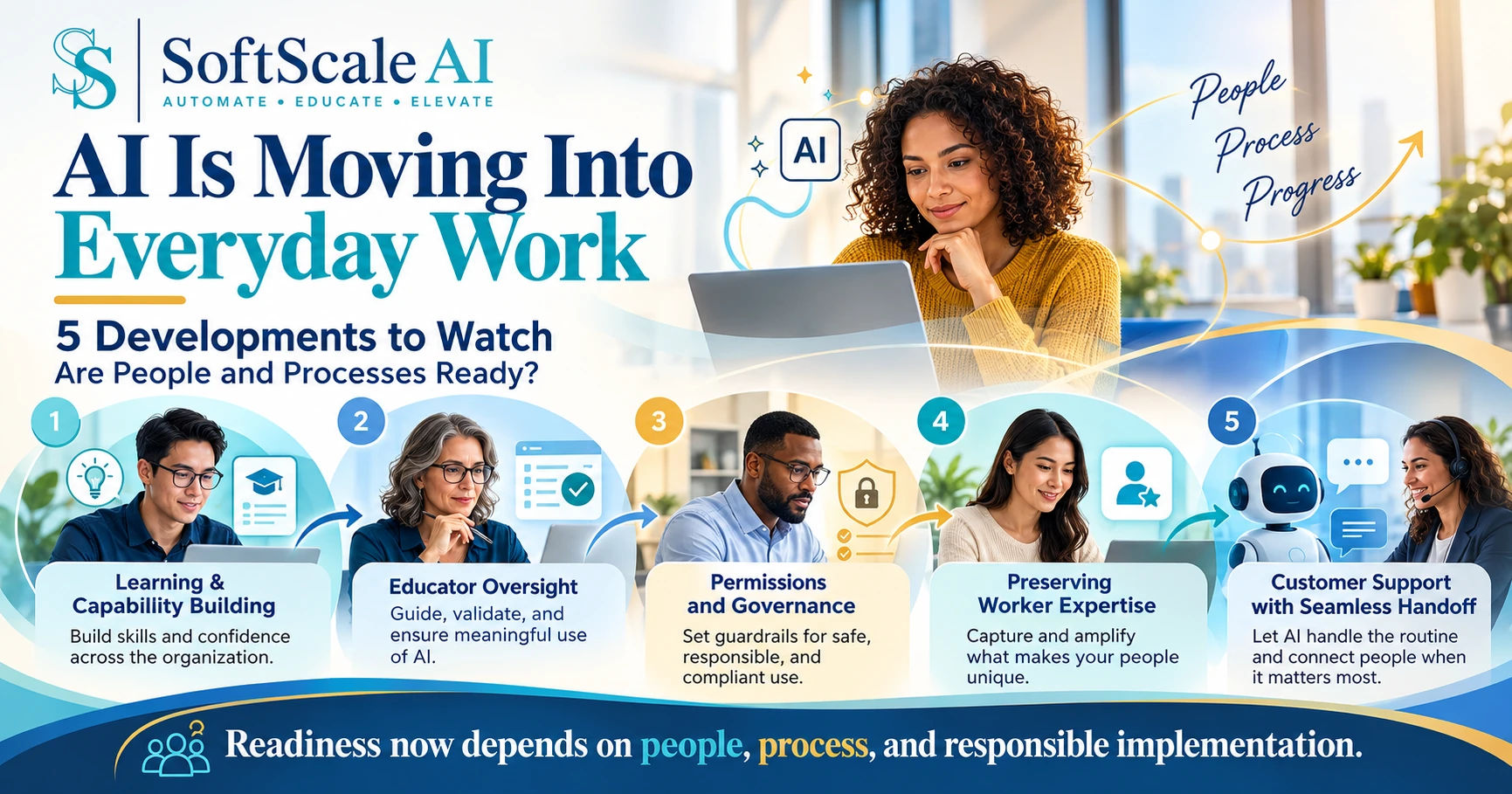
AI Is Moving Into Everyday Work. Are People and Processes Ready? 5 Developments to Watch
This week: a $70 million AI-skills initiative, new educator training, AI agents in banking, a manufacturing knowledge assistant and an AI customer-service voice agent. Plus: Ohio AI Watch.
 This Week in AI with Pamela Gosa
AI Is Getting More Capable. Are People and Organizations Ready? 5 Developments Worth Watching
Five AI developments this week are changing how schools prepare students, how employers prepare workers, how increasingly capable AI systems are governed, and how nonprofits build AI capacity—plus a new Ohio AI Watch development unfolding in Greater Cincinnati.